
From the folklore of Iceland
In the second year Biargey again urged Howard to try for a wergild. She suggested that he should follow Thorbiorn to the Thing and try to obtain justice, for men loathed Thorbiorn’s evil ways, and Howard would be sure to have many sympathizers. Howard was loath to go. “Thorbiorn, my son’s slayer, has mocked me once; shall he mock me again where all the chieftains are assembled? I will not go to endure such shame!”
To his surprise, Biargey urged her will, saying: “Thou wilt have friends, I know, since Guest will be there, and he is a just man, and will strive to bring about peace between thee and Thorbiorn. And harken to me, and heed my words, husband! If Thorbiorn is condemned to pay thee money, and there is a large ring of assessors, it may be that when thou and he are in the ring together he will do something to grieve thee sorely. Then look thou well to it! If thy heart be light, make thou no peace; I am somewhat foresighted, and I know that then Olaf shall be avenged. But if thou be heavy-hearted, then do thou be reconciled to Thorbiorn, for I know that Olaf shall lie unatoned for.”
Howard replied: “Wife, I understand thee not, nor thy words, but this I know: I would do and bear all things if I might but obtain due vengeance for Olaf’s death.”
At last Howard, impressed by his wife’s half-prophetic words, roused himself, and rode away to the Thing; here he found shelter with a great chieftain, Steinthor of Ere, who was kind to the old man, and gave Howard a place in his booth. Steinthor praised Olaf’s courage and manful defence, and bade his followers cherish the old man, and not arouse his grief for his dead son.
As the days wore on Howard did nothing towards obtaining compensation for his great loss, until Steinthor asked him why he took no action in the matter. Howard replied that he felt helpless against Thorbiorn’s evil words and deeds; but Steinthor bade him try to win Guest to his side – then he would succeed. Howard took heart, and set off for the booth which Thorbiorn shared with Guest; but unhappily Guest was not there when Howard came. Thorbiorn greeted him and asked what matter had brought him, and Howard replied: “My grief for Olaf is yet deep in my heart; still I remember his death; and now again I come to claim a wergild for him.”
Thorbiorn answered: “Come to me at home in my own country, and I may do somewhat for thee, but I will not have thee whining against me here.”
Howard said, “If thou wilt do nothing here, I have proved that thou wilt do still less in thine own country; but I had hoped for help from other chieftains.”
Thorbiorn burst out wrathfully: “See! He will stir up other men against me! Get thee gone, old man, or thou shalt not escape a beating.”
Now Howard was greatly angered, and said: “Yes, old I am – too old and feeble to win respect; but the days have been when I would not have endured such wrong; yea, and if Olaf were still alive thou wouldst not have flouted me thus.” As he left Thorbiorn’s sight his fried and anger were so great that he did not notice Guest returning, but went heavily to Steinthor’s booth, where he told all Thorbiorn’s injustice, and won much sympathy.
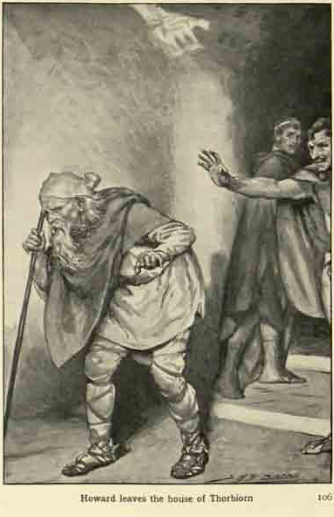
When Guest had entered the booth he sat down beside Thorbiorn and said: “Who was the man whom I met leaving the booth just now?”
“A wise question for a wise man to ask! How can I tell? So many come and go,” said Thorbiorn.
“But this was an old man, large of stature, lame in one knee; yet he looked a brave warrior, and he was so wrathful that he did not know where he went. He seemed a man likely to be licky, too, and not one to be lightly wronged.”
“That must have been old Howard the Halt,” said Thorbiorn. “He is a man from my district, who has come after me to the Thing.”
“Ah! Was it his brave son Olaf whom thou didst slay guiltless?”
Yes, certainly,” returned Thorbiorn.
“How hast thou kept the promise of better ways which thou didst make when thou didst marry my sister?” he asked; and Thorbiorn sat silent. “This wrong must be amended,” said Guest, and sent an honourable man to bring Howard to him. Howard at first refused to face Thorbiorn again, but at last reluctantly consented to meet Guest, and when the latter had greeted him in friendly and honourable fashion he told the whole story, from the time of Thorbiorn’s first jealousy of Olaf.
Guest was horrified. “Heard even man such injustice!” he cried. “Now, Thorbiorn, choose one of two things: either my sister shall no longer by thy wife, or thou shalt allow me to give judgement between Howard and thee.”
Thorbiorn agreed to leave the matter in Guest’s hands, and many men were called to make a ring as assessors, that all might be legally done, and Thorbiorn and Howard stood together in the ring. Then Guest gave judgment: “Thorbiorn. I cannot condemn thee to pay Howard all thou owest – with all thy wealth, thou hast not money enough for that; but for slaying Olaf thou shalt pay a threefold wergild. For the other wrongs thou hast done him, I, thy brother-in-law, will try to atone by gifts, and friendship, and all honour in my power, as long as we both live; and if he will come home to stay with me he shall be right welcome.”
Thorbiorn agreed to the award, saying carelessly: “I will pay him at home in my own country, if he will come to me when I have more leisure.”
“No,” said Guest, who distrusted Thorbiorn, “thou shalt pay here, and now, fully; and I myself will pay one wergild, to help thee in atonement.” When this was agreed Howard sat down in the ring, and Guest gave him the one wergild (a hundred of silver), which Howard received in the skirt of his cloak; and then Thorbiorn paid one wergild slowly, coin by coin, and said he had no more money; but Guest bade him pay it all.
Then Thorbiorn drew out a cloth and united it, saying, “He will surely count himself paid in full if I give him this!” and he flung into the old man’s face, as he sat on the ground, the teeth of the dead Olaf, saying, “Here are thy son’s teeth!”
Howard sprang up, bleeding, mad with rage and grief. The silver rolled in all directions from his cloak as he came to his feet, but he heeded it not at all. Blinded with blood, and furious, he broke through the ring of assessors, dashed one of them to earth, and rushed away like a young man; but when he came to Steinthor’s booth he lay as if dead, and spoke to no man.
Guest would have no more to do with Thorbiorn. “Thou hast no equal for cruelty and evil; thou shalt surely repent it,” he said; and he rode to Bathstead, took his sister away, with all her wealth, and broke off his alliance with Thorbiorn, caring nothing for the shame he put upon so unjust a man.
Howard went home, told Biargey all that had happened, and took to his bed again, a poor, old, helpless, miserable man; but his wife, who saw her presage beginning to come true, kept up her courage, rowed out fishing every day, and guided the household for yet another year.
That summer, one day, as Biargey was rowed out to the fishing as usual, she saw Thorbiorn’s boat coming up the firth, and bade her man take up the lines and go to meet him, and row round the cutter, while she talked with Thorbiorn. As Biargey’s little boat approached the cutter Thorbiorn stopped his vessel, for he saw that she would speak with him, and her boat circled round the cutter while she asked his business, and learnt that he was going with Vakr to meet a brother and nephew of his, to bring them to Bathstead, and that he expected to be away from home for a week. The little skiff had now passed completely round the motionless cutter, and Olaf’s mother, having learnt all she wanted, bade her rower quite Thorbiorn; the little boat shot swiftly and suddenly away, leaving Thorbiorn with an uneasy sense of witchcraft. So disquieted did he feel that he would have pursued her and drowned “the old hag,” as he called her, had he not been prevented by Brand the Strong, who had been helped in his need by Olaf.
As the little craft shot away Biargey smiled mysteriously, and said to her rower: “Now I feel sure that Olaf my son will be avenged. I have work to do: let us not go home yet.”
“Where, then, shall we go?” asked the man.
“To my brother Valbrand.”
Now Valbrand was an old man who had been a mighty warrior in his youth, but had now settled down to a life of quiet and peace; he had, however, two promising sons, well-grown and manly youths. When Valbrand saw his sister he came to meet her, saying: “Welcome sister! Seldom is it that we see thee. Wilt thou abide with us this night, or is thine errand one that craves haste?”
“I must be home to-night,” she replied, and added mysteriously: “But there is help I would fain ask of thee. Wilt thou lend me thy seal-nets? We have not enough to catch such fish as we need.”
Valbrand answered: “Willingly, and thou shalt choose for thyself. Here are three, one old and worn out, two new and untried; which wilt thou take?”
“I will have the new ones, but I do not need them yet; keep them ready for the day when I shall send and ask for them,” Biargey replied, and bade Valbrand farewell, and rowed away to her next brother.
When Howard’s wife came to her brother Thorbrand she was well received by him and his two sons, and here she asked for the loan of a trout-net, since she had not enough to catch the fish. Thorbrand offered her her choice – one old and worn out, or two new and untried nets; and again Biargey chose the new ones, and bade them be ready when the messenger came.
From her third brother, Ashbrand, who had only one son, Biargey asked a turf-cutter, as hers was not keen enough to cut all she wanted; again she was offered her choice and chose the new, untried cutter, instead of the old, rusty, notched one. Then Biargey bade farewell to Ashbrand, refusing his offer of hospitality, and went home to Howard, and told him of her quests and the promises she had received. The old couple knew what the promises meant, but they said nothing to each other about it.
When seven days had passed Biargey came to Howard, saying: “Arise now, and play the man, if thou wilt ever win vengeance for Olaf. Thou must do it now of never, since now the opportunity has come. Knowest thou not that today Thorbiorn returns to Bathstead, and thou must meet him today? And have I not found helpers for thee in my nephews? Thou wilt not need to face the strife alone.”
Hereupon Howard sprang up joyfully from his bed, and was no longer lame or lat, not looked like an old man, but move briskly, clad himself in good armour, and seemed a mighty warrior. His joy broke forth in words, and he chanted songs of gladness in vengeance and joy in strife, and evil omen to the death-doomed foe. Thus gladly, with spear in hand, he went forth to find his enemy and avenge his son; but he turned and kissed his brave wife farewell, for he said: “It may well be that we shall not meet again.” Biargey said: “Nay, we shall meet again, for I know what thou bearest a bold heart and a strong arm, and wilt do valiantly.”
Howard and one fighting-man took their boat and rowed to Valbrand’s house, and saw him and his sons making hay. Valbrand greeted Howard well, for he had not seen him for long, and begged him to stay there, but Howard would not. “I am in haste, and have come to fetch the two new seal-nets thou didst lend to my wife,” he said; and Valbrand understood him well. He called to his sons, “Come hither, lads; here is your kinsman Howard, with mighty work on hand,” and the two youths ran up hastily, leaving their haymaking. Valbrand went to the house, and returned bearing good weapons, which he gave to his sons, bidding them follow their kinsman Howard and help in his vengeance.
They three went down to the boat, took their seats beside Howard’s man, and rowed to Asbrand’s house. There Howard asked for the promised new turf-cutter, and Asbrand’s son, a tall and manly youth, joined the party. At their next visit, to Thorbrand’s house, Howard asked for the two trout-nets, and Thorbrand’s two sons, with one stout fighting-man, came gladly with their kinsman.
As they rowed away together one of the youths asked: “Why is it that thou hast no sword or axe, Uncle Howard?” Howard replied: “It may be that we shall meet Thorbiorn, and when the meeting is over I shall not be a swordless man, but it is likely that I shall have Warflame, that mighty weapon, the best of swords; and here I have a good spear.”
These words seemed to them all a good omen, and as they rowed towards Bathstead they saw a flock of ravens, which encouraged them yet more, since the raven was the bird of Odin, the haunter of fields of strife and bloodshed.
When they reached Bathstead they sprang on the jetty, carried their boat over the ridge of shingle to the quiet pool by the boathouse, and hid themselves where they could see, but remain themselves unseen. Howard took command, and appointed their places, bidding them be wary, and not stir till he gave the word.
Late that evening, just before dusk, Thorbiorn and Vakr came home, bringing their kinsmen with them, a party of ten in all. They had no suspicion of any ambush, and Thorbiorn said to Vakr: “It is a fine night, and dry, Vakr; we will leave the boat here – she will take no hurt through the night – and thou shalt carry our swords and spears up to the boathouse.
Vakr obeyed, and bore all the weapons to the boathouse. Howard’s men would have slain him then, but Howard forbade, and let him return to the jetty for more armour. When Vakr had gone back Howard sent to the boathouse for the magic sword, Warflame; drawing it, he gripped it hard and brandished it, for he would fain avenge Olaf with the weapon which had slain him. When Vakr came towards the ambush a second time he was laden with shields and helmets. Howard’s men sprang up to take him, and he turned to flee as he saw and heard them. But his foot slipped, and he fell into the pool, and lay there weighed down by all the armour, till he died miserably – a fitting end for one so ignoble and cruel.
Howard’s men shouted and waved their weapons and ran down to the beach to attack their enemies; but Thorbiorn seeing them, flung himself into the sea, swimming towards a small rocky islet. When Howard saw this he took Warflame between his teeth, and, old as he was, plunged into the waves and pursued Thorbiorn. The latter had, however a considerable start, and was both younger and stronger than his adversary, so that he was already on the rock and prepared to dash a huge stone at Howard, when the old man reached the islet. Now there seemed no hope for Howard, but still he clung fiercely to the rock and strove to draw himself up on the land. Thorbiorn lifted the huge stone to cast at his foe, but his foot slipped on the wet rocks, and he fell backward; before he could recover his footing Howard rushed forward and slew him with his own sword Warflame, striking out his teeeth, as Thorbiorn had done to Olaf.
When Howard swam back to Bathstead, and they told him that in all six of Thorbiorn’s men were dead, while he had only lost one serving-man, he rejoiced greatly; but his vengeance was not satisfied until he had slain yet another brother of Thorbiorn’s.
Then, with the news of this great revenge to be told, Howard and his kinsmen took refuge with that Steinthor who had given him help and shelter during the Thing.
“Whom are ye, and what tidings do yet bring?” asked Steinthor as the little party of seven entered his hall.
“I am Howard, and these are my kinsmen,” said Howard. “We tell the slaying of Thorbiorn and his brothers, his nephews, and his house-carles, eight in all.”
Steinthor exclaimed in surprise: “Art thou that Howard, old and bedridden, who didst seem like to die last year at the Thing, and hast thou done these mighty deeds with only these youths to aid thee? This is a great marvel, nearly as wondrous as thy restoration to youth and health. Great enmity will ye have aroused against you!”
Said Howard: “Bethink thee that thou didst promise me thy help if I should ever need it. Therefore have I come to thee now, because I have some little need of aid.”
Steinthor laughed. “A little help! When dost thou think thou wilt need much, if this be not the time? But bide ye all here in honour, and I will set the matter right, since thou and these thy helpers have done so valiantly.”
Howard and his kinsmen abode long with their host, until the Thing met again; then Steinthor rode away, leaving the uncle and nephews under good safeguard. It was a great meeting, with many cases to judge. When the matter of the death of Thorbiorn’s family was brought up Steinthor spoke on Howard’s behalf, and offered to let Guest again give judgment, since he had done so before. This offer was accepted by Thorbiorn’s surviving kinsfolk, and Guest, as before, gave a fair award.
Since a threefold wergild was still due to Howard for the slaying of Olaf, three of the eight dead need not be paid for. Thorbiorn, Vakr, and that brother of his slain by Olaf should continue unatoned for, because they were evildoers, and fell in an unrighteous quarrel of their own seeking; moreover, the slaying of Howard’s serving-man cancelled one wergild; there remained, therefore, but one wergild for Howard to pay – one hundred of silver – which was paid out of hand. In addition to this, Howard must change his dwelling, and his nephews must travel abroad for some years. This sentence pleased all men greatly, and they broke up the Thing in great content, and Howard rode home at the head of a goodly company to his stout-hearted wife Biargey, who had kept his house and lands in good order all this time. They made a great feast, and gave rich gifts to all their friends and kinsmen; then when the farewells were over the exiles went abroad and did valiantly in Norway; but Howard sold his lands and moved to another part of the island. There he prospered greatly; and when he died his memory was handed down as that of a mighty warrior and a valiant and prudent man.
Sources:
Chapter 6, Hero-myths and Legends of the British Race, M.I. Ebbutt, 1910



 Kotharian Lightning