
From the folklore of the Slavs
There once lived a Christian couple, Ivan and his wife, Maria; but they had no children. Ivan and Maria lived in love and concord; and so grew old; but no child, alas! was theirs. Bitterly they regretted this, and only felt some consolation at the sight of other people’s children. But what was to be done? Such was evidently the sentence of God in their case. See, from this, that in our world, all is fashioned by God’s decree and not by our feeble intelligence.
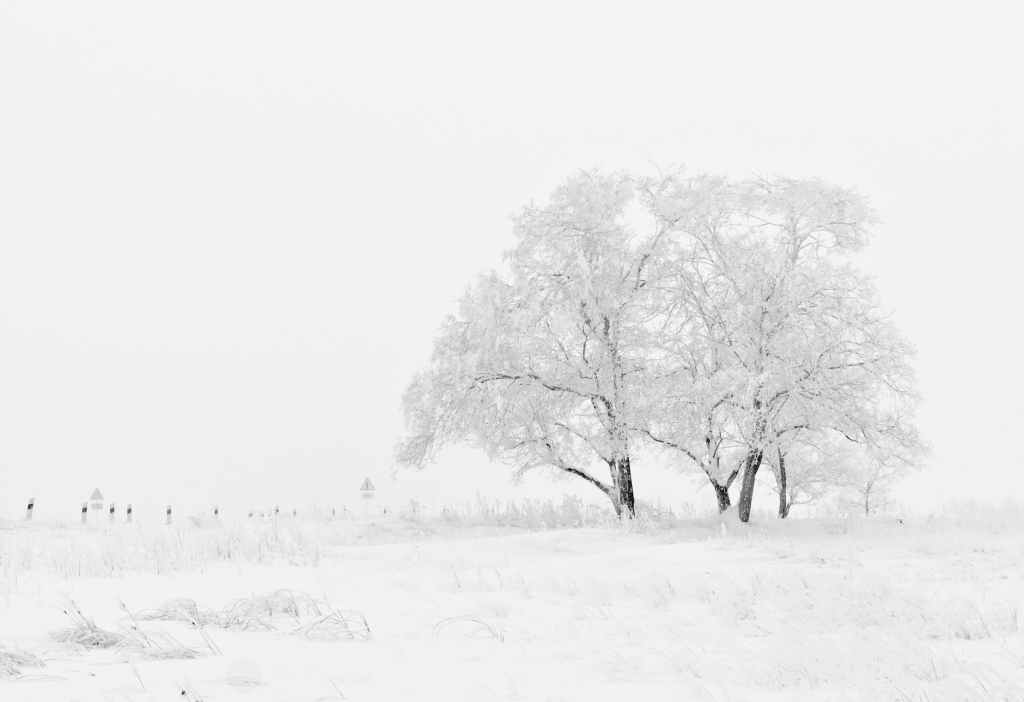
Well, once, when winter had come, and the fresh snow fell knee deep, the children ran out on to the street to play, and our couple sat by the window to watch them. The children ran to and fro, played various pranks, and then set to work to make a snow man. Ivan and Maria looked on silently, full of melancholy reflections. All at once Ivan smiled and said: “Wife, why shouldn’t we make a snow man, too?” Evidently this idea tickled Maria’s fancy. “The idea!” she said, “to go and play the fool in our old age. And besides, who make a snow man, a mere copy of ourselves? Far better make of snow a child such as the Lord God did not favour us with.” “The very thing!” exclaimed Ivan; took his hat and went with the wife of his old age to the garden.
And, in fact, they set to work to make a snow baby – a girl’s figure of snow. First they form the small trunk with hands and feet; put on the top of it a rounded ball of snow and smoothed it down to a small head.
“God help you!” said some passer-by. “Our humble thanks!” said Ivan. “God’s help stands ever in good stead,” added Maria.
“What on earth are you about?” “Why, you see what we are about,” said Ivan. “Making a snow maiden,” added Maria, laughing.
And so they stuck a small nose and a small chin on; made two small depressions in the forehead; and then Ivan traced the small mouth, and all at once, from it, a warm breath seemed to fall. Ivan hastily drew back his hands; and now observed that the depression in the forehead bulged, and a pair of dove-like little eyes blinked out of them; the small mouth, too, was like a raspberry, and wreathed in a tiny smile. “But this is witchcraft; Lord help us,” said Ivan, and crossed himself.
And the child bowed with its small head, and struggled with its small hands and feet in the snow, just like a suckling child in swaddling clothes.
“Oh, Ivan! Ivan!” exclaimed Maria, trembling with delight; “and so, God has given us a child at last!” And rushed to embrace her snow maiden; and now all the snow rolled off, like a shell from an egg, and Maria held in her hands, in real earnest, a living baby.
Ivan, at such a miracle, with difficulty retained his wits, and Maria forgot everything from rapture.
And so Snowdrop, for so they called her, grew not by days but by hours, and every day more beautiful. And were not Ivan and Maria delighted at it! Things went merrily at their house. The children from the whole village flocked there to play with the old people’s child, and dandled it and tricked it out, as though it were a doll, talked with it, sand songs to it, played all sorts of games with it, and taught it all they knew themselves. And when winter was over the child had grown to be a girl, as of thirteen summers, understood everything, talked of what you please, and in such a sweet voice that it enchanted everybody. And she was so good, so obedient, and in everything so adorable. And in person – she was white as snow, with eyes like small forget-me-nots and light flaxen hair down to her waist. Only not a trace of roses had she in her cheeks, just as if there were no living blood in her body, but in spite of this she was so good and comely that one could not tear his eyes away. And in her play, so amusing and amiable that it did one’s heart good. And didn’t all heap love on little Snowdrop! And wasn’t Maria beside herself for happiness. “Oh, Ivan!” she was used to say, “God has given us joy in our old age, and cancelled the affliction of my soul!” And Ivan replied: “Blessings to the Lord Most High! Here joy is not eternal, and sorrow is but for a moment.”
The winter was over. Joyfully sported in the heavens the sun of spring time, and the earth grew warm again. Green grew the grass on the thawed patches; in the sky above the lark carolled. And now pretty girls collected in a ring danced and chanted below the village:
Lovely spring!
On what borne hither?
On baby plough! On baby harrow!
But Snowdrop began to pine. “What is the matter with you, my darling?” exclaimed Maria more than once, and drew her fondly to herself. “You are not ailing? No wicked man has cast an evil eye on thee?” And Snowdrop answered: “It is nothing, mother mine; I am strong and well.”
And lo! Spring, with its warm rays, chased away the last remnant of the snow. Blossomed gardens and meadows; sang the nightingale, and all the songsters of the grove; everything in God’s divine wonder-world began to live and enjoy itself. But now Snowdrop in very earnest, began to pine and droop; avoided the other children, and always sheltered herself from the sun in the shadow, just like a lily of the valley under a tree. Her one delight was to splash about in the cool well under the silvery leaved willow tree. Dear to Snowdrop was the cool and the shadow, but, better still, a timely shower.
In rain and gloom she dwelt right merrily; and once, when a dull grey thunder cloud rolled up and strewed the earth with large hailstone, Snowdrop was as delighted as if they had been real pearls rolling about on the ground; and when the sun again beamed forth and the hail melted to water, Snowdrop wept over it as bitterly as if she wished to weep herself away, as though she were a sister weeping for an only brother.
And, lo! Now spring, too, came to an end; and St. John’s eve drew near. The children of the village collected for an expedition into the wood; came for Snowdrop, and asked Maria to let her go with them. Maria was apprehensive and did not wish to let her go; nor did Snowdrop wish to go either, but she could not get out of it. And, then, Maria thought to herself: “Perhaps it will cheer her up.” And so she dressed her, kissed her, and said: “Go, my child, and make merry with your young companions! And you, children, take good care of my darling Snowdrop; you know she is to me as the apple of my eye.” “Yes! Yes!” exclaimed the children; seized Snowdrop and trooped off to the wood.
There they twined themselves garlands, tied bunches of flowers, and sang with their half sad, half mirthful melodies. Little Snowdrop was with them continually. When the sun sank the children made a bonfire of grass and small twigs, lit it, and all stood garlanded in a row, one behind the other; but Snowdrop was the last in the row. “Observe,” they said, “how we run, and do you do the same. Do not stop behind.” And so all, intoning the Kupalov hymn, jumped through the fire. All at once something behind them rustled, and a piteous groan was heard. They looked round in surprise. There was no one. They looked at one another, and did not observe Snowdrop. “Why, she has really given us the slip this time, the little sinner!” they said, and ran hither and thither to find her; but nowhere could they find her. They called and halloed: she made no reply. “Where has she stowed herself away?” said the children. “Perhaps she has run away home,” they next suggested. And went to the village, but Snowdrop was not in the village.
They sought her next day, and the day after, and paced the wood bush by bush, tree by tree; Snowdrop was not there, and all trace of her had disappeared.
Long did Ivan and Maria bewail and lament for their little Snowdrop; and for still a long time did the wretched old mother go every day to the wood to search for her, and called to her like the lamenting cuckoo:
Ay! ay! Snegurushka!
Ay! ay! Golubushka!
And more than once she seemed to hear the voice of Snegurushka answer echo-like; but Snegurushka herself she saw never more, oh! Never more.
Whither had Snegurushka vanished? Had some wild beast carried her off in the lonely wood, or some bird of prey borne her away to the dark blue sea?
Ah! no. No savage beast had carried her off in the dismal wood, and no bird of prey had borne her off to the dark blue sea; but when Snegurushka ran after her companions and leapt into the fire, all at once she tapered aloft in a thin streak of steam, and flew away to the sublunary heights of heaven.
Source:
Russian and Bulgarian Folk-lore Stories, WW Strickland, 1907



 Kotharian Lightning