
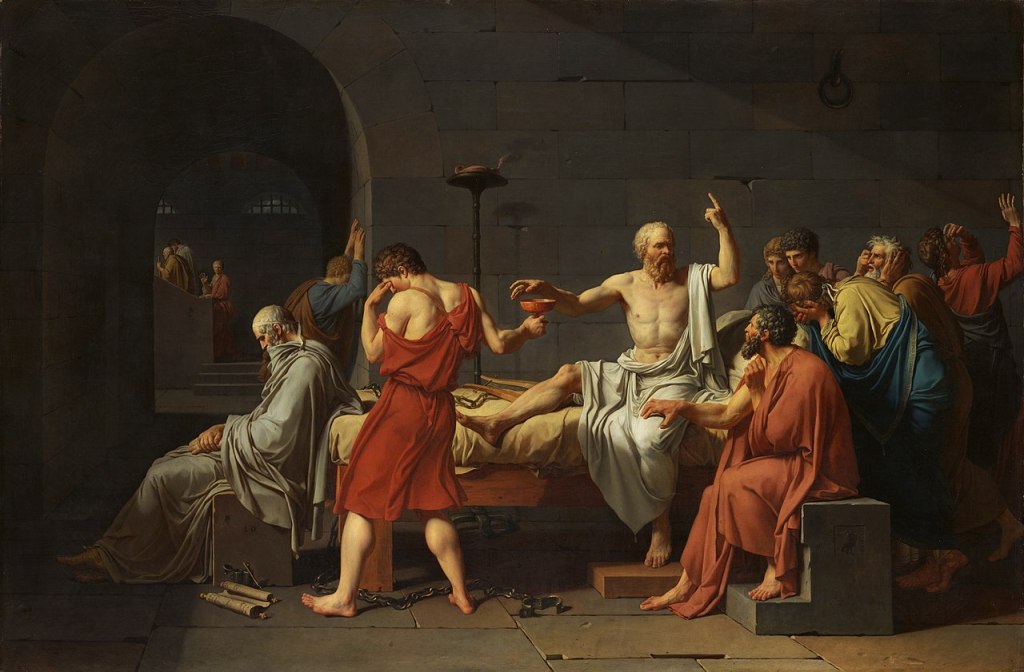
” Socrates began, ‘How are our guardians to be brought up and educated? If we try to answer this question, I wonder whether it will help us at all in our main enquiry into the origin of justice and injustice? We do not want to leave out anything relevant, but we don’t want to embark on a long digression.’
To which Adeimantus replied, ‘I expect it will help us all right.’
‘Then, my dear Adeimantus, we must certainly pursue the question,’ I rejoined, ‘even though it proves a long business. So let us set about educating our guardians as if we had as much time on our hands as the traditional story-teller.’
‘Let us by all means.’
‘What kind of education shall we give them then? We shall find it difficult to improve on the time-honoured distinction between the training we give to the body and the training we give to the mind and character.’
‘True.’
‘And we shall begin with the mind and character, shall we not?’
‘Of course.’
‘In this type of education you would include stories, would you not?’
‘Yes.’
‘These are of two kinds, true stories and fiction. Our education must use both, and start with fiction.’
‘I don’t understand you.’
‘But you know that we begin by telling children stories. These are, in general, fiction, though they contain some truth. And we tell children stories before we start them on physical training.’
‘That is so.’
‘That is what I meant by saying that we start to train the mind before the body. And the first step, as you know, is always what matters most, particularly when we are dealing with those who are young and tender. That is the time when they are taking shape and when any impression we choose to make leaves a permanent mark.’
‘That is certainly true.’
‘Shall we therefore allow our children to listen to any stories written by anyone, and to form opinions the opposite of those we think they should have when they grow up?’
‘We certainly shall not.’
‘Then it seems that our first business is to supervise the production of stories, and choose only those we think suitable, and reject the rest. We shall persuade mothers and nurses to tell our chosen stories to their children and so mould their minds and characters rather than their bodies. The greater part of the stories current to-day we shall have to reject.’
‘Which are you thinking of?’
‘We can take some of the major legends as typical For all are cast in the same mould and have the same effect. Do you agree?’
‘Yes: but I’m not sure which you refer to as major.’
‘The stories in Homer and Hesiod and the poets. For it is the poets who have always made up stories to tell to men.’
‘Which stories do you mean and what fault do you find in them?’
‘The worst fault possible,’ I replied, ‘especially if the story is an ugly one.’
‘And what is that?’
‘Misrepresenting gods and heroes, like a portrait painter who fails to catch a likeness.’
‘That is a fault which certainly deserves censure. But give me more details.’
‘Well, on the most important of subjects, there is first and foremost the foul story about Ouranos and the things Hesiod says he did, and the revenge Cronos took on him. While the story of what Cronos did, and what he suffered at the hands of his son, is not fit to be repeated as it is to the young and innocent, even if it were true; it would be best to say nothing about it, or if it must be told, tell it to a select few under oath of secrecy, at a rite which required, to restrict it still further, the sacrifice not of a mere pig but of something large and expensive.’
‘These certainly are awkward stories.’
‘And they shall not be repeated in our state, Adeimantus,’ I said. ‘Nor shall any young audience be told that anyone who commits horrible crimes, or punishes his father unmercifully, is doing nothing out of the ordinary but merely what the first and greatest of the gods have done before.’
‘I entirely agree,’ said Adeimantus, ‘that these stories are unsuitable.’
‘Nor can we permit stories of wars and plots and battles among the gods; they are quite untrue, and if we want out prospective guardians to believe that quarrelsomeness is one of the worst of evils, we must certainly not let them embroider robes with the story of the Battle of the Giants, or tell them the tales about the many and various quarrels between gods and heroes and their friends and relations. On the contrary, if we are to persuade them that no citizen has ever quarrelled with any other, because it is sinful, our old men and women must tell children stories with this end in view from the first, and we must compel our poets to tell them similar stories when they grow up. But we can permit no stories about Hera being tied up by her son, or Hephaestus being flung out of Heaven by his father for trying to help his mother when she was getting a beating, or any of Homer’s Battles of the Gods, whether their intention is allegorical or not. Children cannot distinguish between what is allegory and what isn’t, and opinions formed at that age are usually difficult to eradicate or change; it is therefore of the utmost importance that the first stories they hear shall aim at producing the right moral effect.’
‘Your case is a good one,’ he agreed, ‘but if someone wanted details, and asked what stories we were thinking of, what should we say?’
To which I replied, ‘My dear Adeimantus, you and I are not writing stories but founding a state. And the founders of a state, though they must know the type of story the poet must produce, and reject any that do not conform to that type, need not write them themselves.’
‘True: but what are the lines on which our poets must work when they deal with the gods?’
‘Roughly as follows,’ I said. ‘God [here meaning Zeus] must surely always be represented as he is, whether the poet is writing epic, lyric, or drama.’
‘He must.’
‘And the truth is that God is good, and he must be so described.’
‘True.’
‘But nothing good is harmful or can do harm. And what does no harm does no evil. Nor can a thing which does no evil be the cause of any evil.’
‘That is true.’
‘And what is good is of service and a cause of well-being.’
‘Yes.’
‘So the good cannot be the cause of everything. It can only account for the presence of good and not for evil.’
‘Most certainly,’ he agreed.
‘Then God, being good, cannot be responsible for everything, as is commonly said, but only for a small part of human life, for the greater part of which he has no responsibility. For we have a far smaller share of good than of evil, and while we can attribute the good to God, we must find something else to account for the evil.’
‘I think that’s very true,’ he said.
‘So we cannot allow Homer or any other poet to make this stupid mistake about the gods, or say that Zeus has two jaws standing on the floor of his palace, full of fates, good in one and evil in the other; and that the man to whom Zeus allots a mixture of both has “varying fortunes sometimes good and sometimes bad”, while the man to whom he allots unmixed evil is chased by the gadfly of despair over the face of the earth”. Nor can we allow references to Zeus as “dispenser of good and evil”. And we cannot approve if it is said that Athene and Zeus prompted the breach of solemn promises by Pandarus, or that the strife of the goddesses and the judgement of Paris was due to Themis and Zeus. Nor again can we let our children hear from Aeschylus that God implants guilt in man, when he wishes to destroy a house utterly.
No; we must forbid anyone who writes a play about the sufferings of Niobe (the subject of the play from which the last lines are quoted), or the woes of the house of Pelops, or the Trojan war, or any similar topic, to say they are acts of God; or if he does he must give the sort of reason we are now demanding, and say that God’s acts were good and just, and that the sufferers were benefited by being punished. What the poet must not be allowed to say is that those who were punished were made wretched through God’s action. He may refer to the wicked as wretched because they needed punishment, provided he makes it clear that in punishing them God did them good. But if our state is to be run on the right lines, we must take every possible step to prevent anyone, young or old, either saying or being told, whether in poetry or prose, that God, being good, can cause harm or evil to any man. To say so would be sinful, inexpedient, and inconsistent.’
Source:
Plato: The Republic, Part 3, Book 1



 Kotharian Lightning