
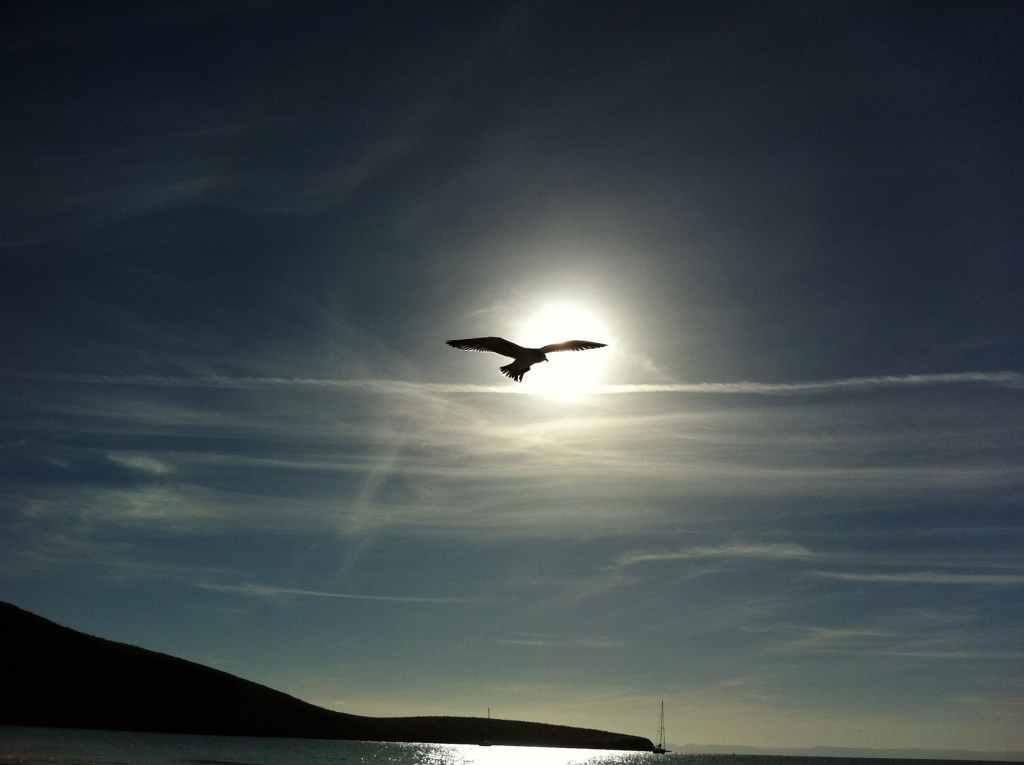
From Wichita Folklore
There was once a village that had two chiefs. They had a sort of division line between them. On the east side, the Thunderbird (Kitihakuts) was chief, but no one remembers who was chief of the west side. The Thunderbird had a good character and everybody thought well of him, though there were a few people who wished to do him wrong and hated him in every way. In those times the people who had evil thoughts were called Evil-Spirited-Persons (Naaniawacadiki). In this place there were played all kinds of games, and they wagered the life of a person, the winner taking the life of the loser. In the Thunderbird’s village there lived the Coyote (Ketox), who was nephew to the chief. Once in a while the Coyote would go and see the hand-game played by some of the people, and expected to beat them playing. The hand-game was the gambling game of the people of these times, and the wager was generally large, as they bet their lives and weapons. Whenever the Coyote went to see the game the chief would beg him to bring along his uncle the next time he came, and on his return the Coyote would ask his uncle to go along with him the next time he should go; but his uncle would refuse to do so, for he knew that it was a dangerous place to go, for the people in the place were seeking in some way to do him wrong.
The Thunderbird was a great hunter, and the things he hunted were the ones that hated him. The Coyote continued to go and see the hand-game played, and every time he went the chief would ask him why he had not brought his uncle along. So every time the Coyote came back from the hand-game he would tell his uncle what the people had said regarding him, but his uncle would say it was a place to lose one’s life cheap. Once upon a time the Coyote asked his uncle again to go along with him to see the game. The Thunderbird said to his nephew: “All right, if you think the fun is more for your advantage than for mine, I will go along with you to see the game.”The Coyote began to think that there must be some danger. He said to his uncle, “What do you mean?” The Thunderbird said: “You will see, and you will wish that you had never begged me to go along with you to the hand-game.”
They entered the place where the hand-game was going on. When they were seen the Coyote was in the lead, and felt proud because his uncle was there. In the lodges where they were having the hand-game, the door faced east, and upon entering the lodge the people were called to the wet part of the lodge, where they saw a sort of high hump, and it was covered up. The Thunderbird was asked to sit down, which he did, and the Coyote felt proud because he thought he and his uncle were being treated with distinction. The game went on, and was being played by some stranger who had come there and was asked to play. When the stranger lost the game the playing came to an end and the men began to leave the place, but the Thunderbird thought he had better wait until everybody had let the lodge before he should leave. So when everybody had left he started to rise, but failed, for he had been stuck to the hump in the presence of everybody. The thing began to move, and when it moved he found that it was some sort of a water-Monster that was under him, and it moved toward a small lake that the people knew to be deep. It moved slowly, and the Coyote followed after to see what was going to become of his uncle. Wherever the Thunderbird went he always carried his bow and four arrows, his bow painted black, two of his arrows painted black and two blood color, and his bow had a sort of red tassel at the upper end. He told his nephew that as long as he should see the tassel he might know that his uncle was still alive, but when it was no longer in sight he might know that he was drowned. There were a great many of the people who followed the monster to the shore to see what it was going to do. The Coyote was right by the side of the monster, talking to his uncle, and saying: “You have great powers, why do you not free yourself from the monster? You can do it.” But the Coyote was then told that it was all his fault that he had lost his uncle. The Coyote would then cry out fearfully for his uncle, but there were a great many people who mocked the Coyote and were glad to see his uncle die. The monster reached the lake and went into the water. He went to the bottom of the lake instead of swimming, and they kept going down and down, until only the top of the monster’s head could be seen, then the water went over the Thunderbird’s head. Then the bow began to sink until the tassel on the end of the bow could scarcely be seen, and finally the whole thing was gone. After this, everybody left the shore of the lake and went to their homes. Some were glad to see the Thunderbird drown, for they hated him, but there were some who regretted it and wept bitterly for the loss of their chief. There was the Coyote alone when his uncle had lost his life for his sake, the Coyote having begged him to go along to see the hand-game. On the next day most of the people left the village to go somewhere else to make their homes, and finally everybody left their former village and followed the rest of the people.
In this village were left an old man, old woman, and their grand-children. For a long time these folks lived here alone. The boys would go around the village into other grass-lodges and look for things that had been left by the people who had left their homes, and would go around the lake and shoot birds, which was their way of having fun. Once upon a time, when these boys were around the lake they heard some one singing, but did not know for certain where the sound came from. They stood around to catch the sound and find out where the singing was. When the could not locate the sound, they left the lake and turned back to their home. They told their grandfather and grandmother about the singing they had heard, and the old man sat there, thinking what it could have been, till finally it came to him. He asked the boys where they had been. They told him that they were near the lake. Then he told them there was some one who was known to have lost his life in the lake; that the person was the Thunderbird, who had been a great chief and a man of good character; that he had been to a hand-game, was seated on something that was covered up, and when he came to try to get up he found that he was stuck to a water-monster so that he could not get off, while the monster moved off into the lake and he was drowned; that he must be the one who was doing the singing. So he told the boys that if there was still any flesh on that man there was life in him; that they should again go over to the lake and bring rocks to the shore and get plenty of them, too, and after so doing they should pile the rocks up and haul plenty of wood; that they should pile the wood on the bottom and some on the top, and after that should burn the wood; that when this was all burned up they should throw all the stones into the water.
The boys went to the lake the next day, and there was by the lake a small hill, and from this place they carried stones all the following day, and after they thought they had stones enough they hauled plenty of wood to the shore where they had piled the stones. After they thought they had enough wood they spread it on the ground, piled the stones on top of it, and after they had put all the stones upon it they again piled wood on top of them and then everything was ready but the fire. One of the boys went back home to bring a burning stick and at once started back to the lake. On the boy’s arrival he set the wood on fire and it began to burn. After the stones were heated red hot they took them and threw all of them into the water; then returned to their home and told the old man about it. On the next day the old man told the boys to go back to the lake and see what had been done there.
The boys went on toward the lake, and on their arrival there they found the lake all dried up, and there they saw the water-monster. They again turned back to their home and reported to their grandfather regarding the water-monster. Then all went down to the lake and cut up the monster, and inside the monster they found the bones of the Thunderbird. They took all the bones, examined them, and found on the bones of the fingers a small piece of flesh. Then the old man told the boys that this must be the thing that was doing the singing, for there was still life in the hand. They then took the bones home. When they reached home the old man told his wife to build a small grass-lodge, big enough for the man to stand inside of it. The old woman at once began to work on this as the old man had requested her to do. Next day the old man took the bones of this man and put them all in their places, and after so doing set the lodge on fire. When the lodge commenced to burn the old man hallooed to the Thunderbird and told him to get out of the lodge, for it was on fire. Then he hallooed the second time, the third and fourth time, and at the fourth time there came out from the burning lodge the Thunderbird, his bow and arrow with him, and he was the same as he ever had been.
When the Thunderbird got out of the burning lodge the first thing he asked was, where the people had gone who used to live in the village. They told him that the whole village had left and that some had left the village happy, and some mourning for him. After this they all went into the lodge and the Thunderbird was given something to eat. After he had eaten he went out hunting, and the following day he killed a buffalo and brought it home with him, and it was as much as he could haul. He went on back to where he was staying, and late in the evening arrived at the place with the meat, and the people had plenty of meat to eat this time. The Thunderbird then told him that he had left some of the meat hanging in a tree, and that on the next day he should go hunting he wanted the boys to go with him and bring home the rest of the meat, while he should go on to hunt some more. So on the next day he and the boys went out to the place where he had left the meat, and on their arrival at the place they took the meat and brought it home, while the Thunderbird went on to hunt again. On the following day the Thunderbird again came in with the deer meat, and from this time on he went out hunting every day. The people had plenty of meat to eat, and the boys were growing rapidly. After a time the boys went out hunting with the Thunderbird, and the Thunderbird gave them power to become great hunters. In this place he stayed for a long while. Once in a while the boys would go out hunting by themselves and let the Thunderbird stay at home, because the boys began to like to hunt. The Thunderbird gave them powers to hunt and the boys never failed to bring in something when they came from the hunt.
Long afterward some of the people began to return home, and after several days came the Coyote with the crowd. On his return they told him that his uncle had been brought to life and was now in the village. The Coyote went straight to where his uncle was and saw him and met him at the old people’s home, where he had been brought to life. The Coyote at one called his uncle, the Thunderbird, to his home, where he stayed for the rest of his time. The rest of the people never returned, for they knew they had lost one of the best men in the village, and they expected him never to live again. After this the people remained in the village for all time, for they had no one to do them harm. The Thunderbird remained as a chief at all times, and his nephew was the second chief for this village. Now there were changes in the village, but all remained as human beings, with the exception of the ones who went off and never returned.
Source:
The Mythology of the Wichita, George A. Dorsey, 1904



 Kotharian Lightning