
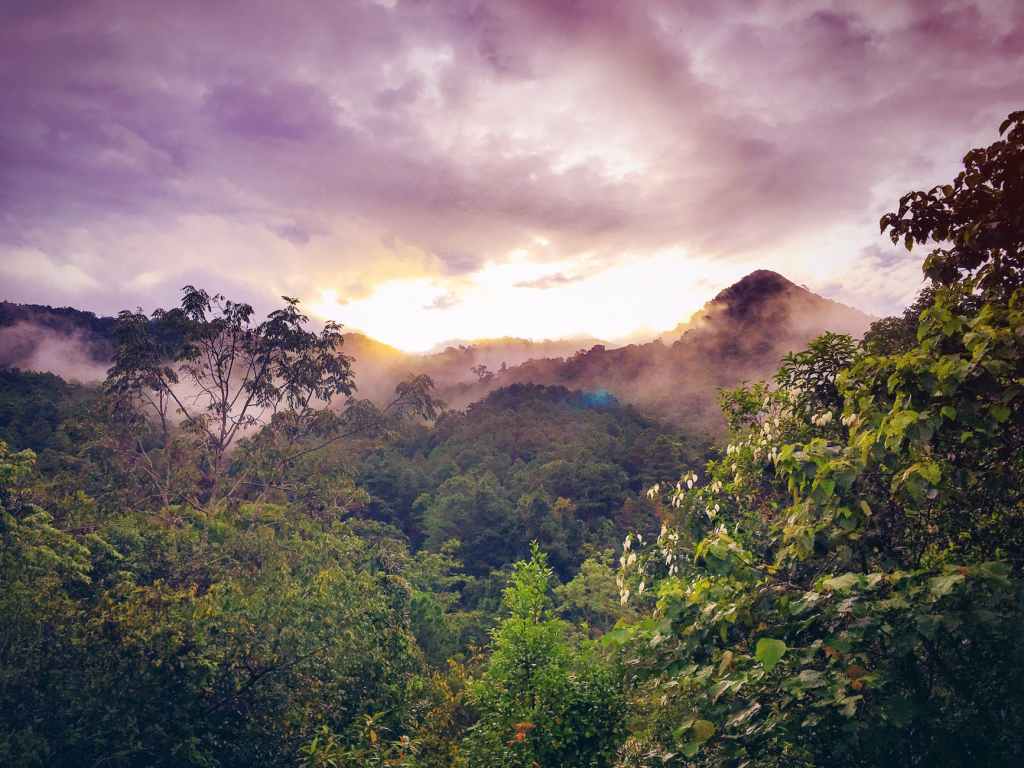
Except from Ethnology of the Mayas of Southern and Central British Honduras by J. Eric Thompson
“A definite fusion of the two religion, paganism and Christianity, has taken place resulting in a form of polytheism. At the head of the Pantheon stands the Dios of the Spaniards, who has become the Zeus of their deities. He is superior to the other gods or spirits, and they must obey his commands. Huitz-Hok, the gods of the mountains and plains, for instance, are very powerful, but they can do nothing if God is opposed. On the other hand, Dios is so remote that little attention is paid him. He has to look after the whole world, whereas the old Maya gods are essentially local. This attitude can be paralleled by the treatment meted out to Kunabku, the creator of the Mayas at the time of the conquest. He was considered to be too remote to be worth propitiating to any considerable extent. Below Diottare are the Morning Star and the Mam, known also as Huitz-Hok. With the latter have been fused the Chacs, the thunder gods, and finally the Ik, the wind gods. After these comes a mixed assortment of saints of the Christian church, the Virgin Mary, St. Anthony, St. Louis, etc., and minor Maya deities such as U, the moon, Kin, the sun, Ha, the water, Kuh, guardian of milpas, Che, the forest spirit, and the Cuchcaan, the holders up of the heavens. Finally there are the purely passive spirits of vegetation such as the spirit of corn, cacao, etc.
The Mams are the most important deities in the Maya Pantheon, although inferior in rank to God and the Morning Star. The name Mam is a generic term meaning grandfather, common to almost every dialect of the group of Mayance languages. The Mams are innumerable. However there are four of prime importance, who are associated with the four directions of the world and the four colors. Of these four one stands out in importance – the White Mam, who is ruler of all others. The Maya conceives the Mam as one single individual or four or as innumerable. In fact, his conception of the Mams is not unlike that of the orthodox Christian in regard to the Trinity.
The Mams are also known among the Kekchi as Tzultacaj, and among the Mayas as Huitz-Hok. The term in both languages means the same, “Mountain-valley.” The Tzultacaj have been treated at some length by Sapper and Dieseldorff and mentioned in brief by Maudslay and other writers.
The Chuj, too, according to verbal information supplied by Oliver Le Farge, have a Mountain-valley deity, Witz-Ailik, the word meaning again “Mountain-valley”.
…
The Mams are gods of the mountains, of the plains, of the underground, of thunder and lightning, and, by extension, of the rain. They are, too, gods of hunting and fish and agriculture, although in this branch they are not the sole patrons. Hunting, fishing and agriculture are under the special protection of Venus as Morning Star, who has delegated his authority to the Mams who are his servants. The special interest of the Mams in agriculture is well brought out by legends.
Their essentially benevolent attitude toward man is recognized by the Indians and emphasized again and again in the legends. Only when they are not accorded their due share of incense and prayer are they hostile. Although the chief Mam is said to be very old physically, others are not necessarily so. I believe the word Mam, grandfather, conveys the idea of their having been in existence before the creation of the world and of being creator gods. This is borne out by their being addressed as grandfather and grandmother, a title given to the creator gods of the Quiche, the Aztecs, and numerous other American Indian tribes. At least they are credited with the introduction of agriculture, and the teaching of it. They first gave animals to the world and fish to man. Furthermore they are thunder and lightning gods, who throughout the new world are associated with agriculture.
They are of both sexes, although primarily looked upon as male. The Female Mams are called tsits, which means grandmother. I suspect that the Maya in a hazy way consider them to be dual both in nature and sex. Their duality in nature is shown by the manner in which they give rain. Some rains are beneficial, others, at other times, do considerable harm. The winds, which they probably control, bring the rains but they may also blow down the young plants. This applies too to Mexico. For example, the dual nature of Mexican gods is depicted in the Codex Borgia, where Quetzalcoatl and the death god sit back to back. In the same manner they are dual in sex. Itzam, one of the four great Mams, is one moment considered male, at the next female. Similarly duality is shown over and over again in Mexican mythology. Centeotl, the Totonac maize deity, is described as both male and female.
…
The Kekchis of the Toledo district have brought with them from the Alta Vera Paz their local names for the four chief Mams, which are at the same time mountains in that region. The chief Mam is Yaluk. He is white and associated with the West. The second Mam is called Coha. He is the lord of the seas and associated with the South. Itzam is the ruler of the warm country and rules over the East. Xucaneb is the lord of the cold weather and the North. These last three are associated with the colors yellow, red and black, but it is not now clear which Mam is associated with which color. However it is interesting to note that the same association of white with the West prevailed in Yucatan at the time of the conquest. They stand at the four corners of the earth, and always shake themselves in June thereby causing the rain.
Kitzan or Itzam is claimed to be both male and female. As a woman she is aid to be the wife of Coha (although Dieseldorff states that she is the wife of Xucaneb who in turn he says is the chief Mam). It is said that formerly she died very seven years and with her died all creation, coming to life again after a short interval. One would not naturally expect a mountain god to be associated with the sky, but Itzam according to one informant once ruled the sky. In connection with this it is interesting to note that the Yucatecan sky god was named Itzamna. Furthermore the death and return to life every seven years is reminiscent of the somewhat obscure reference in the legend of Venus, the Sun, and the Moon to previous suns that lasted seven years.
…
Sapper describes the Tzultacaj as living in a hammock of serpents. He is lord of agriculture, water and fever, and punishes people by the stings of serpents for their sins. He is the lord of the lightning. The thunder is the noise he makes when he strikes a tree with his stone axe. Floods are the signs of the feast he holds in the bowels of the earth. He is often worshipped in caves.
This description, I believe, demonstrates what I have tried to point out above; namely, that the Tzultacajs and the Mams are one and the same. For Sapper emphasizes the bad side of the Tzultacaj whereas according to Dieseldorff Tzultacaj is benevolent, although at the same time he states that the Tzultacajs are lords of fevers and are much feared in their guise of hot springs. Further, Sapper writes that the Tzultacaj live in the bowels of the earth and cause the floods. According to Dieseldorff, it is the Mam who live below the ground the cause the floods. Sapper obtained his information from Coban Kekchis, which would indicate that the difference between the religious concepts of the Kekchis and Mayas of San Antonio and those of the Kekchis of Coban is not due to the Chol blood and traditions of the former, but to Dieseldorff having misunderstood the beliefs of the latter.
…
As a final complication we have the identification of the Chacs with the Mams. The Chacs among both the ancient and modern Mayas were lords of thunder and lighting and the rains. By extension they are lords of the milpas. Again there is a chief Chac among four principal ones, who are associated with the four corners of the world and the four world colors. In addition to this there are innumerable minor Chacs. They are also said to be of great size. They, like the Tzultacajs, carry stone axes; when the lightning strikes a tree the Chacs are said to have cut it with their stone axes. The Chacs live on the hill tops, and are also associated with the winds. By extension they were probably once gods of fevers, as natural fever is invariably attributed to bad winds. It is obvious that the Chacs are the lowland Maya equivalent of the Mountain-valley gods of the highland tribes.
…
The Morning Star is a deity who ranks next to the Christian God in power, but in importance is below the Mams, and might be described as sharing second place in the amount of attention paid to him with the Christian God. He is known as Santo Xulab (sulab, star) or Noh Ich or Nohoch Ich (Noh or nohots, great; Its, eye or face). In connection with the latter name it is interesting to recall that the Aztecs used to depict a star as an eye, and this practice may have been introduced into Yucatan in late times.
….
Xulab is the patron of agriculture, hunting, and fishing, particularly the last two. As already explained he has delegated his authority to the Mams as brought out in the legend of the Sun, the Moon, and Venus. This practice of offering first to Xulab at dawn, and later to the Mam is still maintained by the more orthodox of the Toledo Indians.
Just before dawn the deer and other inhabitants of the forest are astir in search of food and water, and this possibly accounts for the adoption of the Morning Star as a patron of hunting, for the Mayas saw when Ah Nohoch Ich rises his children rise too. Xulab is considered to be bearded and very ugly, and this accords with the depiction of his Mexican counterpart, Quetzalcoatl.
The belief that the Morning Star is the real patron of agriculture, hunting and fishing, but has delegated his power to the Mams, is probably the result of an attempt made by the priest astronomers to substitute their pet deity, Venus, for the Mams. The attempt to suborn the soil-loving peasants from their earth gods failed, and the result was the present compromise. In all probability the Mam cult dates back to “archaic times,” whereas Venus worship would not have been introduced until the Venus calendar was in full swing.
The modern Mayas no longer distinguish Venus from the other planets, and the worship is accorded whichever planet happens to be the Morning Star. However, when more than one planet is visible in the eastern sky before dawn Venus is recognized by its greater size. No attention is paid to the evening star, nor is Venus recognized as Evening Star. The astronomical knowledge of the Maya of the old Empire times has been entirely lost. For example in the legend of the Sun, the Moon, and Venus, the youngest brother is believed to have become one of the planets, but my informants could only say that he was not the Morning Star, and after some hesitation suggested that he became the Evening Star. One of them, Cecilio Cal, a particularly intelligent and well-educated San Antonio Maya, said that he thought he had become Jupiter, but cross-examination revealed that he was unable to distinguish Jupiter from any of the other planets, but by naming it solely tried to show that another planet other than Venus was indicated.
The worship of the moon (U) in San Antonio would appear to have been introduced by the Kekchi immigrants in recent years. From the Mayas she is the recipient of scant attention, although the Kekchis consider her a deity of some importance, and worship her under the name of Po. They do not consider the moon to be the patroness of anything in particular, but invoke her, apparently more or less as an afterthought, on any occasion. The passing generation of Kekchis used to burn copal to the new and full moon. When the moon is new, the flesh of all animals is believed to be tender. The people of San Antonio say that there is a rabbit seated in the moon. This belief they share with the Aztecs. It is also stated that there is a woman in the moon.
Kin (Qin), the sun, is of scant importance. He is rather dreaded, and is never addressed in prayers. It is believed that were he asked to shine down with more force upon the earth, he would comply, but to such an extent that the crops would be burnt up by his fierce rays. There is seldom any need for more sunshine, although at time there may be too much rain.
In the Corozal District of British Honduras the sun is invoked under the name of Kankin (yellow sun) during the Cha Chac or rain-making ceremonies.
…
Kuh (Quh) is associated in some unrecognized way with the milpa, but he is also invoked in the prayers of the hunters. Today he is little more than a name associated with Huitz-Hok on occasions. Among the Mayas of Yucatan the spirits of the milpas are known as Kuhs (quhob). They are believed to live in the fifth heaven. The word Kuh is also used in Yucatan to express god in general, or temple or pyramid.
The Cuchcaan are four in number. They stand at the four corners of the world and hold up the heavens. Their title, in fact, means “the holders up of the sky.” They are associated with the four world colors, and correspond to the Yucatecan Bacab. They are accorded no worship, and play no part in the religious life of San Antonio.
Ha (water) is the water spirit both of rain and of water upon the face of the earth. However, Ha is looked upon as essentially a passive god with little actual power himself and more or less under the strict authority of the Chacs. He has authority over the fishes and crocodiles, and so we find him invoked when fishing parties take place. His closest parallel is Ixim, the maize spirit; both have but little control over nature, and are at the mercy of more active deities.
Che (forest or wood) is the spirit of vegetation. He again is purely passive. He control to a certain extent the wild game living in the forest, but his functions are largely usurped by Huitz-Hok, and Nohock Ich. These spirits or deities bear the current names of the forces of nature they personify. With the destruction of the old priesthood with their knowledge of the calendar and the esoteric side of the Maya religion, there perished all but the elemental quasi-deities connected intimately with the daily life of the Maya peasant. Nevertheless, in the survivals we have the vestiges of the religion of the layman in the days when the Maya yet ruled. Esoteric religious concepts such as that of Kukulcan have entirely disappeared among the Yucatecan, the Lacondone and the Maya of the Toledo District.”
Source:
Ethnology of the Mayas of Southern and Central British Honduras, J. Eric Thompson, 1930



 Kotharian Lightning