
From Hawaiian Folklore
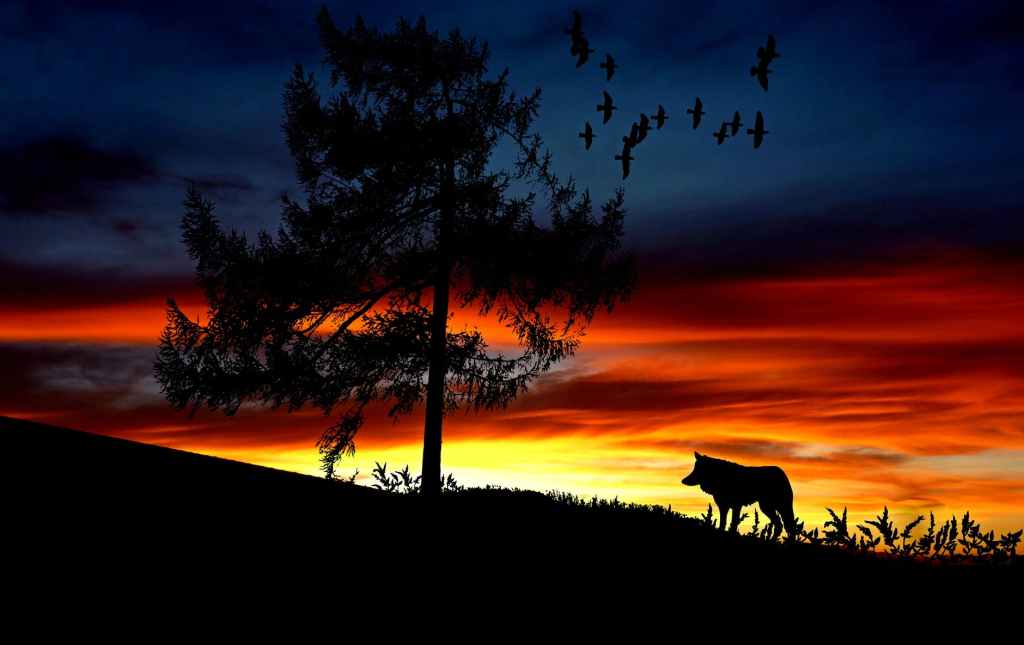
Ku, the dog-man, decided to come down from the clouds and visit mankind, so he assumed the form of a little dog and went around almost unnoticed.
Ku saw a group of three rainbows moving from place to place or resting for a long time above the home of a high chief. Sometimes the rainbows went up to the forests of ohia and kukui-trees on the mountain-side. Sometimes they rested over the deep pools made by the waterfalls of the swiftly descending mountain streams. Most frequently the beautiful colors were arched over a small grove of trees around a bathing-pool protected on two sides by steep ledges of rock, over which diverging streams poured their cool waters which rose from the shadows and rippled away through the little valley toward the sea. On the remaining side of this sequestered nook was a sunny beach of black sand, back of which the trees opened their promise of refreshing shade.
Here Na-pihe-nui, the daughter of the high chief, came daily with her company of maidens to bathe and sport in the water and then let the afternoon hours pass in rest and pleasant conversation.
One day while diving into the pool from a shelf on the rocky ledge one of the girls saw something moving on the shore. She called to her companions and with them hastened to the place where their clothes had been thrown down. Here they found a little white dog lying on the kapa mantle of the princess.
For a time they played with the little stranger and were very much delighted with his unusual intelligence. He gambolled around them in great delight, obeying the call of one after the other, but showing very marked preference for the princess. When the maidens returned home they took the little dog with them and cared for him.
The high chief, Polihale, was interested in the peculiar powers possessed by this strange dog. Perhaps he thought that it was under the control of some spirit. His suspicions were in some way aroused and the dog was watched. Soon the chief learned that this was a man of marvellous ability, who could appear as a dog or a man at his own pleasure. Then the chief called his retainers and ordered them to kill this dog. They gathered stones and clubs and tried to surround it, but it dashed into the woods and made it escape. It was the great dog Ku, who had seen the three rainbows and followed them to the bathing pool and then, having seen the princess, had determined to find an opportunity to carry her away as his wife. This premature discovery drove him away before he could accomplish his purpose.
Then Ku changed himself into a man of fine appearance and came boldly to the high chief’s home demanding the princess in marriage, but the chief, warned by the omens as studied by his soothsayers, refused.
Ku was in great anger and threatened to kill the chief’s people, and to destroy the protectors of the princess, but the high chief drove him away.
A dream came to the high chief, in which he saw the strange man coming as a great dog. The next morning as he looked toward the mountains he saw this same large dog stretching itself out of a cave on the mountain-side; so he knew that this dog with magical powers would be a very difficult enemy to overcome.
The chief soon learned that Ku was catching his people one by one and devouring them and decided to take final issue with his enemy.
Selecting a cave he hid all the women of his family in it, placing the princess in their care. They took provisions with them and prepared for a long siege. Water could be found int he cave itself. Stones were placed before the opening so that the enemy would find it hard to enter.
Then the high chief and his follower waged war against Ku, the dog-man, but Ku was very strong and overthrew his pursuers when they closed in around him. Many times he killed some of the chief’s people and carried their bodies away to feast upon them. He was also very swift in his motion, rapidly passing from place to place. Sometimes he fell like a flash of lightning upon a group of his foes and then in an incredibly short time he would make an attack in a far distant place.
The high chief became desperate and offered sacrifices to his gods and secured charms from his priests. Incantations and prayers were prepared against Ku.
At last a terrific battle was fought and Ku was overpowered and beaten to the ground. Still he fought fiercely, but the hard wooden spears pierced him and the heavy clubs broke his bones, until he lay a crushed and bleeding mass at the feet of his conquerors. Then they cut his body in two pieces, throwing one piece to one side and the other to a place some distance away. Then the power of the priests was invoked and the two parts of the body of Ku-ilio-loa became two great stones which had been objects of veneration among the Hawaiians for many years.
Ku stretches his form along the mountains and sometimes reveals himself as the great dog among the myriad shapes which the changing clouds are ever assuming. Sometimes he is seen in the clouds of Oahu, and then again his form is in the skies of other islands.
[Foot-Note: The Hawaiian legends frequently unite animal and human forms and characteristics in one individual, like the centaurs of Roman mythology. In some cases the man always carries with him a part of the animal shape. The legends of shark-men place the shark mouth between the shoulders of the man, and he is compelled to always wear a cloak to conceal his deformity.
Usually, however, the legends give to the human being the power to change at will into the peculiar animal form with which he has affinity without carrying with him any marks of his previous shape. In the Pele legends a chief appears as a beautiful bird and later as a handsome man, and marries the chiefess. When the hog-man, Kamapuaa, however, courts Pele he is compelled to hide his pig-like deformities under a covering of kapa cloth.
The legend of the great dog Ku is somewhat reversed from the usual order. Ku, the dog, was given the power to change himself into a man and return into his animal form whenever he wished.]
Source:
Legends of Old Honolulu, W.D. Westervelt, 1916



 Kotharian Lightning