
From Zuni Folklore
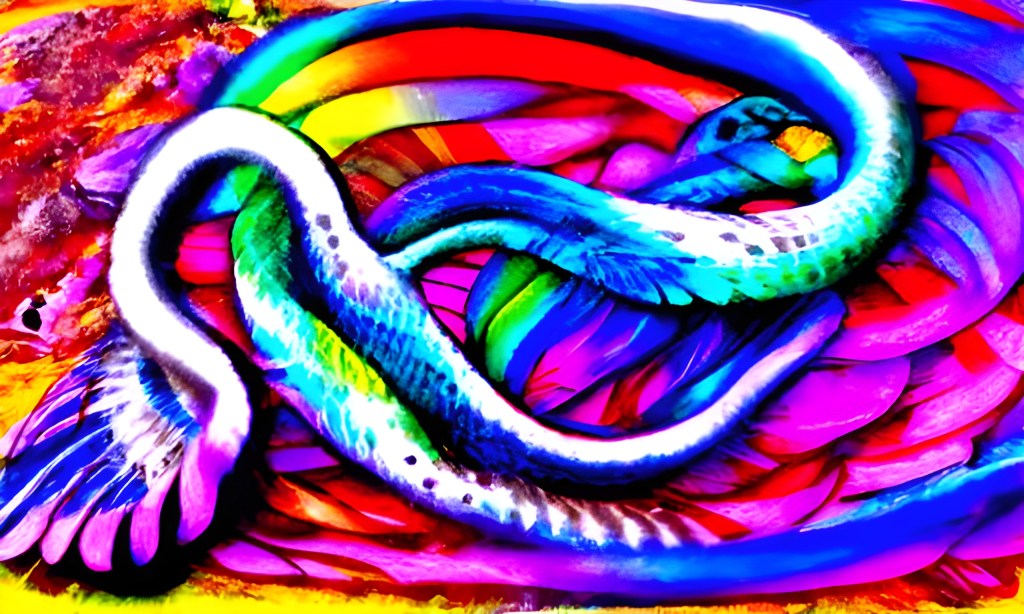
(Editor’s Note: The “Rainbow Worm” of this story is more commonly known as the Plumed, or Feathered, Serpent. In this case he also connects with the phenomenon of the rainbow, a belief shared by a number of other peoples around the world.)
Ataht! All during the travels of the Zuni clans, K’yaklu, the all-hearing and wise of speech, all alone had been journeying afar in the north land of cold and white desolateness. Lost was he, for lo! All the world he wandered in now was disguised in the snow that lies spread forth there forever. Cold was he – so cold that his face became want, and white from the frozen mists of his own breathing withal, white as became all creatures who bide there. So cold at night and dreary of heart was he, so lost be day and blinded by light was he, that he wept, continually wept and cried aloud until the tears coursing down his cheeks stained them with falling lines along the wrinkles thereof (as may be seen on his face to this day when in due season he reappears), and he died of heart and thence became transformed (i’hlimnakna) lastingly as are the gods. Yea, and his lips became splayed with continual calling, and his voice grew shrill and dry-sounding, like to the voices of far-flying water-fowl. As he cried, wandering all blindly hither and thither, these water-birds, hearing, flocked around him in numbers and curiously peered at him, turning their heads from side to side and ever approaching nearer, all the while calling one to another.
Behold! When he heard them calling, their meanings were plain to him, wise as he was of all speeches! Yet still he lamented aloud, for none told him the way to his country and people.
Now, when the Duck heard his cry, lo! It was so like to her own that she came closer by than any, answering loudly. And when they were thus come near to each other, much related appeared they, strange as that may seem. Forasmuch as he was of all times the listener and speaker, and therein wisest of all men, so was she of all regions the traveler and searcher, knowing all ways, whether above or below the waters, whether in the north, the west, the south, or the east, and therein was the most knowing of all creatures. Thus the wisdom (yu-yananak-ya) of the one comprehended (aiyuhetok’ya) the knowledge (anikwanak’ya) of the other, and K’yaklu in the midst of his lamentations besought counsel and guidance, crying –
Ha-na-ha! Ha-na-ha! A-hah-hua!
O, grandmother! Where am I straying
So far from my country and people?
All speeches I know, of my sitting
In councils of men and the beings,
Since first in the depths they had being!
But of far ways, alas! I am kenless!
Ha-ua-ha! Ha-na-ha! A-hah-hua!
The mountains are white, and the valleys;
All plains are like others in whiteness;
And even the light of our father
The Sun, as he rises and passes,
Makes all ways more hidden of whiteness!
For in brightness my eyes see but darkness –
And in darkness all ways are bewildered!
Ha-na-ha! Ha-na-ha! A-hah-hua!
In the winds, lo! I hear the directions;
But the winds speak the ways of all regions,
Of the north and the west and the southward,
Of the east and of upward and downward,
They tell not the way to the Middle!
They tell not the way to my people!
Ha-na-ha! Ha-na-ha! A-hah-hua!
“Hold, my child, my father,” said the Duck. “Think no longer sad thoughts. Though thou be blind, yet thou hearest all as I see all. Give me, therefore, tinkling shells from thy girdle and place them on my neck and in my beak. Thus may I guide thee with my seeing if so be thou by thy hearing grasp and hold firmly my trail. For look, now! Thy country and the way thither well I know, for I go that way each year leading the wild goose and the crane, who flee thither as winter follows.”
And so the K’yaklu placed his talking shells on the neck of the Duck, and in her beak placed the singing shells, which ever in his speakings and listenings K’yaklu had been wont to wear at his girdle; and albeit painfully and lamely, yet he did follow the sound sh made with these shells, perching lightly on his searching outstretched hand, and did all too slowly follow her swift flight from place to place wherein she, anon, going forth would await him and urge him, ducking her head that the shells might call loudly, and dipping her beak that they might summon his years as the hand summons the eyes. By and by they came to the country of thick rains and mists on the borders of the Snow World, and passed from water to water, until at last, lo! Wider waters lay in their way. In vain the Duck called and jingled her shells from over the midst of them, K’yaklu could not follow. All maimed was he; nor could he swim or fly as could the Duck.
Now the Rainbow-worm was near, in that land of mists and waters. And when he heard the sacred sounds of the shells he listened. “Ha! These be my grandchildren, and precious be they, for they call one to the other with shells of the great world-encircling waters,” said he; and so, with one measure of his length, he placed himself nigh them, saying –
Why mourn ye grandchildren, why mourn ye?
Give me plumes of the spaces, grandchildren,
That related I be to the regions,
That uplifted I be to the cloud-heights,
That my footsteps be countries and countries;
So I hear ye full swift on my shoulders
To the place of thy people and country.
K’yaklu took of his plume-wands the lightest and choicest; and the Duck gave to him her two strong pinion-feathers that he might pendant them therewith, making them far reaching and far-seeing. And the Rainbow arched himself and stooped nigh to them whilst K’yaklu, breathing on the plumes, approached him and fastened them to his heart side. And while with bent head, all white and glistening wet, K’yaklu said the sacred words, not turning to one side not to the other, behold! The Rainbow shadow gleamed full brightly on his forehead like a little rainbow, (even as the great sky itself gleams little in a tiny dew-drop) and became painted thereon, and I’hlimna.
“Thanks this day!” said the Rainbow. “Mount, now, on my shoulders, grandson!”
The Rainbow unbent himself lower that K’yaklu might mount; then he arched himself high amidst the clouds, bearing K’yaklu upward as in the breath a mote is borne, and the Duck spread her wings in flight toward the south. Thitherward, like an arrow, the Rainbow-worm straightened himself forward and followed until his face looked into the Lake of the Ancients, the mists whereof were to him breath and substance.
And there in the plain to the north of Ka’hluelane, K’yaklu descended even ere the sun was fully entered, and while yet it was light, the Rainbow betook himself swiftly back.
But alas! K’yaklu was weary and lame. He could not journey farther, but sat himself down to rest and ponder the way.
Now, as he sat there, all silent, came across the plains the shouts and harangues of the Ka’yemashi as they called loudly to one another, telling, like children, of the people who had but then forded the wide river, and passed on to the eastward.
For the children of the Twain knew not yet the people of their parents, nor did their parents tell them aught, save to bid them hide in the mountains; for they willed not that their shame be made known whilst the hearts of their earstwhile people were so sore with anguish.
And as K’yaklu, the wonderful hearer, lifted his head and signed to the Duck, forthwith, knowing from the talk of the Ka’yemashi (the androgynous gods descended from the ecstatic union of a certain god and goddess) who they were and what had chanced to their parents, his own brother and sister, and all the evils that had befallen his people by the sin and change-makings of these two. Lo! The strength of his heart wasted as he bowed him down again in the plain, alone, blinded of sight, wearied and lamed, and now from very sadness blinded even of thought withal, now that he learned of the woes which the two, his own brother and sister, had wrought upon all of the people. The Duck, long waiting, at last shook her shells and called to him. He heard not, or hearing gave no heed, but sat, like one bereft of all thinking, lamenting the deeds of his brother and sister and the woes of his people.
The Duck thereupon fled away toward the mountain whence issued the garrulous talking, and thence beyond, spying water, to the lake in its hollow. There she swam to and fro, this way and that, up and down, loudly quacking and calling. Lo! The lights of the Kiwitsin of the Ka’ka began to gleam in the waters, and as she gazed, she beheld, rising from them, snout foremost, like one of her own kind, the Salamopia of the north, whom the gods of the Ka’ka, the noble and surpassing Pautiwa and the ancient K’yau’hliwa, had dispatched to bid the Duck dive down and lay before them whatsoever message she might bear. The Duck followed down, down, into the great assembly halls. There she told of the far journeys she had made, of her finding and leading the K’yaklu, and how now K’yaklu say blind of eyes, maimed and hearing naught of her calling, in the plain beyond the mountains.
“Yea, him know we well!” replied the gods. “Of our sacred breath breathed his father and his mother when days were new and of us shall be numbered they, when time is full. Lo! Therefore because changed violently of his grief and sore hardships whilst yet but k’yaiyuna, he hath become ‘hlimna (or ancient), and yet unchanging, since finished so; yea, and unceasing, as one of ourselves, thus shall he remain. True also is this, of his brother and sister who dwell with their uncouth offspring in the mountain hard by. Go upward, now, and with thy tinkling shells entice these children to the lake shore. Loudly will they talk of the marvel as in their wilder moments they ever talk of anything new to hap. And they will give no peace to the old ones until these come down also to see thee! Thou wearest the sacred shells and strands of K’yaklu wherewith he was ever wont to count his talks in other days when days were new to men. When these they see, lo! The will become instantly grave and listen to thy word,s for they will know the things they watched him wear and coveted when they were still little, all in the days that were new to men. Bid them make forthwith of poles and reeds, a litter, and bear it away, the father of them all with his children (nay not the sister-mother, to sore hurt the love of a brother eldest for a sister youngest, whereby so pitiably he mourneth even now) to where, in the far plain, K’yaklu sits so mourning. Bid them greet him, and bring him hence. They may not enter, but they may point the way and tell him how, fearlessly, to win into our presence, for as one even of ourselves is he become; yea, and they also, save that they stayed themselves for the ages, midway betwixt the living and the dead, by their own rash acts did they stay themselves so, wherefore it is become their office to point the way of the again living to the newly dead, for aye. Tell the grandchild, thy father withal, K’yaklu, to mourn not any longer, neither tarry, but to get him straightway hither, that he may learn from us of his people of the meanings of past times, and how it shall be in times to come.”
Even so did the Duck, as bidden, even so did the Ka’yemashi, one and all, as it had been said they would do as the Duck bade them, and ere the morning came, they with a litter went, singing a quaint and pleasant song, adown the northern plain, bearing their litter. And when they found the K’yaklu, lo! He looked upon them in the starlight and wept; but their father, he who had been the glorious Siweluhsiwa, his youngest brother, stood over him and chanted the soothing yet sad dirge rite, and he, too, wept and bowed his head; but presently he lifted his face and, as a gleeful child, his children joining, cajoled the silent K’yaklu to sit him down in the great soft litter they did bear for him.
Then lifting it on their shoulders, they bore it lightly, singing loudly as they went, to the shores of the deep black lake, where gleamed from the middle the lights of the dead.
Uprose at this point, the Salamopia Tem’hlanahna or of all the six regions, led by the leader of them all and taking K’yaklu on their shoulders, they in turn bore him out over water to the magic ladder of rushes and canes which reared itself high out of the water; and K’yaklu, scattering sacred prayer-meal before him, stepped down the way, slowly, like a blind man, descending a skyhole. No sooner had he taken four steps than the ladder lowered into the deep; and lo! His light was instant darkened.
But when the Salamopia of the regions entered the central sitting place of the Ka’ka with K’yaklu, Shulawitsi lifted his brand on high and swinging it, lighted the fires anew, so that K’yaklu saw again with fulness of sight and so that they shone on all the gods and soul-beings therein assembled, revealing them. Yea, and through the windows and dooorways of all the six chambers encircling, and at each portal, the Salamopia of the region it pertained and led unto took his station. And Pautiwa, and his warriors the bluehorned Saia’hliawe, and the tall Shaalako-kwe, yea, and all the god-priests of the regions six, those who are told of without omission in the speech of K’yaklu and in other speeches of our ancient talk, bade K’yaklu welcome, saying, “Comest thou, son?” “Yea,” he replied. “Verily then,” said Pautiwa,
Sit thee down with us,
That of much we may tell thee,
For far thou hast wandered
And changed art become
As a woman with children
Is loved for her power
Of keeping unbroken
The life-line of kinsfolk,
So shalt thou, tireless hearer,
Of all sounds with meaning,
Be cherished amongst us
And worshipped of mortals
For keeping unbroken
The Tale of Creation,
Yea, all we shall tell thee
Of past days and future.
So said Pautiwa, cloud-sender and sun-priest of souls, and his brothers younger of the regions all, joined in so saying.
Then K’yaklu sat him down and bowed his head, and calling to the Duck, who had guided him, stretched forth his hand and upon it she settled, as upon a wave-crest or a wood bough.
The gods sent forth their runners, the Salamopia and the timid, fleet-footed Hehea, to summon all beings, and then, gathering themselves in a sacred son-circle, called in from the several chambers dancers in semblance of the Ka’kokshi, or Dance of Good. And with these came, behold! The little ones who had sunk beneath the waters, well and beautiful and all seeming wonderfully clad in cotton mantles and precious neck jewels. And these played, sad only with the sadness of their mothers, but resting therefrom when in dreams, above, these rested.
And when the dancers paused, the gods turned to K’yaklu and said: “Lo! We begin, given thou be ready.”
And K’yaklu said: “It is well; I am ready; yea, even my heart listeneth,” and in cadence to their speech following, he moved the Duck with her tinkling, talking shells, as a master of song moves his baton, or a dancer his rattle, and in solemn, ceaseless tone, as in singing yet with speech more steady, the gods, one by one, told to K’yaklu the things each best knew, whereof he so wondrously speaks when come amongst us for the welfare of our little children, bringing them the sacred breath of the Ka’ka itself, and to their elders these same speeches of the gods.
When, after long time, they had done, they further charged him with a message of comfort to the mourning mothers, and with commandments and instructions to men and the beings.
Then they brought forth the sacred cigarette, and the master priest-gods smoked in relationship with K’yaklu to all the six regions, and, rising, he was led in turn to the portal of each chamber, first to the northern, then to the western, southern, eastern, upper, and lower, and he placed his fingers on the sill of each, that in aftertimes he should know, though but dim of sight, or in the dark, the places of worship (which men built then but poorly) from others, and in such alone, and to chosen few who hold the rites of the Ka’ka, should therein tell and do the customs and words of the gods and tell of other such like precious ancient things.
Then the Sa’lamopia lifted the ladder and guided upward K’yaklu and the Duck, showing them safely to the shore of the lake. When the old ones (Ka’yemashi) heard the shells of the Duck tinkling, forth they came, bringing their litter and singing boisterously, for much they loved K’yaklu as the light of the rising sun fell upon him, as a raven loves bright shells or chips of glistening stone.
And when they had come to the side of K’yaklu, instantly they became grave, for he bade them hearken to the words of the gods, and their instructions.
“Ye shall attend me, for know that ye are to be the guardians of the Kaka and tellers of its meanings, and givers of enjoyment to the children of en, even as ye gave the enjoyment of comfort unto me, when ye sought me in the plain of my sorrows. Ye shall bear me to the people yonder, for I have tidings for them, and instructions to which ye shall cherish the Kaka: yea, and all other precious customs, for thereunto as unto life mortal, yet unceasing, became fitted thy father, my brother younger; and thereunto were ye born, ye and thy sister elder, man-woman of the Kaka, as unto the councils thereof am I become slave yet master. But my sister, thy mother, shall abide by the place she hath made, maintaining it, as woman ever maintaineth the hearth she hath made, all the days of men.”
Thus said K’yaklu as he sat him down on the litter, and obediently the Ka’yemashi lifted it upon their shoulders and bore it away, along the trail eastward, down which westward we go after death and fulfillment. And as they journeyed through the plain, calling loudly to one another, the little people of the Marmot villages ran out and stood up, looking at them and calling to one another, which was so amused and pleased the Ka’yemashi that they became proud of their master and uncle, K’yaklu, and sang all the way thereafter of the audience they had at every prairie-dog village, of Marmot youths and Marmot maidens; and thus they were singing gleefully as they neared the camp of the people, insomuch that none were frightened, but all wondered who were those pleasant, strange people coming, and what one of precious consideration guided of the far-journeying Duck they were bearing aloft on their littler. Thus, ever since, they sing, as they bring in K’yaklu from the western plain, along the river-trail of the dead, and thus happily and expectantly we await their coming, out little ones wonderingly as did the first men of those days.
Speedily the fathers of the people recognized their lost K’yaklu (led and prompted as they were of the Twain), and preciously they housed him, as we preciously and secretly receive with the cigarette of relationship a returning relative, and purify him and ourselves ere he speak, that he may not bring evil or we receive it, perchance, with the breath of his strange words.
Thus the father of the people did to K’yaklu and the ancient ones, receiving them into secret council. And as one who returns famished is not given to eat save sparingly at first of the flour of drink (ok’yuslu), so with this only was K’yaklu regaled; but his bearers were laden speedily with gits of food and garments which, forsooth, a message of comfort to the mourners, telling them how, below the waters into which their little ones had sunken, they were dwelling in peace amongst the gods, and how all men and mothers would follow them thither in other part in the fulness of each one’s time.
And then, holding in his hand the Duck, the guide to his blindness, he spake in measured motion and tone, to the sound of the shells on the neck of the Duck, the words of creation, K’yaklu Mosonan Chim-mik’yanak’ya penane, and of his wanderings, and the speeches of gods and beings as they had been told him, and the directions of the sacred customs, all did he tell ceaselessly as is still his wont from mid-day to mid-day to each one of the six councils, that no part be forgotten.
Thus did our people first learn of their lost messengers, all save two of them, Anahoho achi, and of their lost children in the City of Ghosts; yea, of the spirit beings and man, animal, and of the souls of ancient men dead beforetime; yea, and yet more learned they – that all would gather there even those who had fled away in fear of the waters in the fulness of time.
And when K’yaklu had finished speaking, he and the ancient ones breathed into the nostrils of those who had listened, and into the mouths of four chosen from amongst them (small of stature like as he was) he spat, that their tongues might speak unfailingly the words he had uttered. And these became the K’yak’lu Amosi, whose office we till keep amongst us. Then the ancient ones lifted him upon the litter, and loudly joking about their gifts and bidding men call them ever with the Kaka that they might receive more haha, they sang of how the young women and maidens would wait for them as for lovers, bringing them the water of guest to drink, and amid laughter they bore K’yaklu back whence they had come, to the mountain and city of the Kaka.
Source:
Zuni Creation Myths, Frank Hamilton Cushing, 1896



 Kotharian Lightning