
From Chinese Folklore
(Footnote: Heng O is the same as Ch’ang O, the name Heng being changed to Ch’ang because it was the tabooed personal name of the Emperors Mu Tsung of the T’ang dynasty and Chen Tsung of the Sung dynasty.)
Heng O, during her husband’s (Shen I) absence, saw a white light which seemed to issue from a beam in the roof, while a most delicious odour filled every room. By the aid of a ladder she reached up to the spot whence the light came, found the pill of immortality, and ate it. She suddenly felt that she was freed from the operation of the laws of gravity and as if she had wings, and was just essaying her first flight when Shen I returned. He went to look for his pill, and, not finding it, asked Heng O what had happened.
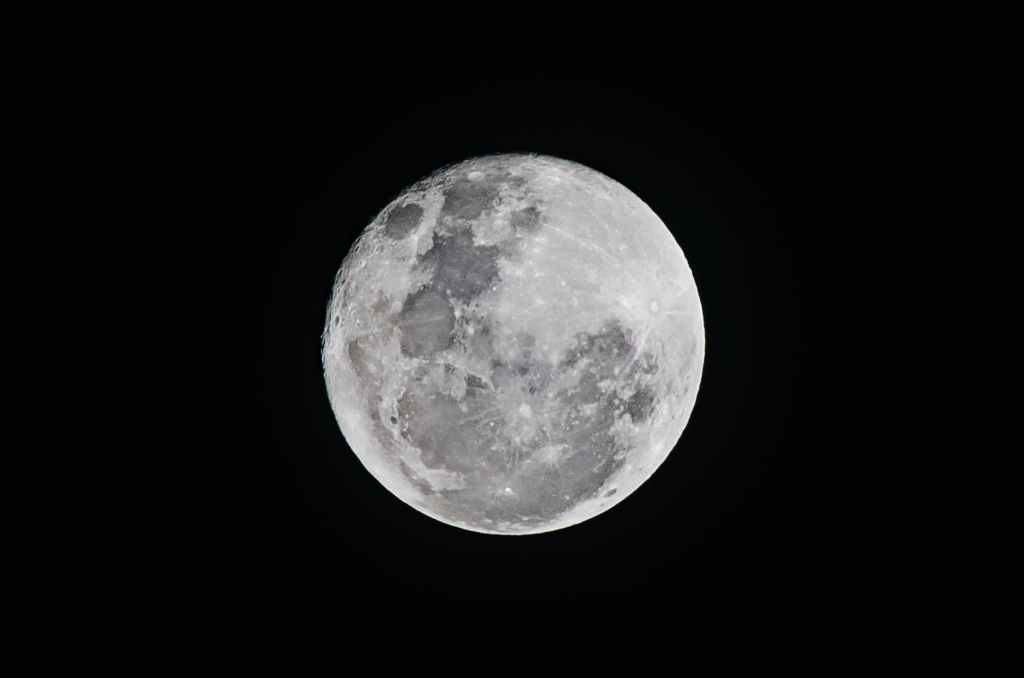
The young wife, seized with fear, opened the window and flew out. Shen I took his bow and pursued her. The moon was full, the night clear, and he saw his wife flying rapidly in front of him, only about the size of a toad. Just when he was redoubling his pace to catch her up a blast of wind struck in to the ground like a dead leaf.
Heng O continued her flight until she reached a luminous sphere, shining like glass, of enormous size, and very cold. The only vegetation consisted of cinnamon-trees. No living being was to be seen. All of a sudden she began to cough, and vomited the covering of the pill of immortality, which was changed into a rabbit as white as the purest jade. This was the ancestor of the spirituality of the yin, or female, principle. Heng O noticed a bitter taste in her mouth, drank some dew, and, feeling hungry, ate some cinnamon. She took up her abode in this sphere.
As to Shen I, he was carried by the hurricane up into a high mountain. Finding himself before the door of a palace, he was invited to enter, and found that ti was the palace of Tung-hua Ti-chun, otherwise Tung Wang Kung, the husband of Hsi Wang Mu,
The God of the Immortals said to Shen I: “You must not be annoyed with Heng O. Everybody’s fate is settled beforehand. Your labours are nearing an end, and you will become an Immortal. It was I who let loose the whirlwind that brought you here. Heng O, though having borrowed the forces which by right belong to you, is now an Immortal in the Palace of the Moon. As for you, you deserve much for having so bravely fought the nine false suns. As a reward you shall have the Palace of the Sun. Thus the yin and the yang will be united in marriage.” This said, Tung-hua Ti-chun ordered his servants to bring a red Chinese sarsaparilla cake, with a lunar talisman.
“Eat this cake,” he said; “it will protect you from the heat of the solar hearth. And by wearing this talisman you will be able at will to visit the lunar palace of Heng O; but the converse does not hold good, for your wife will not have access to the solar palace.” This is why the light of the moon has its birth in the sun, and decreases in proportion to its distance from the sun, the moon being light or dark according as the sun comes and goes. Shen I ate the sarsaparilla cake, attached the talisman to his body, thanked the god, and prepared to leave. Tung Wang Kung said to him: “The sun rises and sets at fixed times; you do not yet know the laws of day and night; it is absolutely necessary for you to take with you the bird with the golden plumage, which will sing to advise you of the exact times of the rising, culmination, and setting of the sun.” “Where is this bird to be found?” asked Shen I. “It is the one you hear called Ia! Ia! It is the ancestor of the spirituality of the yang, or male, principle. Through having eaten the active principle of the sun, it has assumed the form of a three-footed bird, which perches on the fu-sang tree (a tree said to grow at the place where the sun rises) in the middle of the Eastern Sea. This tree is several thousands of feet in height and of gigantic girth. The bird keeps near the source of the dawn, and when it sees the sun taking his morning bath gives vent to a cry that shakes the heavens and wakes up all humanity. That is why I ordered Ling Chen-tzu to put it in a cage on T’ao-hua Skan, Peach-blossom Hill; since then its cries have been less harsh. Go and fetch it and take it to the Palace of the Sun. Then you will understand all the laws of the daily movements.” He then wrote a charm which Shen I was to present to Ling Chen-tzu to make him open the cage and hand the golden bird over to him.
The charm worked, and Ling Chen-tzu opened the cage. The bird of golden plumage had a sonorous voice and majestic bearing. “This bird,” he said, “lays eggs which hatch out nestlings with red combs, who answer him every morning when he starts crowing. He is usually called the cock of heaven, and the cocks down here which crow morning and evening are descendants of the celestial cock.”
Shen I, riding on the celestial bird, traversed the air and reached the disk of the sun just at mid-day. He found himself carried into the centre of an immense horizon, as large as the earth, and did not perceive the rotary movement of the sun. Heng O then enjoyed complete happiness without care or trouble. The thought of the happy hours passed with his wife Heng O, however, came back to memory, and borne on a ray of sunlight, he flew to the moon. He saw the cinnamon-trees and the frozen-looking horizon. Going to a secluded spot, he found Heng O there all alone. On seeing him she was about to run away, but Shen I took her hand and reassured her. “I am now living in the solar palace,” he said; “do not let the past annoy you.” Shen I cut down some cinnamon-trees, used them for pillars, shaped some precious stones, and so built a palace, which he named Kuang-han Kung, ‘Palace of Great Cold.’ From that time forth, on the fifteenth day of every moon, he went to visit her in her palace. That is the conjunction of the yang and yin, male and female principles, which causes the great brilliancy of the moon at that epoch.
Shen I, on returning to his solar kingdom, built a wonderful palace, which he called the Palace of the Lonely Park.
From that time the sun and moon each had their ruling sovereign. This regime dates from the forty-ninth year (2309 B.C.) of Yao’s reign.
When the old Emperor was informed that Shen I and his wife had both gone up to Heaven he was much grieved to lose the man who had rendered him such valuable service, and bestowed upon him the posthumous title of Tsung Pu, ‘Governor of Countries.’ In the representations of this god and goddess the former is shown holding the sun, the latter the moon. The Chinese add the sequel that Heng O became changed into a toad, whose outline is traceable on the moon’s surface.
Source:
Myths and Legends of China, E.T.C. Werner, 1922



 Kotharian Lightning