
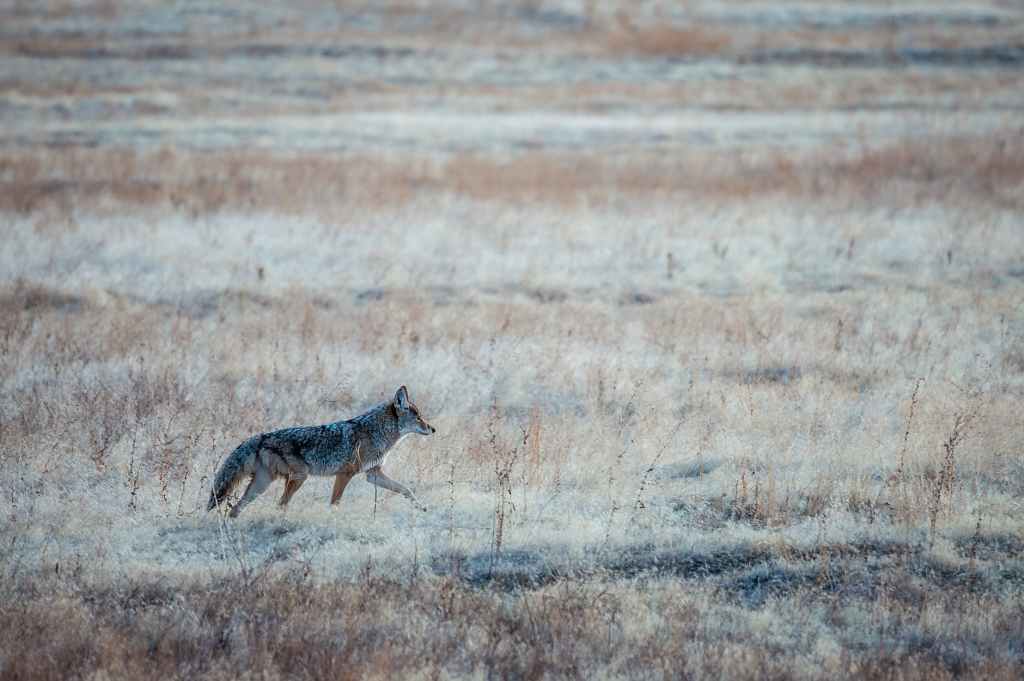
From Wichita Folklore
At the time when the Coyote (Ketox) saved the lives of many people there were two villages, one in the east and the other in the west, situated some distance apart. The people of both villages were in the habit of going on the war-path, but on the return of their war-parties the conduct of the people in the east village was very different from that of the people in the west village. On the return of the war-parties from the east village the people had good times; but when a war-party returned to the west village there was crying, which, when it was heard at the east village, excited wonder, for the people in the east village knew that both villages were accustomed to sending out the same kind of parties. They thought it must be that the enemy met the war-parties of the west village and killed off all their men.
Once upon a time the Coyote resolved to visit this village, stay there until a war-party should go out, and find out why the people cried. He went to the village. A war-party was sent out, and the Coyote went along with them, to see what would happen to the men, so that he might find out why the people cried on the return of the war-party. They traveled all that day, and late in the evening the men stopped, and, there being so many of them, they gathered plenty of wood in a very shot time. The Coyote noticed that the men cut some dog-wood. He wondered, and, to be like the rest, he began to cut some dog-wood himself, though he did not cut as much as did the others. The sun having set, the men made a fire. Then some one was heard to ask from a distance in the north, which was the way to the fire. So the man was directed the way to the fire. The Coyote wondered why the man should ask which way he should come. The Coyote was anxious to learn who the man was and why he had come. The man came up to the fire, and as soon as the Coyote saw him he was afraid of him, for he was dressed entirely different from any man that the Coyote had ever seen. His bonnet was red and hung down his back to the ground. Fringes of human hair hung from the sides of his legs and arms. Each of his legs was marked in front with four black dots like the eyes of a human being. In his right hand he held a war-club. His name was Sign-that-the-Enemy-would-be-weakened (Hossednawa), a Shooting-Star. But when living as a human being he had great powers, some good and some bad. He was a sort of evil-spirited man. The dress which he wore was made of tanned hides and was finished with hair of a human being. When he walked it sounded like thunder and the groaning of human beings. On his moccasins were to be seen human eyes, which were looking at the warriors.
As he stood by the fire it was seen that he had plenty of dogwood with him, the same as the other men. The Coyote wondered what they were going to do with the dogwood sticks. Then, one at a time, the men began to use the sticks to count how many times they had killed their enemies, and each stick counted one enemy. The number of sticks used by a man showed how many men he had killed. But the stranger could count beyond any of the others. Then the trouble began with the Coyote’s party. Whenever a man had told all his war-tales the stranger would kill him. This continued throughout the entire night. The Coyote wanted to be the last to enter into the contest. There were a good many in the war-party, but none of them could recount so many enemies killed as did the stranger. The men became fewer and fewer. The Coyote was watching for daylight to come, for he had an idea that if daylight should come before it was his turn he would have a chance to escape the danger. There were a good many men lying dead around the camp-fire. The Coyote was beginning to learn why the people at the west village cried. The men became very few about daylight, but they kept on telling war-stories. Finally it was daylight, and the Coyote asked to be excused for a little while. As soon as he had got out he began to travel very fast, in order that he might report at the west village what was happening to the war-party.
As he went further h e met a man by the name of Little-Man (Ihasikitse), one that existed in those times and are supposed to exist to-day, whom he asked to save him. Little-Man told the Coyote that he would receive him, and for him not to be troubled, for he himself had great powers and was not afraid of the strange man, although the strange man had blinded him so that he could not find his trail; that he was completely out of patience with his meanness; that he was going to give the Coyote power to kill the strange man. Little-Man gave the Coyote a bow and some arrows and told him that when he got to the west village he should ask for a dress to be made after the same fashion as that worn by the strange man, though buffalo hair might be used in imitation of the human hair; and that his moccasins should have eyes like those of the strange man’s.
Little-Man also told the Coyote that when he should get ahead of the strange man in telling war stories, he (the Coyote) should tell him that he was going to kill him right there; that the strange man would then say: “Well, you have beaten me in this, but we are yet to contest in a foot-race;” that when he should be asked by the strange man whether he preferred to race under the ground or above the ground he should reply unmistakably that he wanted to go on top of the ground; that by running on top of the ground he would beat the strange man to the goal; that when he should have beaten him he would be asked to spare his life in return for his powers, but that he (the Coyote) should kill the strange man, and not accept his powers. Little-Man also enjoined the Coyote that when should have accomplished all he should not marry, lest by marrying he should lose his powers. Little-Man then said that when he should have killed the strange man he should gather into one pile the bodies and bones of those who had been killed of the men of his war-party; that he should then gather plenty of wood and place it over the bodies and bones, then born the wood; that when the wood should get to burning he should call to the men to come out of the fire; and that all the men who had been killed would come out right there. These were the instructions given to the Coyote. The Coyote told Little-Man he knew he could perform all this without making a mistake, for he was too old to make any bad mistake.
The Coyote then went on straight to the west of the village. When he arrived there he went direct to the chief’s place and got the chief to call the people together at his place, for he had something to tell. The chief ordered a crier to tell the people to come to his place. Finally there was a great crowd of people at the chief’s place, and when everybody was present the Coyote was invited to tell what he had to say. The Coyote said that he had come to their village to learn why the people of the village cried so often; that for this reason he had joined himself to the war-party that the people had sent out; that as the war-party had come to the end of their journey they had met with trouble and had been killed; that he was the only man to escape; that he wanted the people to get him buckskin or any other tanned hide which was good enough for leggings, shirt, and moccasins, and to make them for him; that he was going back to the place where the warriors had been killed and try to kill the man who had killed them, and, if possible, restore them to life and bring them home. Thus did the Coyote talk to the people, and the talk sounded good to them. Immediately the things for which he asked were brought, for the people were anxious to see the Coyote save all the men whom they had lost. Not only did they make the desired clothes, but they made the proper bonnet. So the things were made as the Coyote directed. After everything was finished, Little-Man gave to the clothing the real appearance of that of the strange man. The Coyote now told the people that he was going to the unsafe place where dire things happened when it was visited.
The then journeyed to the place where everybody dies, to see if he too would be killed. He traveled a good deal faster than he had traveled the first time, for the first time he knew not where the place was. At length he reached the place and mimicked the men of the war-party in getting plenty of wood to last all night and in getting dogwood sticks to count with. Of course he had come to the place early enough to have time to get plenty of wood. All being ready, it began to get dark. The Coyote heard the evil spirited man coming to visit his camp-fire. The Coyote told him to come straight to the place where he always came when anybody camped there. When the strange man came up, there sat his opponent, the Coyote, whose dress closely resembled his own. He was surprised to note this close resemblance.
The Coyote sat on the east side of the fire and the strange man sat on the west side. They commenced to tell their war tales, and at first they came out even at the end of every round. All night they continued, till finally the strange man began to fall behind. The Coyote told more tales than did the strange man. The strange man told true stories, but the Coyote being known to tell what was not true, could tell more tales than any other man; his stories were not half true. At about daylight he had not told half of his war-stories, but his opponent then had to search a long time in recalling his war tales, and the Coyote would hurry him, and he said that he himself had not come there to meet any one whom it took so long to recall tales. Finally it got so that the strange man had to search a long time for his tales. The Coyote would add more tales, so that it was impossible for the strange man to catch up with him. Daylight came and the strange man had told all of his war tales.
The Coyote rose, took his weapon and was ready to take the strange man’s life, when he told the Coyote that there was one more thing to be done before he could take his life, which was to run a race. He told the Coyote he might choose whether he would run on the top of the ground or under ground. The Coyote decided to race on top of the ground. At the south of them there was a high hill which was to be the goal. They commenced to run for the high point. It was agreed that whoever should get there first should be the winner. The strange man went under the ground and the Coyote went on top of the ground. The Coyote ran much faster than he had ever ran before, receiving his power from Little-Man. He ran very fast, and behind him he could hear the strange man coming under the ground. The Coyote finally succeeded in reaching the point first, and he noticed that the strange man had not yet arrived. So the Coyote got ready to take his life as soon as he should come out of the ground. Finally the strange man arrived at the place, and there was the Coyote, ready to meet him.
The strange man begged the Coyote to spare his life and offered him a part of his powers, but Coyote refused, and killed the strange man.
Coyote then dragged the strange man to his camp-fire and gathered the human bones that were lying around the place. He put them into a big pile. He then brought wood enough to burn them all and set fire to the wood, and there was a great blaze. Coyote called out all the names of the men who had been killed in that place, and there came out men from the fire, one at a time until the fire went out, and all the men had been restored to life. Coyote was then with a crowd of men. He told the men to return to their homes, and those who were from his village he told to go there. Coyote started off, and the men wondered who this famous man was that possessed powers greater than those of the strange man, who they knew to be famous and a dangerous man to attack; and who had killed the strange man. Finally, through the intervention of Coyote, the men reached their homes. The chief of the village was pleased to see the return of those men whom he knew to have been restored to life. The chief ordered the servant to call the people together. The people came to the chief’s place, and some of the men asked him why he had called the people together. The chief replied that since some one had favored the people by restoring the lives of their warriors and had killed their enemy, he wanted to make that one head chief over him; that he wanted them to build for him a new dwelling place; that it was only right that some of the men who had been at the dangerous place should offer their sister to the man who had restored their lives.
The Coyote thought that it was a pretty good announcement, and it was just what he wanted. Little-Man had forbidden him to entertain the foolish idea of getting a wife and becoming a chief: nevertheless, the Coyote having killed the strange man, thought it safe to disregard the admonition of Little-Man. The chief made the announcement and the people thought it only right that they should do the Coyote the favor and let him remain with them at their village. The people began at once to build the Coyote a home, but they did not knew that it was for the Coyote. The Coyote stayed with the chief while his home was being built. Little-Man saw that the Coyote was disobeying his orders by accepting these others. Soon the people had completed the lodge for the Coyote, and the Coyote had wives. He moved into his new home that the people had given them in return for his good work.
After he had moved into his home the most prominent men came around his place to entertain him during the day and night, just as they used to entertain the chief. The old chief would come around to visit him, and so there was a great crowd of men around every day. The Coyote had enough wives to do the cooking for his visitors. The Coyote’s wives soon became pregnant. His powers began to leave him, and one night Little-Man sent a whirlwind to the Coyote’s place to take away all of the Coyote’s powers and leave him the same as he was at first, because he had disobeyed his orders. After the Coyote and his wives had gone to sleep the whirlwind entered his lodge and took away everything that he had, and his powers, too. This was a punishment to the Coyote for not obeying the man who had given him powers.
Early the next morning when the Coyote’s wives woke up they saw a coyote sleeping with them in the place of a human being. They screamed and woke the Coyote, and when the Coyote saw that he was no longer a human being he ran out and left the village forever. When he was out away from the village he cried because he had lost his powers. So, often when we hear the coyote crying, it means that he is regretting his foolish disobedience which lost for him his powers.
The village still existed, and finally the news that the Coyote had lost his powers and that he had left the village began to spread. The people began to learn that this famous man who had brought them to life was the Coyote. After the departure of the Coyote his wives began to have children, and the children were all coyotes. The brothers of the wives then had all the people take one each to their home for pets. The village still existed there, and every one lived happy after the Coyote had killed their enemy.
Source:
The Mythology of the Wichita, George A. Dorsey, 1904



 Kotharian Lightning