
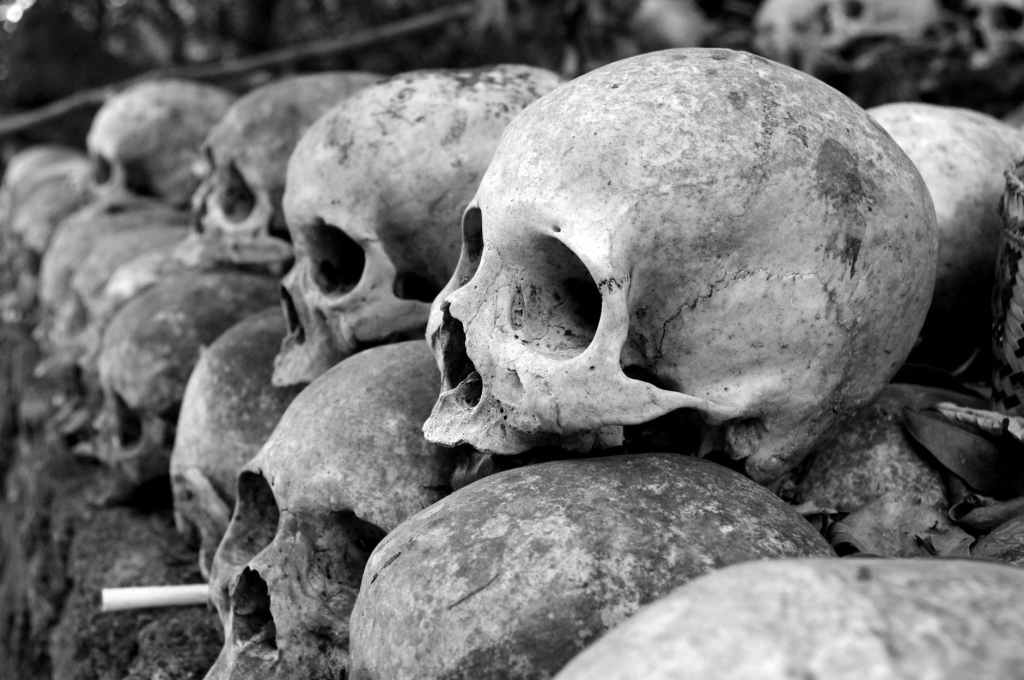
From Hawaiian Folklore
Ke-alii-ai Kanaka was a powerful man. He is described as a champion boxer and wrestler. In some way he learned to love the taste of human flesh. When his awful appetite became known he was driven from his home. As he passed through the village the women who had been his playmates and companions fled from him. His former friends, the young warriors, called out “Man-eater! Man-eater!” and openly despised him. In bitter anger he called the few servants who would follow him, and fled to the royal Waianae Mountains. Driven from his kindred and friends, he carried himself and his brutal appetite to the mountain forests.
It is possible that soon after this he visited the island Kauai, and there passed himself off as a chief from a foreign land. But “his hand was against every man” and therefore “every man’s hand was against him.” Finally he made his permanent home among the Wainanae Mountains, in the range that borders Waialua.
His followers numbered only a handful, for a single canoe brought them away from Kauai – if his was indeed the band driven from the hospitable shores of that fertile island.
Kokoa and Kalo were the names by which he was known in his nobler young manhood, and Kokoa was his name to his followers, but he was ever after Chief Man-eater to the Hawaiian world.
It was a wild and wonderfully beautiful spot that Kokoa chose for his final home. It was a small mountain surrounded by other higher and more precipitous cliffs. It was luxuriantly covered with tropical growth and blessed with abundant rains. The Hawaiians have given the name Halemanu (house-of-the-hand) to this plateau. Its sides, sloping down into the valleys, were so precipitous as to be absolutely inaccessible. It could be entered only along a narrow ridge. The pandanus dropped its long leaves and aerial rootlets along the edges. The uluhe, or tangle-fern, massed and matted itself into a thick disguise for the cannibals’ secret paths through the valleys below. Native flowers bordered the paths and crowned the plateau, as if man’s worst nature could never wither the appeal of things beautiful. A magnificent koa, or native mahogany, tree spread its protecting branches by the spot chosen by Kokoa for his grass house. Kukui-trees furnished their oily nuts for his torches. The ohia, or native apple, and the bread-fruit and wild sugar-cane gave generously of their wealth to the support of the cannibal band. They easily cultivated taro, the universal native food, and captured birds and sometimes unwary hunters who penetrated the forest recesses in search of the birds with rare yellow feathers. It was a beautiful den into which, spider-like, he dragged his victims.
Kokoa led his followers into the mountains through winding valleys and thick forests and sometimes in the very beds of the Waianae brooks to this secluded retreat lying within the walls of one of the enormous extinct craters of the volcanic mountains. As they entered the valley below the plateau, one of his followers said to another: “Our chief has found a true hiding place for us. Let us hope that it may not prove a trap. If our presence here should be known to the people of Waialua, they could easily close the entrance to this valley with a strong guard and drive us against the steep walls up which we cannot climb.” Kokoa only called out, “Wait, I will protect you,” then led them to the plateau he had selected.
The ascent to the summit was along a knife-blade ridge flanked by picturesque sides. For a long distance there was only room for one man to walk. One of the men carelessly hastened across this causeway, bearing a heavy burden of goods and weapons. His foot slipped. His burden overbalanced him. The sloping side of the ride was covered with grass, which afforded no foothold. In a moment the fallen man and his burden were hurled down the slope. The terrified friends watched the flying body in its rapid descent, and sat it shoot out in space over the edge of a lava cliff, and heard it strike the broken debris at the foot.
Two of the men were at once sent back to skirt the cliff and secure the remains of their companion. The others follow Kokoa with more careful steps.
This hill, crowned by table-land, which was to be their home, was apparently the very centre of volcanic activity in former days. It had been the deposit of the last traces of the crater. Lava and ashes had been piled up, and then when the fires died away had been coated with the island plant life. Here they found a fortress that could not be assailed or approached except by one man at a time. From this place raids could be easily made upon the surrounding country. Here they brought their captives for their inhuman feasts.
After the grass houses were built for permanent shelter, Kokoa (Ke-alii-ai Kanaka) caused a great hole to be made. This was the imu, or oven, in which the bodies of animals and men were to be baked. A fire was built in the bottom of the hole. Stones were placed upon the burning wood. When these stones were thoroughly heated and the fire had died away, the bodies were wrapped in fragrant and spicy leaves, laid upon the stones, and covered so that the heat might not escape. Then water were carefully poured down so that clouds of steam might make tender the flesh roasting over the heated stones. This was the ordinary Hawaiian method of preparing fish or chickens or animals for their numerous feasts. It was the regular festival preparation required by the cannibals.
After a time Kokoa and his companions took a huge outcropping block of lava and smoothed away the top, making a hollow ipukai, or table dish, or more literally, a gravy dish, upon which their ghastly repasts were served. This stone table was finally rounded and its sides ornamented by rudely carved figures. The stone was five or six feet in circumference. Not far from it the chief’s grass house was built and the ground prepared for the taro which should be their daily food.
Sometimes members of the little band carried birds which had been cunningly snared, and exchanged them for fish and chickens with families living on the seashore. Frequently the entire band would make an attack upon a lonely household and carry every member of it to the mountain lair, that day after day they might be provided with such food as would satisfy the shameless craving of their gross appetites.
The cannibal band often met strong resistance, and with their captives carried back the dead bodies of their friends. Sickness and death occasionally crossed the narrow ridge and struck down some of Chief Man-eater’s followers, until at last Ke-alii-ai Kanaka stood alone by the ipukai.
Alone he watched for hunters and for those who came searching for rare plants or woods or birds. He guarded well his solitary retreat on the tableland. He did many daring deeds and terrified the people by his fabulous strength and courage.
One day he captured and killed a victim whom he carried through the forest of Halemanu.
A brother of this victim discovered and followed him to the path along the ridge. He recognized the chief who had been driven long before from Waialua. He knew the reputation for boxing and wrestling which belonged to his former leader. He went back to his village. For a year Hoahanau gave himself up to athletic training. He sought the strong men – the boxers and wrestlers of Waialua. He visited other parts of the island until he found no one who could stand before him. Then alone he sought the hiding-place of Chief Man-eater. He covered his lithe and sinewy body with oil, that his enemy might not easily grasp and arm or limb. He reached the narrow pass leading to Halemanu.
His challenge rang out, and Chief Man-eater came forth to meet him. The chief started along the narrow path swinging a heavy war club and flourishing a long spear.
Hoahanau made himself known and was recognized by the chief. Then Hoahanau made known the terms upon which he wished to wrestle with the chief.
“Take back your club and spear, and stand unarmed beside your ipukai, and I will also stand unarmed by your imu. No weapon shall be near out hands. Then will we wrestle for the mastery.”
Ai-kanaka despised Hoahanau, whose strength he had well known in the past. He believed that he could easily overcome the daring man who stood naked before him; therefore, boastfully taunting Hoahanau and threatening to eat his body upon that very ipukai, he threw away his weapons and waited the onset.
As the combatants threw themselves against each other, Aikanaka was surprised to find his antagonist ready for every cunning feint and well-timed blow. It was a long and fearful struggle. The chief had been once thrown to the ground, but had twisted aside and regained his feet before Hoahanau could take advantage of the fall.
Foaming at the mouth and roaring and screaming like an enraged animal, Ai-kanaka turned for a second toward his house, with the thought of rushing to secure a weapon. Then Hoahanau leaped upon him, caught him, and whirled him over the edge of the plateau. Down the chief swept, broken and mangled by the rough, sharp spurs of lava rock, until the lifeless body lodged in the branches of a tall ohia-tree far below.
Source:
Legends of Old Honolulu, W.D. Westervelt, 1916



 Kotharian Lightning