
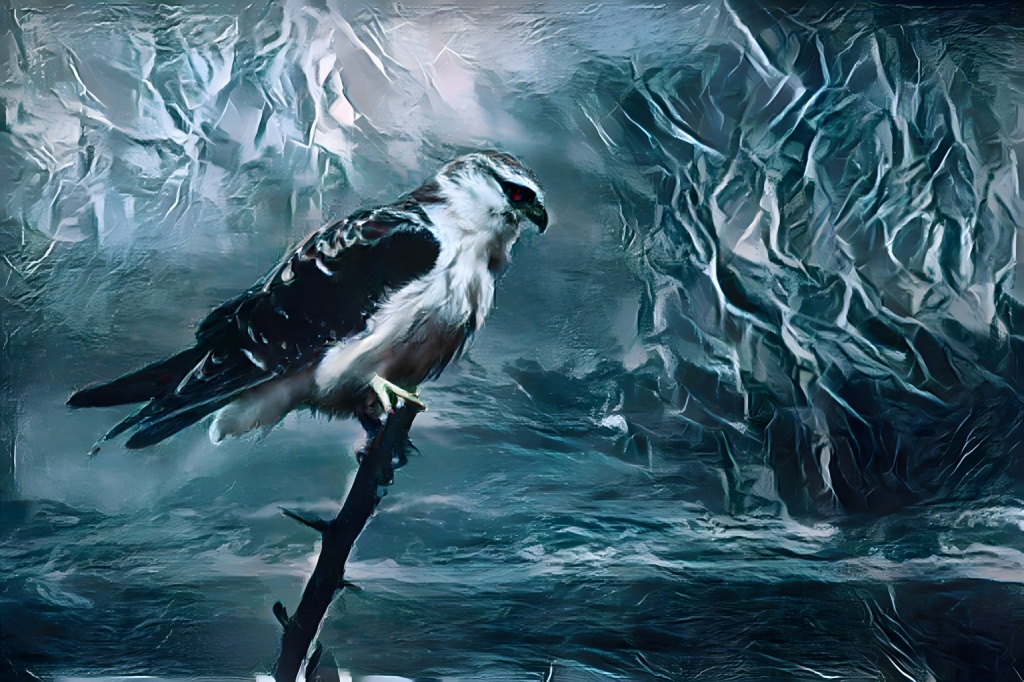
From Wichita Folklore
Once upon a time there lived a man, his wife, and his three sons. The oldest son was named Small-Hawk (Garseyasikrits); the name of the second was Striped-Tail-Hawk; and the name of the third was Tears-in-the-Eyes (Wetskidikheya), Swallow-Hawk, which name he bore because of the black streaks about his eyes. They, by themselves, lived away from the village. The oldest boy went to visit the north part of the village. He took with him his weapons – his shield, quiver with bow and arrows, and all the things that he could carry. Having traveled four long days he arrived at the edge of the village, late in the evening. He waited at a high point at the south of the village. He saw that many games were being played by the people living near the village, such as shinny, the double-ball game, etc. When he arrived he met a certain person of whom he asked where visitors were entertained. The person directed him to a certain place in the middle of the village, where a large tipi was to be seen, and there he would find accommodation, for the tipi was that of the chief. He went as directed.
When he reached the tipi he entered. He was told to go to the bed of the northwest side. When he sat down on the bed he noticed that the chief was grieving. After he had sat a while the chief rested his head and commenced to talk to the boy. He said: “There is only one bad thing about this place. You will be called early in the morning, for in the south side of the village live evil-spirited people, and the chief of these people, whose name is Shadow-of-the-Sun (Ihakaatskada), will challenge you to a foot-race. As soon as you came in, perhaps some one from his village came to spy on you.” After telling him these things the young man was given something to eat. The men in the tipi sat up until about midnight, then retired to their homes.
Early the next morning the chief of the village of the evil spirited men called the young man to a foot-race, and with a loud voice, telling him that he had heard of his arrival, and that no one ever came to the village without being challenged by him. It was the custom that after a person had been challenged by Shadow-of-the-Sun the one who was challenged would always go to the nearest flowing water and take a bath, to prepare for the race. After the boy had gone down to the water, and had taken his bath, and was ready to go and race, the chief he was visiting was ready to go with him. The people from both sides of the village crowded around the ground when the young man and the chiefs arrived. They started to the west, away from the village. As they went along the young man saw that he was to have a close race, for he knew that Shadow-of-the-Sun was a fast runner. Finally they came to a place where the race was to commence. It was the custom of the chief to accompany, as far as he could go, the visitor in the race.
Now began the race with Shadow-of-the-Sun. The boy raced with the chief until the chief gave out; then he began to race with Shadow-of-the-Sun. The boy raced with the chief until the chief gave out; then he began to race with Shadow-of-the-Sun. The boy’s custom when racing was, first to get on the right side of his opponent, then, after giving out on that side he would get on his left side, and so on. Then, should he be beaten, he was to forfeit his life. This is how Shadow-of-the-Sun overcame his victims.
They were going very fast toward the village. When they were near the village the boy gave out. Then Shadow-of-the-Sun took his club and struck him on the head. Whenever the visited chief’s visitors lost a race this chief would lost some of his people, which he forfeited to Shadow-of-the-Sun. After the boy had been clubbed the good chief would offer his life to Shadow-of-the-Sun, because so many men had lost their lives through paying him a visit. But Shadow-of-the-Sun would refuse to take his life, saying it was through his visitors that he got all his fun. The trouble was always started by the evil spirited people.
At the boy’s home, his parents were wondering what had become of him, and no one but his father knew, and he was disposed to let his boys go wherever they pleased. So at another time the second boy resolved to go and look for his brother. He told his mother to prepare some corn meal for him, that he might have it to eat on his journey to the village where his brother had gone. Four days he journeyed, and on the evening of the fourth day he arrived at the edge of the village. He sat down at the same place where his brother had sat, watching the people playing their games and amusing themselves. After the sun had gone down he went toward the village.
As he entered he saw a certain person of whom he inquired where visitors were accommodated. The person told him to go to the middle of the village, to the largest tipi, and there he would find the chief, who always received visitors. The boy went on toward the chief’s tipi. When he got there he entered. He saw a crowd of men about the chief’s place. He was told to pass on to the bed on the northwest. As he passed on his noticed some things that looked familiar to him. He recognized that they had belonged to his brother. He hung his own things in the same place. He was told that Shadow-of-the-Sun might call for him the next morning to have a foot-race with him. The men in the tipi noticed that this young man looked just like the man who had recently visited him. They thought that he was the same man, but that he was much younger. Having been told these things the boy was given something to eat. He sat up a part of the night talking with some of the men who were visiting the chief. Finally all the men went to their homes. The boy now rested, for he had come a long way.
The next morning when he woke he heard some one calling him to come to a race. He went to the flowing water, took his early morning bath and went back to the chief’s tipi. The two chiefs went with him to the race course. When they got there they started off toward the west, and went about the same distance as the boy’s brother had gone, and there they started the race. The good chief started. When he gave out the young man continued the race. He was defeated, as his brother had been, having made a great effort four different times and having failed to win the race. Now his life was taken. When the good chief had arrived he saw that the evil-spirited people had carried off some of his people. So he felt sad that the young man had lost his life through paying him a visit.
Again the parents of this boy at his home were wondering what had become of him, whether he was alive or dead. Soon after, the youngest of the three brothers decided to go out in search of his two brothers. He asked his mother to make him a pair of moccasins and prepare some corn meal to take with him. When these things were ready he set out. He journeyed four days, until he came to the village his brothers had arrived in. After arriving he sat down at the same place where his brothers had, and watched the people playing in the village. After the sun had gone down he inquired of a certain person, then went to the middle of the village, to the largest tipi. When he reached the tipi he entered. He was told to go to the bed on the northwest side. When he sat down he noticed many men gathered around the chief’s tipi. The chief commenced to tell him what he would have to do; that the next morning some one from the evil spirited men’s village would call out with a whoop for him to come to a foot-race. Now he was given something to eat. The Chief’s visitors, having sat up talking until late at night, now left, and the boy went to bed.
The next morning he heard some one shouting for him, telling him to come to the foot-race. He got up, went to the flowing water and took his early morning bath, then returned to the chief’s tipi. He then set out with the chiefs to the course. They went the same distance from the village as his brothers had gone with the chiefs. Now they started for the race. The good chief was beaten. Shadow-of-the-Sun was next to race with the boy. The boy would race a part of the way on the chief’s right side, and as soon as he saw that he was not gaining he would go on his left side, then on his right and gain on his left. Finally he was beaten by Shadow-of-the-Sun, who then killed him. The good chief’s part of the village was again in trouble. The visited chief grieved over the loss of his people, for some of his people were always killed when his visitor lost the race. Then the visited chief would beg the evil spirited chief to take his life instead, but he would say that it was better to save him, for he was always having visitors.
Now, at the boys’ home there was left the father and mother. The old man knew that something had happened to his children. He resolved to go in search of his boys. He took a small wooden bowl in which he put water. He then colored the water with white clay. He told his wife to watch the bowl during his absence, and that if anything should happen to him, and he should be killed, she would see blood in the water, which would be a sign that he was dead, but if the water remained clear it would indicate that he was still alive. After during this he had his wife make a pair of moccasins and prepare some corn meal to take along for his food. He started out. He traveled the entire day. Late in the evening he came to a fireplace. Here he knew each of his boys had stayed over night. He took his bow and arrow and shot toward the timber. He shot a deer for his food. Now he had some meat to eat. The next morning he started out again and traveled all day, until late in the evening, when he found another fireplace where each of his boys had stayed for a night’s rest. He knew his boys had stayed there over night. Again he took his bow and arrow and shot toward the timber and killed a deer. Now he had something to eat.
The next morning he started out and traveled all day until late in the evening, when he again found a fireplace where each of his boys had stopped over night. He knew his boys had stayed here over night. He took his bow and arrow and shot toward the timber and killed another deer, which he had for his meat. On the fourth day he started again, and traveled all day until he arrived at a high hill at the edge of the village. Here visitors were always expected to stop before entering the village. He noticed the young folks playing all sorts of games in the village. Later on, he went down toward the village and noticed a certain man of whom he asked were visitors were accommodated. He was told to go to the middle of the village, to the highest tipi he could see. There he went. When he found the place he entered the tipi, and was told to go to the northwest bed, which was for visitors. The chief saw that this was an old man that had come to visit him. He told him that there was one thing that always happened to his visitors; that there was a certain man, Shadow-of-the-Sun, who was always watching for his visitors, and that, perhaps, some one had already noticed his arrival, so as to carry the news back to him.
As he hung up his weapons the old man noticed the weapons and things of his boys hanging up beside his bed. Now, he began to think that there was danger in the village, and that his boys had probably been killed, but he always had considered that he had as great powers as anybody else. He was given something to eat. The rest of the night he sat up with the men talking about things of the past. After midnight all the visitors returned to their homes. The old man went to be and to sleep, for he had traveled a long way from home.
On the next morning he was called to race. He went down to the flowing water, jumped in, and when he came out of the water he was changed to a young man, and he returned to the chief’s tipi. Now the chief went with him to the race course, and the old man and the two chiefs went the same distance from the village as the boys had gone to start, but when they had reached the starting place the old man refused to start the race at this point, for he said he had never raced from a place so close to the village. It was custom to go out a distance from the village and race back. Shadow-of-the-Sun gave a whoop, and said it would be the first time he had ever had a hard race.
Again they went on, till they had doubled the distance, and the evil spirited chief said this was another starting place, but the old man refused to stop. Shadow-of-the-Sun gave another whoop, and said he was going to have a hard race. They went a distance equal to the last, where Shadow-of-the-Sun said was another starting place, but the old man refused to stop. Shadow-of-the-Sun gave a whoop and they went on, measuring off a fourth equal distance. Here they started the race.
The visited chief started the first part of the race. He fell behind. Then the old man commenced to race with Shadow-of-the-Sun. As they went along Shadow-of-the-Sun saw that he was having a pretty close race, for the old man was with him all the way down, until the old man slacked up and went on his left. Again they had another race, and they were even all the time. Now the old man went around the chief again on his right side. Then he went back to his left. At the fifth time the old man turned into a Swift-Hawk (Duseios), and lighted on the back of Shadow-of-the-Sun’s shoulder. The chief would now turn his head to see where the old man was, but he was even with him all the time, but the old man said: “Go on! Go on! You have been looking for a hard race.” He kept patting the chief on the back. Finally they saw the village. Shadow-of-the-Sun was still doing the racing, not knowing that the old man was on his shoulder. Before entering the village the old man kicked the chief on the breast, so that the old man entered the village first. Thus Shadow-of-the-Sun lost the race. The old man rested.
Shadow-of-the-Sun came up to him and begged him to spare his life. He offered the old man his powers, but the old man refused to have any such powers as he had, for he knew that he was the man that had killed off his boys. He knew that many people had lost their lives by him. Finally the good chief arrived, and he was happy, for the old man had won the race. He knew that Shadow-of-the-Sun would have to die, and with him all of his people. The old man then rested for a long time, but Shadow-of-the-Sun kept begging him to spare his life. The old man refused, and everybody thought he ought to refuse, on account of the way Shadow-of-the-Sun had treated every one. Since he could not get anything out of the old man he went up into the sky, saying to the old man: “If you are going to kill me I shall go somewhere else, where I shall be safe.” As he started to go up in the sky, the people thought the old man should hasten to kill Shadow-of-the-Sun. Finally, the old man got up on his feet, and asked the people where Shadow-of-the-Sun stayed when he went up in the sky. The place was shown him wherein he stood. Now his bow and arrows were brought to him. He shot up toward the sky and told the people to watch for results. So they watched for Shadow-of-the-Sun to come down. Finally they saw something coming down in the shape of a shadow. It came down and fell to the ground. The old man had shot him behind.
Now, the old man commanded all the good chief’s people to bring all the wood they could find, and all the human bones they could find, skulls and small bones. When they had done this they placed the body of Shadow-of-the-Sun on the pile of wood with all the other bones. When they had placed all the bones upon the wood they started the fire. When the wood began to burn and to settle down, they stirred it up to make it burn better. Now, they called those who had been killed by Shadow-of-the-Sun, and as they called them they jumped out of the fire, one after another. When the fire went down, there was a lot of men. After this was done the old man returned to the chief’s place, having destroyed the evil spirited people.
On the next day the people in the village were called together at the chief’s place. When they had gathered around his place they asked the chief why he had called them there. The old chief told of the good things the old man had done for them; what hard times they had had while living with the evil spirited people, and said they had better not exist any longer as human beings, for they had hard enough times; that by and by, by turning to other beings they might enjoy better times; that those who wished to live as human beings could do so. After this was announced the people began to return to their places, some going out and flying away from the village, some going into the timber and some into the prairies. The good chief became an Eagle (Kos).
After the people had moved away the old father took his boys back home. While they were going the woman had known that the old man was still alive, for she had seen no sign of any blood, the sign for death, in the bowl of white mixture. So they lived for a good while. The old man thought perhaps some other evil things might befall him, the same as had happened to his boys. He thought they had better become something else, so they turned into Swift-Hawks (Gusseios).
Source:
The Mythology of the Wichita, George A. Dorsey, 1904



 Kotharian Lightning