
From Pawnee Folklore
(Told by Mouth-Waving-in-Water, Kitkehahki. The ceremony described in this tale is sometimes known as the Elk medicine, because of the great feather appendages placed on the bird which stand son the altar which bear a superficial resemblance to the antlers of the elk. The ceremony is no longer given by the Pawnee, as none of the medicine-men who belonged to this society are now living.)
A long time ago when the Kitkehahki lived upon the Republican River, near Swimming-Mound, there were two people who were half women and half men. These two people once took up their hoes and sacks made of buffalo hide and went to a place where there had been artichokes. They found none and so they went farther down the river until they came to a bank where there were many artichokes. One of the hermaphrodites straightened up from digging artichokes and saw a man sitting near. He showed no sign of fear, but went on digging. As he dug he whispered to his companion: “There is a man sitting near us. I will continue to dig around, and suddenly I will straighten up, walk around the bank, and his him upon the back of his head with my hoe; then we will kill him.” His companion said: “Go at once and do as you have said. I will keep on digging.” The one who first spoke straightened up and walked around as though he was looking for artichokes. When he came around behind the stranger he took his hoe and struck him behind the head, and the man fell. Then he called for his companion and they killed him. They took up their sacks of artichokes and ran home.
When they reached the village they told the people that they had killed a strange man and that the man lay along the bank where they had dug artichokes. The men did not believe them, but notwithstanding they went to the place and there they found the strange man. The man had on a robe with the hair side out. His face was painted with blue mud and red streaks of paint. His hair was roached and covered with soft downy feathers, and a long downy feather struck through his scalplock. His head was covered with blood, so that every many who came to the place though the man had been scalped and would not touch the head. The people removed his robe and saw around his shoulders a black hair lariat rope. Some people said, “He must have been a warrior.” Others said, “No, he is a wonderful man.” They all went home and had war dances and in the night the women gave scalp dances.
Two or three days after the man had been killed, an old man took the hand of his grandson, who was four or five years old, and led him to the place where the dead man lay. When they got there the man gave the boy a stick and said, “Now, grandchild, strike the enemy and count coup on him.” The boy struck the man, and then he saw the long downy feather upon the dead man’s head.” The old man took his knife and cut the scalp-lock where the feather was stuck in, and then gave the stick to the boy to carry to the village. When they got to their lodge the boy placed in front of it the pole that had the scalp and the downy feather attached to it.
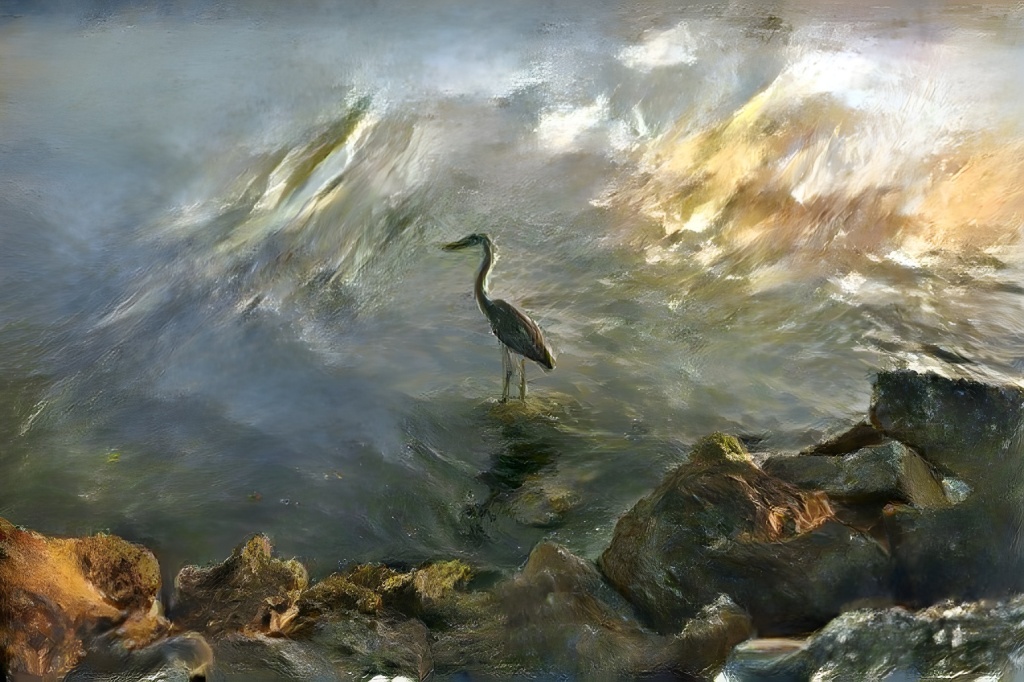
The next night the boy in a dream saw the man who was daubed with blue mud. The downy feather was in his scalp-lock. The man said: “My son, I came to your people to talk to them, and they killed me. I am not a man; I am Thunder-Bird, the bird that flies away up in the heavens. Look at me.” The boy looked, and there just where the man had stood was standing a tall bird. This bird had long legs and its bill was very long. It was like a crane. It opened its wings and the boy saw upon its breast the downy feather that the man had had in his scalp-lock.
The bird turned back into a man. Then the man told the boy that he was going to tell him something wonderful; that he must keep the downy feather, for as long as he kept it his spirit would be with him. The boy awoke and he lay awake for a long time, thinking of what he had dreamed. In the morning he went out and there upon the lodge was his stick with the scalp and feather. After a time the boy threw away the scalp, but the feather he kept, for he knew that it was not that of an eagle but of a crane. As he grew up he carried the feather with him.
One time while on a buffalo hunt, the boy hung the feather near his tipi. He dreamed again of seeing the man and he said: “My son, let us go through thick timber near here; I want to talk to you. Take me to the timber. Place the feather upon some limb and go on through the timber.” The boy awoke, and did not wait to eat, but went out of the tipi, took down the feather, and went into the timber. He left the feather as he was told to do in his dream. He went on into the timber, and as he came to a pond he saw a man coming through the reeds and brush, who every once in a while turned into a crane, then back into a man. The boy said, “This is wonderful! I wonder what it is.” He stopped and looked and saw that it was the man he had seen in his dream.
This mysterious being came close to the boy and said, “My son, we will now go into the timber.” They went into the timber to a place that seemed to have been cleared for a purpose. At the west was the altar. There stood a large bird, with downy feathers on the top of its head. The bird was dead. Int he east was an unknown animal. Another bird was in the south, known as Bird-That-Never-Moves. The boy was seated at the west behind the bird. The man then began to teach the boy a ceremony, and then he taught his some sleight-of-hand tricks. For several days they sat together, and the mysterious man told the boy that the people had gone on; that they had given him up as dead. Then he told him to go on home.
The boy started for home and carried with him the things that were given him by the mysterious man. The boy did not seem to get tired, but ran faster every day. One night he saw the camp, and so he went on, walking very slowly. He heard a man crying upon a high hill, and went to the hill and saw that the man was his father. He slowed his steps until he was close, and then he said, “Father, stop crying; I am here.” His father looked and saw his son standing before him. He tried to put his arms around the boy, but the boy told his father not to touch him for a while. They went on down to the camp, and there close to the village was his mother, crying. The father told the boy to wait while he went and told his wife that her son had come back. The man went up to his wife and told her to stop crying, that the boy had come back. She stopped crying and they went to the boy. The boy told his mother that she must not touch him. They went to their tipi, and the boy told his parents not to let other people know he had come back. The next day the people saw the boy with his parents and wondered about him. People from the next camp came into their tipi and tried to find out where he had been, but the boy would say nothing. When the people found buffalo, the boy told his father to kill many, so that they could have plenty of the dried meat. The man knew that the boy wanted dried meat to take to the medicine-man’s lodge. He told his relatives what the boy wanted, and they killed many buffalo and dried the meat. They suspected that in time the boy would work wonders. When the people had killed many buffalo and all their families had plenty of fried meat, they turned back to their village.
After they had arrived and the people had settled down, the medicine-men began to prepare for their wonderful ceremonies. When they were all ready the boy unwrapped his little bundle and said: “Father, I must go into the medicine-lodge. I want to perform sleight-of-hand tricks.” The father went out and told his relatives what the boy had said. They came into the boy’s lodge and brought many presents that were to be presented to the medicine-men. The boy arose with his buffalo robe wrapped around him and his face daubed with blue mud. He put his little bundle upon his left arm and started fo the medicine-lodge. His relatives followed him with goods, buffalo robes, blankets, and dried buffalo meat. The boy went into the lodge and stood in the center, while the man who carried the goods and meat stopped. The young man spoke to the medicine-men and said: “Medicine-men, I am a young man. I have come into your lodge that you may give me a seat among you. I want to perform, and have brought my friends with me who have with them goods and meat.” All of the medicine-men said, “Nawa.” The leading medicine-man gave him a seat in the south. The goods were then placed near the altar, and the meat was placed near the entrance. The boy did many wonderful tricks, so that the people wondered, for his people were not medicine-men.
Towards the last of the ceremony the boy turned the downy feather into a large thunder-bird. He also made a skull, which was placed in the east, while the thunder-bird stood in the west. He then made a crane, a bird that stands by the ponds and lakes and looks at the sun. This was placed at the south with three things in the lodge that the boy had made. At last he made them disappear. Then he stood up before all of the medicine-men and said: “Medicine-men, my tricks are ended. You have seen me perform. I have a ceremony that I want to perform, but I want a lodge first. I want three things to be placed there when the lodge is done – the skull in the east on the north of the entrance, a sun crane in the south, and a large crane in the west.” The medicine-men were glad to hear what the boy said.
After the ceremony the boy’s relatives went to work and gathered poles and forks, and the lodge was put up. A buffalo skull was brought out and placed at the northeast entrance. In the south was placed a sun crane; and the young man himself placed the large crane at the west. This crane had soft downy feathers upon the top of its head, but it also had feathers standing on its head like deer horns. The people called this particular ceremony the “Elk dance.” They saw many wonderful things performed by the boy. After the boy had finished his tricks the ceremony was ended. He did not allow any others to perform any sleight-of-hand. The lodge was never inhabited until the boy died. Then the birds and skull were removed.
Source:
The Pawnee Mythology: Part 1, George A. Dorsey, 1906



 Kotharian Lightning