
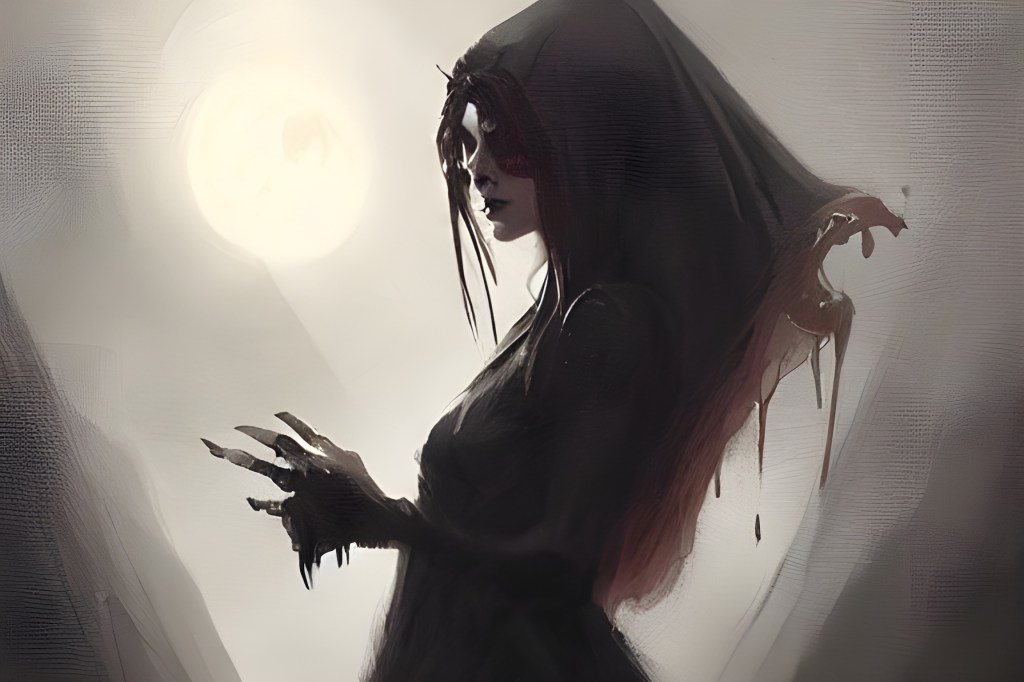
From Basque Folklore
[Introductory Note: In the territory which stands between the towns of Zuggaramurdi and Echalar, a mountainous tract covered with woods, crossed by rivulets, and divided by narrow and very deep valleys, will be found, isolated and darksome, the mountain of Aquelarre, overgrown with brambles and thorns, and surrounded by rocks and waterfalls.
…
It is said that “Ariel,” the titular genius of the Biscayans, one day stretched out his powerful arm and wrenched from its base this singular mountain, placing it at a distance from its companions, so that they should not become contaminated by any contact with this accursed mountain.]
Izar and Lanoa were two orphan children; the first was seven years of age and the latter nine. These poor children, true wandering bards, frequented the mountains, earning a livelihood by singing ballads and nations airs in sweet-infantile voices, in return for a bed of straw and a cupful of meal. Throughout the district these children were known and loved on account of their sad state, as well as for their graceful forms and winning ways.
There was, however, a difference between the two. Izar, the younger brother, was fair as jasper; his long hair fell in curls, pale as the stems of the maize, down his shoulders and back; his eyes were of the purest sky-white, while from them shot glances at once sweet and suppliant of irresistible force; is lips were red as the flower of the wild pomegranate, around which hovered a smile as gentle as the light puff of an expiring breeze, and, on contracting them, two dimples appeared in his rosy cheeks. Izar was the more patient of the brothers, the meeker, and the more beautiful; his voice had a purer tone, and for that reason was the favourite of the inhabitants of the mountains.
Lanoa was as handsome of his brother, but Nature had dowered him with a different style of beauty. His figure was more lithe, and his limbs of stronger make; the looks he cast out of his black eyes were haughty – at times even arrogant and full of daring. The way he curled his upper lip revealed a passionate, proud character; his hair was black with the bluish shade seen on the feathers of the raven; his long eye-lashes somewhat softened the fire of his eagle eye. Nevertheless, Lanoa was a good lad, and loved his younger brother, notwithstanding that at times he would treat him roughly.
It was a sad, cloudy day in November that these two were walking towards Aranaz, crossing with difficulty the mountains, enveloped in a fog, and covered with snow.
Izar grew very tired climbing the heights, and the poor child had not the courage to ask his brother to help him up. Lanoa, on his part, was not disposed to offer any help, however much in his heart he desired Izar to ask assistance, which he could then give without loss to his pride.
“Poor fellow, he is tired,” he would say to himself; “but he does not wish to humble himself to ask me to help him up. If he expects me to offer it…”
Musing in this way, he increased his speed, thus lengthening the distance which separated him from Izar. The latter endeavoured to reach him by taking great strides to do so; but he could barely keep on his delicate feet, until by a great effort he sought to keep within hearing of his voice.
All at once a gust of wind brought down large masses of wet heavy snow into the defile through which walked the brothers, and Lanoa was compelled to suspend the rapid speed he had sustained, and thus enabled Izar in a short time to come up to him.
“What shall we do?” he timidly asked.
“Do what you please, lazy boy,” Lanoa replied, roughly; “for my part I shall continue my walk as soon as the dog clears away a little.”
“Very well, my brother,” replied Izar, gently; “but meanwhile sit down at my feet and I will cover you with my capusay, for you are in such a heat with your efforts.”
“Women and lazy children like yourself require to be sheltered from the wind; as for me, I am a man, and I am not frightened with the cold.”
Saying this, he uncovered his head, and exposed his wavy hair to the freezing gusts of the north wind.
“What are you doing, my brother?” cried Izar, rising from the broken rock upon which he had sat, and covering with his cap the head of Lanoa. “Oh, please let me cover you from the cold,” he continued. “I well know that you are stronger than I am, and for that very reason should you take care of yourself, so that you may help me that am so weak.”
“Be off!” cried Lanoa, pushing his brother away, who slipped and fell to the ground. And with bare head he resolutely commenced anew his march across the deep, cold snow.
Izar did not reply a word, nor did he even utter a cry of pain as his head was wounded by falling upon a stone. He rose up to renew his good work of abnegation and charity; and then he noticed with deep sorrow that his brother had disappeared from view. He ran in all directions, calling him with loud cries; but the fog was so dense that he was unable to find him. Then, half dead with fatigue, in despair, and shivering with the cold, the poor child looked around him, and perceived through the dog that at a short distance from him stood an immense tree, and that its trunk was hollow.
Night was rapidly closing in, covering with its dark mantle these solitary places. The dog grew more heavy and damp; and instead of dispersing, remained stationary, clinging to the branches of the trees, and descending like the waters of a stream into the marshes and valleys.
From the hollow of the tree in which our young hero had taken shelter could be seen an extensive tract of land covered with a white mist; in places it remained still like the waters of a lake; in others it rose and fell like the sea waves that break on the rocky promontories.
In that veritable ocean of fog could be perceived here and there black points like so many dark islands, which no doubt were the peaked heights of that range of mountains.
The silence was deep and solemn. The night was fast increasing in darkness.
In the distance, and above the fog, could be seen a yellow line of light presaging the rising of the moon, which at that time of the year was of opaque brilliancy, and more so seen in that atmosphere full of fog and mist.
Izar understood, from what he could descry, that he was standing on the top of a mountain; so quitting his shelter he reconnoitred the surroundings.
The protecting tree stood in the centre of a small plain, surrounded on all sides by thick shrubs and brushwood, so tangled and close that he could discover no opening or path by which he could possibly descend from its height down to the base.
How did that lost child find his way into such a spot?
He could not tell.
Feeling hungry and thirsty, and, moreover, finding himself in a spot which was totally unknown to him, he began to cry from anguish and fear; but at length, convinced that all this was unavailing, he returned to the work-eaten hollow of that tree, fully determined to pass the night in its hospitable shelter. He fervently commended his soul to God; he thought in sadness of his mother, who had loved him so tenderly, and he prayed to the All-power to deliver his elder brother of whatever danger he might find himself in. Having done this, he sat down, and wrapping himself as comfortably as he could in his poor coat, he huddled up in his hiding-place, and the sleep of innocence very soon closed his eyelids.
At the moment when he placed his soul and body trustingly in the safe keeping of a God full of goodness, the heavens were rent open and an angel beautiful as are all the angels, descending in a rapid flight and alighted on the branches of the tree. Then he extended his white wings, and with loving solicitude watched the sleep of the innocent child.
For a length of time did Izar sleep calmly and sweetly under the loving care of the angel. At length he was suddenly aroused by a singular and incessant uproar which seemed to fill space. He cautiously peeped out of the hollow trunk of the tree, and an incomprehensible spectacle presented itself to his view. The moon was shining on the plain, and, casting a pale reflection over space, imparted a weird appearance and fantastic form to all objects.
From the point in the heavens occupied by the planet of night, and extending along the vast line of the horizon, the tints were becoming more and more sombre, passing from light grey to the deepest black. Out of the four cardinal points of the horizon rose up four extremely long lines of fantastic shadows, from which issued terrible unearthly cries, and these shadows with astounding rapidity all travelled to meet in a concentric point. This point was actually the very plain which we have just described. To depict in words the strange cavalcade upon which these fantastic shadows were mounted, would be a work superior to human ability. The one would press between its fleshless knees the skeleton of a mammoth of huge proportions; the other rode a horrible monstrous owl; others, again, divided the air riding on broomsticks; while some were perched on the backs of serpents bearing enormous wings, long tails, and with brilliant eyes.
All these shadows joined one another until the four lines formed an immeasurable chain. And thus they whirled until they gathered together at a distance of about a hundred feet from the ground; then they greeted one another with frenzied cries, ringing shrieks of laughter, deafening shouts, and hideous yells. After this they began a circular flight in a confused disorder, and little by little they began to descend to the ground.
The astonishment and terror of Izar increased when he perceived that all these shadows were so many forms of decrepit old women. Their faces, blackened and wrinkled, were repulsive, while their hideous bodies inspired disgust, their short matted hair and fleshless limbs were truly fearful to see. The terror which all this scene inspired in the heart of Izar, who was an unwilling witness, increased to a terrible degree when he noticed that all these women were preparing to execute some unearthly dance, taking one another’s hands, and forming a large circle around the hollow tree in which he had taken refuge. And, what was more strange still to him, was the fact that this immense crowd fitted perfectly in the plain without requiring to widen its circuit of to diminish the size of the figures. As Izar had feared, it was not long before the dance commenced. At first this dance was of slow movements, and all kept time stepping together, now on one foot, now on the other.
Little by little the leaps became more violent, the turns more rapid, until at length this nameless dance turned into a sort of whirlwind, increasing in speed, until it caused dizziness to attempt to follow the movements.
Jumps, cries, terrible contortions, turns – all were supernatural, all horrible to the sight, all was a confused, incomprehensible jargon to the ear.
Poor Izar could no longer support that spectacle, and he fell fainting to the ground. When he recovered consciousness the moon had disappeared. The night was pitch dark, a sepulchral silence reigned throughout the plain. He looked out again from his hiding-place, judging that these fiendish women who had so alarmed him must have disappeared; but he perceived in terror that they still occupied the same spot as before, but in more strange attitudes, if possible. They were all ranged in a circle, huddled up close together, around a throne of ebony, upon which was seen calmly sitting an enormous he-goat From this throne gleamed a few rays of yellow light, the only light which illumined the scene. The old women were successively approaching the throne, and as they did so they each respectfully kissed the hair cloven foot of the goat. Then, after this long ceremony was concluded, the goat shook his head, and one by one each of these creatures commenced to relate what she had done.
Izar, horrified at being compelled to listen to their hideous narratives of premeditated deaths, mutilation of babes, profanation of cemeteries, and other crimes, was once more about to faint away with horror, when he heard a sweet voice which seemed to come from among the branches of the tree, and which pronounced his name. Astonished at this, he arose, and raising his eyes to the direction from whence came the voice, he saw among the branches a young man of celestial beauty, who was gazing upon Izar with tender, loving looks.
“Listen, and do not fear,” the young man said, “for I am here to guard and watch over you.”
Then Izar bent his ear to listen to what was said by the women, and he heard the following conversation.
“All my sisters,” one of the witches was saying in a hissing voice, “have obeyed your commands. There was not a single one of them who did not send you, oh sovereign master, some victims, but I challenge any of them to do what I can.”
“Speak, my daughter,” murmured the goat: “I well know that you are one of my most devoted worshippers.”
“You know, my lord,” continued the witch, “that the grand reigning Duke of F and his lady are both zealous Christians, faithful and true, and you are also aware that they have a daughter lovely as the son, whom they idolize. What a joy to me to make this beautiful creature die by inches; to wither that flower in all its youth and freshness, and to sow despair in the hearts of her parents, and so deliver them up to your powerful temptations! Would it not be a masterly stroke to kill them also after tow or three months of cruel sufferings? What would it cost you, my lord, to impel them to destroy their own life?”
A horrible grimace, which no doubt was intended to be a smile of satisfaction, overspread the countenance of the goat, and his eyes darted gleams of fire impossible to describe.
“Should you do so,” replied the author of evil, “you will become the best beloved of my daughters.”
“Well, then, give me my reward, my lord. It is now a week since the princess began to suffer, and no one is able to discover the cause of her complaint, and still less can they find the remedies to effect her cure.”
“Are you not afraid that some one will discover it?”
“No, my lord, because the spell which binds her consists in the existence of an enormous toad which lies concealed under a broken statue, which had been abandoned and cast away in a corner of the garden of the ducal residence. So long as this toad is not destroyed, the sickness will follow its course and the princess will die.”
“This that you tell me pleases me greatly, Bazzioti, and I desire to have frequent and exact accounts given me of what happens. I give you my thanks for what you do,” continued the genius of evil, “and I summon you to come next Saturday.”
Saying this, the evil one shook his head; a terrible thunderclap was heard, and the throne disappeared along with he who sat upon it. All things became enveloped in a complete obscurity.
Soon after this Izar heard the noise of the witches rising up and taking to flight on the winds, and by the now dim light of the moon he descried the fantastic line of shadows that in silence were departing towards the points of the horizon from whence they came, and slowly disappeared among the mass of black clouds.
Izar then looked up to the branches of the tree and saw the points of the horizon from whence they came, and slowly disappeared among the mass of black clouds.
Izar then looked up to the branches of the tree and saw there the young man who had bidden him have no fear. This angelic youth then said to him, “Fulfil your mission as I have fulfilled mine!” Then, spreading his wings, he rose to the sky, casting behind him sparks of brilliant light, and leaving a celestial fragrance which comforted the child’s benumbed limbs and instilled warmth and courage into his heart.
Source:
Legends and Popular Tales of the Basque People, Mariana Monteiro, 1887



 Kotharian Lightning