
From Pawnee Folklore
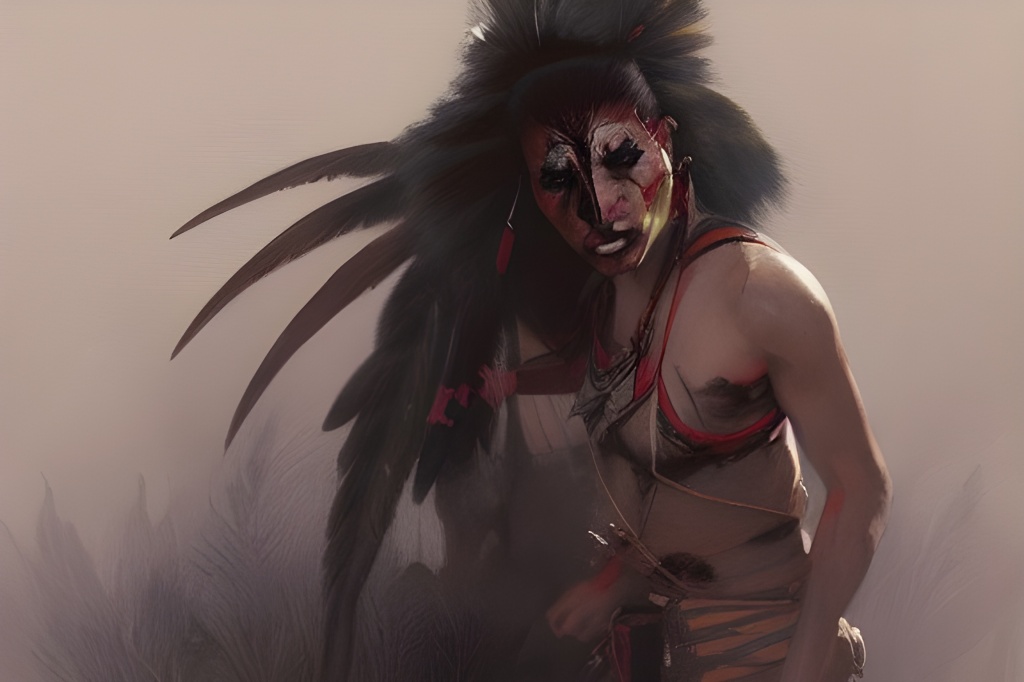
Two young brothers lived in a village. The older wore yellow paint all the time, and always carried a cougar quiver with black arrows in it and a dark red bow. The younger boy was more quiet but more wonderful than the older brother. Not far from their village was another village and many young men went there and never returned. It had been rumored that a gambler lived in that village and that all the men who had disappeared had played with him and had lost their lives by gambling them away after they had lost everything else; that this man’s wife was Spider-Woman, and that she liked to eat people.
One day the older brother went off; he traveled east for many days. At last he came to a hill, and on one side of the hill there was a steep bank. Here the young man sat, looking at the strange village. A young man, errand man for the gambler, saw him. This errand man made it his business to watch, and if any strangers came to the village reported to the gambler, who invited the stranger to eat with him. The errand man went and told the gambler that he had seen a strange young man and that he was fine-looking. The gambler sent the boy out to see where the strange would stop. The young man on the hill arose and went to the village, and was invited to one of the lodges. The people told this young man that the gambler would be good to him and would invite him to eat with him, but they told him not to go.
While he was eating the errand man came and said: “I invite you to go to the tipi of the gambler, who wants to talk with you.” The boy arose and went, thinking he had power to destroy the gambler and win from him. The gambler was glad to see the boy and gave him a seat near him, saying: “You must have traveled far. I shall give you the best I have for your dinner.” The old woman whispered to the sky and said: “I shall have his head in the center, and I shall move other heads down.” A wooden bowl was placed in front of the boy, filled with what looked like black corn. The boy ate, and as he ate, his power went from him, for he was eating human eyes. After eating, the man said: “Well, my son, may we play a little with the sticks?” The boy said: “I am tired; I will play with you to-morrow.”
The next day preparations were made fro the game. They went to the place and there they played. The gambler had many people on his side and the boy had many on his side. The boy lost everything he had. Then the gambler said: “I want you to put up yourself, and if I beat you I shall kill you; if you beat me you will kill me.” The boy consented and they played. The boy lost. The old witch kept dancing around, while the game was going on, and yelling: “What a fine head he has! He shall be mine!” As the boy lost, the people ran away. The young man was taken to a place where the people were killed, and his head was chopped off. The head was taken into the lodge and the boy left outside.
After a long while the people began to wonder why the boy did not appear at his home, and they asked for him through the village, but could not get trace of him. The younger brother sent birds out to see where the boy had gone. The Raven came back to him and said: “Your brother is dead. His head is at the gambler’s lodge.” The boy said: “I will at once start out to hunt my brother.” The boy started, and as he went he brought all of his powers into play so that he could see well. He followed the steps of his brother, and where his brother had slept there he slept.
After a while he came to the bank where his brother had sat, and as he sat down he saw the errand man watching him. The boy said to himself: “I know you; I will fix you.” He arose and went to the tipi where his brother had stayed. He was welcomed, for he looked so much like the other boy. The people told him that he would surely be invited to the gambler’s, and they said: “He will offer you something to eat, and it will be human eyes. Do not eat them; tell him that you ate plentifully and do not care to eat any more, but if he does not object you would like to take the food to your stopping-place. If you bring the good, we will take it out and throw it away.” The errand man came around and said: “The gambler wishes you to eat with him.” The boy said, “Very well; I will go.” The boy went, and as he entered the lodge the gambler told him to take a seat by him. They offered him the bowl of eyes, but he would not eat them. He said that he had eaten plenty. The young man was asked if he could play the game of sticks. He said: “Yes; I will play with you, but as I am tired I will put it off until the fifth day.” “Very well,” said the gambler. The boy told them that he wanted to take the bowl to his stopping-place, so that when he should become hungry he could eat it.
The next two days the boy spent around the tipi, for he was thinking of his brother who had been killed. On the third day he was invited again. The people with whom he stopped said: “This time he will try to feed you dried human ears. He will try to make you believe that they are pieces of squash.” The boy went to the gambler’s lodge. They were very kind to him and offered him the bowl of squash. The boy said that he was sorry, but he had eaten so much that he could not eat any more; but he was very fond of squash and wished that he could take it to his stopping-place. He arose and took the bowl of human ears with him. The people received the bowl and threw the contents away. The bowl was taken back to the gambler’s lodge.
The fourth day came and the boy asked the man who was in the lodge if he could tell him of a place where there were buffalo wallows and bones. “Yes,” said the man; “I can show you. You see yonder hill-side? There is where the bones are. There the buffalo have been slaughtered by people who did not take the bones home. They took only the meat an left most of the buffalo on the prairie.” On the fourth night the boy went to the place, and there were many skeletons of buffalo. He began to cry. He went from one to another set of bones and continued to cry. After a while he came to a set of bones where there was a bull skull. Its horns were not smooth and were loose, and it seemed very old. The boy stood at the head and cried. Then he sang a song:
My father, my father,
The reason I am crying,
The gambler has requested
That I play sticks with him,
And I have no sticks.
Give me sticks, father.
Give me sticks, mother.
The old bull said: “My grandchild, I am very sorry for you and we will try to help you. These are my children lying around here. We have made up our minds to help you. I myself can not do it, for I am old and can not stand the game, but there are some young bulls who will help you, for we want to get rid of the gambler. Now go. The spirits of the buffalo have all returned.” The boy continued to go around from one set of bones to another, crying as he went. At last he came to the skull of a bull whose horns were sharp and turned in at the tops. Here he stopped and cried and cried. At last the skull spoke and said: “My son, what are you crying for?” The boy then sang, saying in his song: “I am crying, for I am about to play sticks with the gambler, and I have no sticks. Pity me! Help me! Give me sticks and a ring, so that I can beat this gambler. We are to put up our lives.” The young bull said: “Very well, my son. We shall help you. I am the strongest bull. I can fight a long time and never get tired. Now watch.” The boy watched, and buffalo came from different directions. They made a bellowing noise and all ran and stopped where these bones were; then they stamped and fought. At last these buffalo dispersed and he heard one say: “There he goes!” The boy looked and the buffalo disappeared, and there where the buffalo were he saw a stick. A voice came from the stick and said: “I will be one to beat the gambler. Take me and see that the point is burnt black.”
Now the boy went farther, and he came to a skull of a young bull, whose horns were yet straight. The boy then stood and cried. The head moved and said: “My son, I will help you. I am young and easily give out. I will be the white stick, and the man shall choose me and use me. I will be the fine-looking stick; also very light. I will not try to go after the ring, for I never had intercourse with any female. Now watch and I shall move.” Something moved. The buffalo had turned into a playing stick, without ceremony, for it was to be the gambler’s stick. The boy picked up the stick and went to another set of bones.
Again he cried, and some one spoke to him and said: “Go over yonder, for there are bones of a young woman buffalo who had just learned to be after buffalo bulls. She can run and beat all the other buffalo women.” The boy went to the skeleton of a young female calf, and cried and cried. He did not hear anything, so he threw the sticks in front of the skeleton and then a female voice said: “I will help you, but the bulls must come and turn me into a ring.” The boy cried the harder and sang: “Help me, my grandfathers. Give me a ring to go with these sticks, so that I can beat the bad man who is killing people and eating them.” All at once there was a rush of buffalo bulls where the boy stood. The buffalo stamped and bellowed, some saying: “I have her; I ran my stick into her; I caught her with my legs.” Others said something else. The female buffalo spoke and said: “This is the way I shall run to your stick, my boy.” Now the female buffalo rand and turned into a ring. The ring rolled and fell on the black stick and was on the top piece of the stick. “Nawa,” said the boy. (I thank you, my grandfathers.) Then the old bull said: “My boy, you can not see us, but our spirits will be with you. You see many strings on the sticks. They are many buffalo. Now take the sticks, put the ring on the black stick, and hang them up in the lodge on the north side. Play first with the gambler’s sticks. He shall just about beat you, but just as he throws his last stick you shall shoot his stick with your stick, and his stick shall break. Then you shall use these sticks that we give you. Now go!”
The boy went home and put the sticks upon the side of the lodge where he was told to hang them up. The next morning was the time to play. The boy told the people to stay outside and sweep out the lodge clean, and that no one should remain inside. The people went out and the lodge was swept and the mats placed in order. Then the people started out to the place where the man and boy were to play the sticks. The gambler was already out with his sticks. The people divided and some were on one side and some on the other. The witch woman was at one end and already had a quirt made of bone, for she intended to hit the boy on the head with it and kill him. Then the boy arose and sang:
Yonder, from yonder I came,
You challenged me to play
From yonder I came,
Now rise, stand, play,
For you are the gambler.
From yonder I came.
They played first for the things they wore. They picked up the sticks and ran. The gambler threw the ring. The boy at once commenced to lose. The old woman danced, made fun of the boy, and said that his head was what she was after. The boy lost all his clothing. Then the man said, “Suppose we bet our lives now?” The boy said, “All right.” They played and played, the gambler catching the ring every time, and the boy losing. The man had to hook the ring once more, and the boy’s life would be won. As they started, the man threw the ring, then the stick, and the boy took good aim at the man’s stick and he hit it and broke it. The gambler wanted to put off the game, but the boy said: “No, I am not tired. I will either lose or win. Bring another set of your sticks.” The man said he had none. The boy said: “I have a set. You make one ring and I am beaten. I do not want to go home. If my life is to go I am willing that I lose it at once.” The man then sent his errand man, who was no other than Coyote (the Trickster). He went to the lodge, and as he entered he heard many buffalo, so that he got scared and came out. He came to the ground and said: “There are no sticks in the lodge.” He was sent again, and again the buffalo scared him. He ran away again and said: “There are no sticks there.” Again he was sent. He walked right in, and as he went towards the sticks, the buffalo made a big noise, and Coyote ran and defecated in the lodge. He went to the grounds and said: “I do not find any sticks there.” The boy then sent his errand boy, who was no other than Black-Bird. He went out, and although the buffalo made a noise, he flew upon their backs and get the sticks. As soon as he got the sticks the noise ceased. He saw much of Coyote’s dirt on the ground of the lodge. He took the sticks to the ground.
The boy gave the gambler his choice of sticks. The gambler chose the white stick. The boy knew that he would. Before commencing the game anew, the boy said: “Now let us bet all our friends, too. If I win, I have a right to kill all your people; if you beat me then you may kill all my people.” “All right,” said the gambler. Away they went with the sticks, the gambler throwing the ring. They both threw the sticks and the gambler hooked the ring, but the ring came off and went to the burnt stick and sat on top. The boy then took charge of the ring. The boy threw the ring gently, then threw his stick. The ring and stick did the work. The gambler had no chance. At last the boy won all of his property and everything that he had, so that he put his wife and all of his children up. The boy won them, and then the gambler put up his own life. When he saw that he was going to be beaten, he fell down on the ground and said: “My leg is broken, and I can not go.”
Then the boy stopped and sang:
Come now, stand up,
You are the gambler,
Come now, stand up.
Why do you sit down?
You are the gambler,
Come now, stand up.
Now arise, stand up.
Now arise, stand up.
You are the gambler,
You are the gambler,
Now arise, stand up.
When the boy sang about the man being a gambler, he arose and said: “It is true; I am a gambler.” Then he arose and again they threw the sticks. When they threw their sticks for the last time, the sticks and the ring turned into buffalo and ran away. As soon as the gambler was beaten the people who were on the boy’s side took up their sticks and beat the gambler and his wife and children and the witch and Coyote until they were all dead. They all rejoiced because the wicked people were killed and could no longer put fine young men to death.
Source:
The Pawnee Mythology: Part 1, George A. Dorsey, 1906



 Kotharian Lightning