
From the Folklore of Uttarakhand
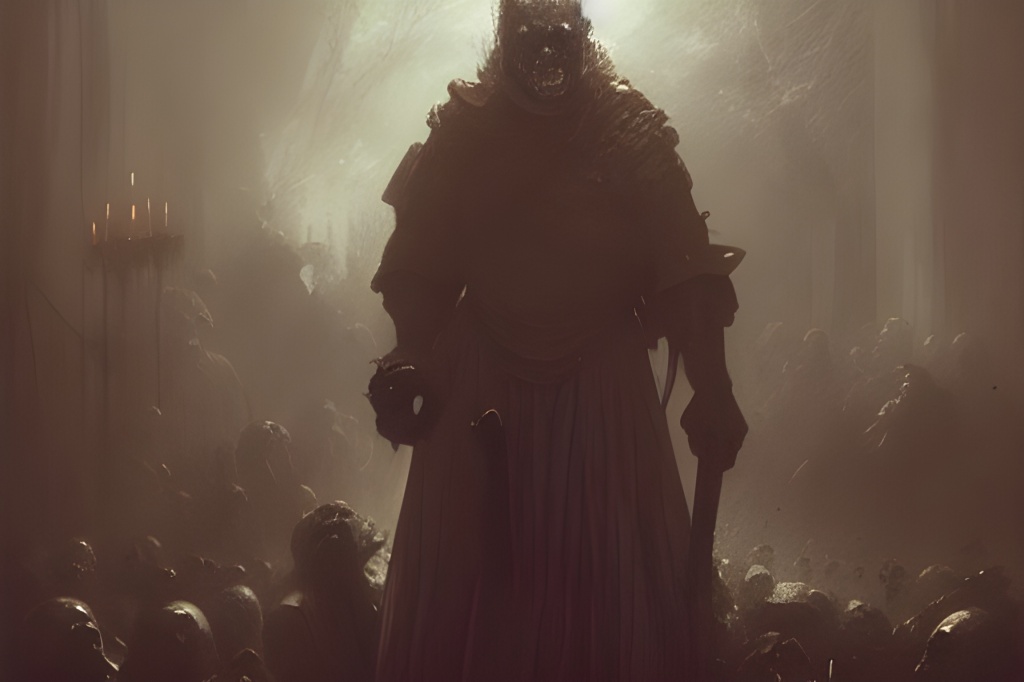
There lived once a rakshasa (evil spirit/giant) in an island beyond the seven oceans. The rakshasa had a beautiful daughter. A certain prince being enamoured of her set out to obtain her. The journey to that place took him six months. On his arrival there he found a large and beautiful city full of gold, silver and precious stones, but devoid of human beings, the inhabitants of this city having all been devoured by the fiend. He saw the damsel sitting near a window of a big palace.
No sooner did the girl see the prince than she advised him to go away at once, and said, “Oh human being, what evil fortune brought you here, only to be devoured by my father who has just gone far off to hunt for human beings and other animals? How will he spare you, who have come to this barren island and fallen into his clutches? He can scent human beings, and walks hundreds of miles in a few strides. So you had better run away with as swift speed as you possibly can.” The prince said, “Oh excellent lady, I have come here only for your sake, after undergoing a great many hardships and troubles. I cannot leave you now, whether you kill me yourself or cause me to be eaten by your father.”
The lady thus touched by the speech of the prince shewed him some gourds provided by the rakshasa for the protection and defence of his own life. The first contained mist, the second thorns, the third water, the fourth mountains to be placed before one’s adversary, and the iron cage in which a parrot was kept, which contained the soul of the rakshasa (i.e. the death and troubles of the bird meant those of the fiend himself). She then instructed him in detail how to kill the rakshasa.
No sooner had the prince taken the four gourds in his hand than the rakshasa felt giddy and feverish. Perceiving that an attempt was being made against his life he ran towards his home. The prince dashed down the mist gourd, which made darkness come in his way. Then he broke the thorn gourd, the water gourd, and the mountain gourd one by one. All these threw obstacle after obstacle in his way and greatly impeded his speed towards his home. In spite of all these impediments in his way he continued his journey. When he had come near his home the two legs of he parrot were severed, and the rakshasa became lame. He however dragged his body along to kill his enemy. Just as the rakshasa was close to his antagonist, the latter killed the parrot which caused the death of the rakshasa. After being thus delivered from the rakshasa the prince married the daughter and returned to his home with his bride triumphing in his success and good luck.
Source:
Himalayan Folklore: Kumaon and West Nepal, E.S. Oakley and Tara Dutt Gairola, 1935



 Kotharian Lightning