
“Zhao Gao was contemplating treason but was afraid the other officials would not heed his commands, so he decided to test them first. He brought a deer and presented it to the Second Emperor of the Qin Dynasty, but called it a horse. The Second Emperor laughed and said, “Is the chancellor perhaps mistaken, calling a deer a horse?” Then the emperor questioned those around him. Some remained silent, while some, hoping to ingratiate themselves with Zhao Gao, said it was a horse, and others said it was a deer. Zhao Gao secretly arranged for all those who said it was a deer to be brought before the law and had them executed instantly. Thereafter the officials were all terrified of Zhao Gao. Zhao Gao gained military power as a result of that.”
The Records of the Grand Historian, Watson, 1993
Introduction
Mythology, the word takes one back to the ideas, stories, and beliefs of the distant past. It is the world of Olympians, Titans, the Aesir, the Vanir, the Iliad, the Arthurian Legends, the Popol Vuh, and a multitude of other forms. In mythology we find the stories and beliefs that are cental to tribes, peoples, and countries. Historically these are tales of ancient heroes, historical events, founders, and gods, but even parables and folk sayings become a mythology of sorts.
Yet, though we often identify the idea of a mythology with the ancient past, the modern world has produced numerous mythologies centered around countries and ideologies. Consider any number of the following events of mythos which, right and wrong, glorified and exaggerated, noble and cowardly, wise and foolish, which have defined societies:
– The American Continental Army defeating the British Empire against all odds, creating the United States of America.
– The overthrow of Nazi Germany by the Allies and the creation of the UN.
– The communist mythos of the oppressed, yet heroic, laborer rising up against the corrupt and greedy bourgeoisie.
– The peaceful revolution of Gandhi in India against the British conqueror.
– The civil rights movement in the United States.
– The War in Vietnam, from both the perspective of Vietnamese unification and American foreign policy,
– 9-11 and the War on Terror.
– The founding of Israel and the return to the land, creating both the modern mythos of Jewish statehood and Palestinian nationalism.
– The post-colonial world and the aspiration for nationhood in Africa and other places.
Numerous other examples could be added to these, but I believe these have adequately demonstrated the principle. In this year of 2022 we have seen the world stage shift focus to the conflict between two nations, Russia and Ukraine, each of which have their own societal mythology that defines and guides their struggle. The mythology of Russia is grandiose and dualistic in nature, crafted for a nation which views itself as the true moral leader of humanity, the opposite of the forces it faces. Ukraine’s mythology is national and subdued, an argument for the survival of a distinct people in the face of historical adversity.
Examples of Societal Mythologies: China and Britain
Before discussing Ukraine I would like to explain what a national mythology is using analogies from several other countries. This will give the reader the necessary knowledge to understand what to look for.
In China there are two fundamental mythologies which have echoed through the ages, one of the philosopher of reason and hierarchy who has overcome the need for superstition, the other as the mystic who dreams of achieving ascension.
The mythology of the naturalistic philosopher found its greatest manifestation in the Confucian Heavenly Kingdom, which stated that the Emperor of China and his court are the lower manifestation or echo of the Celestial Court, ruled over by its own emperor, Shang Di. While the Emperor of China holds true to the path of Shang Di by maintaining moral order and honoring the traditions of China, he is regarded as the bearer of the Mandate of Heaven, making him the highest authority in the world and China as the Middle Kingdom, the center of the world. In a society such as this there is no higher authority, nor can the manifestation of the Emperor of the Celestial Court be considered as flawed while He remains true to its traditions. In keeping with Confucian beliefs, the rites of China are held to be revealed by ancestral spirits, yet nothing else can be known of the spiritual world (making Confucius a sort of soft-agnostic on the subject of religion). Thus, any sort of superstition is deemed worthless charlatanry and those glorified as gods are more often than not emperors or the greatest servants of past emperors. In this way it can be said that Confucius overcame the tendency to religious mythologization, making instead a secular myth.
Yet, though this system was the belief of the Imperial Court and its philosophers, alongside it we find the religious sects collectively known as Taoism. Taoism emerged out of the folk religions of China, which were often mixtures of ancestral worship and various local deities, and systemized them into a form which presented a similar intellectual appeal to the Indian Buddhist tradition. The difference between those two being that the point of Taoism is to ascend and become a god, eternally living in the universe, while in Buddhism the point is to become as nothing to the Universe (given in the mysterious statement, ‘Let it neither be said that the Buddha exists or that the Buddha does not exist. Nor let it be said that the Buddha both exists and yet does not not exist’). Regardless of their different ends, both hold that the way to achieve ascension is through self mastery and meditation, with Taoism also delving deeply into alchemy and magic. Importantly, in Taoism spiritual mastery is not something limited by ones rank and many Taoist stories delight in Taoist priests proving their spiritual mastery over emperors, even to the point of tormenting their hierarchical superiors. After all, Taoism, by claiming that one can master the spiritual world, represents a fundamental rejection of Confucius, the teacher of emperors.
Much can be said of the effects of these societal mythologies on China for both good and ill. The Taoist can call himself the ascendant peasant (as a scion of the old folk myths), the man of imagination who overcame the system that held the human spirit in such ordered confinement. Yet, the Confucianist might well point out how that mentality has resulted in wars of fanatical religious leaders that have weakened the nation, and, in the modern day, can magic contend with modern science? Furthermore, should a man, even an emperor, not possess an idea of something superior to him? Without that does one nor run the risk of creating a monster that upsets the order of the world?
Meanwhile, the Confucianist can point to the nation of order that he has created, a place where all have a position ascribed for them. It is a land where reason and philosophy has triumphed over superstition, possessing the might that comes from stability. Yet, the Taoist may well point out how such a society has thrived in the material sense, but at the cost of creating a nation where thought is for the few and rote obedience for the rest. Has this not resulted in social stagnancy when applied en masse? And has not the voice of emperors, magistrates, and fathers proven all too often to be merely those of mortal men, flawed and even pettily tyrannical? Can such superiors truly be relied upon to dictate the truth?
A synthesis of these two ideas occurs in the Neo-Confucianism which rose to ascendancy amongst the Manchu emperors. Here the spiritual world of the Celestial Court is done away with, leaving the Emperor, unleashed from his metaphysical obligations, to moderate a traditional magisterum. In modern times it is hard to not see a part of the Taoist in early Mao Zedong, the peasant who humbled an emperor. Yet, it is equally hard not to see something of the Neo-Confucianist in Xi and the modern party, where spirituality is deemed a threat to the strictly ordered society. And in Taiwan, perhaps we have seen the once strict Confucianist society of Chang Kai-shek turn into one essentially guided by a Taoist mentality in a form unparalleled in Chinese history. And, perhaps ultimately the two mythos are the concept of the supreme man contrasted with the supreme idealic state, ever at war with one another.
If you’ll allow me one more example before we return to Ukraine and Russia, I would like to talk about Britain. Two contrasting mythologies of Britain are revealed in a story and a place. The story is the tale of Jack the Giant Slayer, the commoner Britain who becomes a hero and saves his land from a ferocious and greedy giant. Sometimes he is a clever man who outwits the giants by traps, at other times he is a simpleton who succeeds under the guidance of a mystical entity. In either case, his reward for slaying the giant is a horde of treasure, ensuring prosperity for the rest of his days. Yet, there is another story of Britain, the story of who the giant was and how he acquired his wealth. And thus we come to the story of a place. In the City of London, the financial capital of Britain, two giants named Gog and Magog are honored as its saints and symbols. This unspoken mythology can be tied to story of Jack the Giant Slayer thusly: Jack gained his gold, yet found that it was never enough. Over time greed drove him to devour more, allowing him to grow in strength and might. Soon countries were devoured and plundered, whether near or over far oceans. Yet it was still never enough. And so he continued on in his lustful pursuits until one day he met a boy named Jack. Through wits or out of sheer luck, the giant fell at the hand of this unlikely foe. And then his slayer took but one golden coin from the trove and promised that it would be enough. Did he keep that promise?
This history has manifested countless times in Britain. Even in the earliest pseudo-mythologies we have Brutus defeating a race of giants to claim Britain for his own people, even receiving the promise of a goddess that all the wild places of the world would belong to his ancestors in the future. We have the ascension of the Tudor dynasty, where a prince of Wales defeated the mighty English king and claimed his throne, fulfilling an ancient prophecy of his people and granting them equal rights at long last. In time the descendants of this prince would found an empire, shatter the mightiest fleet ever assembled in Europe, and expand over an ocean, only to at last be devoured in decadence and conflict. The Stuarts, rising from the poor kingdom of Scotland, became the Kings of England. Yet in mere generations they would be overthrown by a small, yet determined, group of religious Puritans led by the Oliver Cromwell. These same Puritans would then become giants themselves, devouring Ireland. Upon the return of the Monarchy to the Empire, small groups of dissenters left for the New World, contributing to the founding of America. Of all British successor states, America is the greatest of giant slayers and the greatest of giants. In its founding it defeated the proud British Empire, its father giant. Yet, just as all who had come before, America soon devoured peoples in pursuit of its expansion to the Pacific (beginning, one might say, in America’s suppression of Shay’s Rebellion, which provoked Jefferson to write in sympathy regarding the rebels that, “the tree of liberty must be occasionally watered with the blood of patriots.”) One could even see the American Civil War as two men staring at one another, wondering which had become a giant. Later, America would slay the fading giant that was the Spanish Empire, gathering its remaining colonies for itself. Then America slew Nazi Germany and Imperial Japan. Finally it slew the Soviet Union. And so it stands, a man who is both a giant and a giant slayer, conflicted within himself. One might perhaps call America the modern Siegfried, torn between the heroic acts of a knight and the lure of the dragon’s treasure.
The Russian Mythology
We will begin the analysis of the modern Russian mythos by allowing distinct sources to demonstrate it in their own words. One is the ideology of the Russian political establishment as communicated by Putin in his speech on September 30th wherein he outlined his reasons for annexing part of Ukraine and his opposition to the west. The second comes from the Z or or Imperialist Russians, who are the more violent and ideological counterparts to Putin. For this group we will be using a brief post from Alexander Dugin which succinctly explains their viewpoint. Tying into this last group, we’ll be looking at statements about religion from Ramzan Kadyrov and the state controlled Eastern Orthodox Church.
To begin, I have selected a number of excerpts from Putin’s speech at the annexation ceremony of the Ukrainian territories on September 30th, 2022. I intend to do a follow up post to this one analyzing and replying to his major arguments, but that will wait until another day.
“Today we are signing agreements on the admission of the Donetsk People’s Republic, the Luhansk People’s Republic, the Zaporizhia Region and the Kherson Region to Russia. I am sure that the Federal Assembly will support the constitutional laws on the adoption and formation in Russia of four new regions, four new subjects of the Russian Federation, because this is the will of millions of people.
And this, of course, is their right, their inalienable right, which is enshrined in the first article of the UN Charter, which directly speaks of the principle of equal rights and self-determination of peoples.
I repeat: this is an inalienable right of people, it is based on historical unity, in the name of which the generations of our ancestors won, those who from the origins of Ancient Russia for centuries created and defended Russia. Here, in Novorossia, Rumyantsev, Suvorov and Ushakov fought, Catherine II and Potemkin founded new cities. Here our grandfathers and great-grandfathers stood to death during the Great Patriotic War.
We will always remember the heroes of the “Russian spring”, those who did not come to terms with the neo-Nazi coup d’état in Ukraine in 2014, all those who died for the right to speak their native language, preserve their culture, traditions, faith, for the right to live. These are the warriors of Donbass, the martyrs of the “Odessa Khatyn”, the victims of inhuman terrorist attacks staged by the Kyiv regime. These are volunteers and militias, these are civilians, children, women, old people, Russians, Ukrainians, people of various nationalities.”
…
“Behind the choice of millions of residents in the Donetsk and Lugansk People’s Republics, in the Zaporozhye and Kherson regions is our common destiny and a thousand-year history. This spiritual connection people passed on to their children and grandchildren. Despite all the trials, they carried through the years love for Russia. And no one can destroy this feeling in us. That is why both the older generations and the youth, those who were born after the tragedy of the collapse of the Soviet Union, voted for our unity, for our common future.”
…
“I emphasize that one of the reasons for the centuries-old Russophobia, the undisguised malice of these Western elites towards Russia is precisely that we did not allow ourselves to be robbed during the period of colonial conquests, we forced the Europeans to trade for mutual benefit.”
…
“It is the so-called West that has trampled on the principle of the inviolability of borders, and now, at its own discretion, decides who has the right to self-determination and who does not, who is not worthy of it. Why they decide so, who gave them such a right is not clear. To themselves.”
…
“The American elite, in fact, uses the tragedy of these people to weaken their competitors, to destroy nation states. This also applies to Europe, this also applies to the identity of France, Italy, Spain and other countries with a long history.
Washington is demanding more and more sanctions against Russia, and most European politicians meekly agree with this. They clearly understand that the United States, pushing through the EU’s complete renunciation of Russian energy carriers and other resources, is practically leading to the de-industrialization of Europe, to completely taking over the European market – they understand everything, these elites are European, they understand everything, but prefer to serve the interests of others. This is no longer servility, but a direct betrayal of their peoples. But God bless them, that’s their business.
But sanctions are not enough for the Anglo-Saxons.”
…
“I repeat, the dictatorship of the Western elites is directed against all societies, including the peoples of the Western countries themselves. This is a challenge for everyone. Such a complete denial of man, the overthrow of faith and traditional values, the suppression of freedom acquiring the features of a “reverse religion” [the opposite of what the religion is] – outright Satanism. In the Sermon on the Mount, Jesus Christ, denouncing the false prophets, says: By their fruits you shall know them. And these poisonous fruits are already obvious to people – not only in our country, in all countries, including many people in the West itself.”
Vladimir Putin – September 30th, 2022 speech, on formally annexing part of Ukraine
Now, for the imperialist voice in Alexander Dugin (a prominent thinker in Russia whose ideas have partially been accepted into the popular mould). Here is how he defined the Eurasianist ideology:
“The basic principles of Eurasianism are as follows:
https://t.me/eurasianyouth/85
• differentialism: a plurality of value systems versus the conventional and obligatory domination of a single ideology (American liberal democracy first and foremost);
• tradition versus the suppression of cultures, their dogmas, and the wisdom of traditional society;
• the rights of nations versus the “golden billion” and the neocolonial hegemony of the “rich North”;
• ethnicities as the primary value and the subjects of history versus the homogenization of peoples, which are to be imprisoned within artificial social constructions;
• social fairness and human solidarity versus exploitation and the humiliation of man by man.”
Alexander Dugin,
“Eurasian Mission”
Here is his statement on how the establishment of a Russian Empire is the salvation of humanity. Note, incidentally, that despite many wishing to call Dugin a ultranationalist, he is actually an advocate for establishing many empires over the world, each with their own sphere of influence (for example, Russia having a sphere of influence over the CIS countries). He has actually gone on record as regarding the concept of nationhood as evil. And this is basically him giving away what the multi-polar world is actually about:
“In the eyes of the globalists, other traditional civilizations, cultures and societies are also to be subject to dismantling, reformatting and transformation into an undifferentiated global cosmopolitan mass, and in the near future to be replaced by new — posthuman — forms of life, organisms, mechanisms, or their hybrids. Therefore, the imperial awakening of Russia is called upon to be a signal for a universal uprising of peoples and cultures against the liberal globalist elites. Through rebirth as an empire, as an Orthodox empire, Russia will set an example for other empires — the Chinese, Turkish, Persian, Arab, Indian, as well as the Latin American, African… and the European. Instead of the dominance of one single globalist “empire” of the Great Reset, the Russian awakening should be the beginning of an era of many empires, reflecting and embodying the richness of human cultures, traditions, religions, and value systems.”
Alexander Dugin, Telegram, https://t.me/Dugin_Aleksandr/5276, https://archive.ph/djckF
Here is the definition of Atlanticism, or the sea states, from his article entitled The Time for Half-Measures Is Over:
From a geopolitical point of view, Russia cannot even allow the very existence of Ukraine as the bridgehead of the Atlantic, Sea, Western Terrorist Organisation. All geopoliticians – from the founder of this science, Mackinder, the former Entente Commissioner for Ukraine and Zbigniew Brzezinski to our Eurasians and the modern Russian school of geopolitics – have understood this very well. Russia is a subject, an empire, an independent geopolitical force only together with Ukraine (at least together with Novorossia). This is… the law. Mackinder and Brzezinski have drawn the conclusion: the West must at all costs get Ukraine out from under Russia’s feet. Russian geopoliticians have come to the exact opposite conclusion: Ukraine and Russia (as well as other parts of Greater Russia, the post-Soviet space) must stand with Russia or at least be neutral. Direct hostility and control over them by the Sea is ruled out, and no international law is an obstacle here. If we are indeed Russia, then there should be no anti-Russia along our borders.
In other words: the Belovezh Accords as a signature of our loss only exist as long as Russia remains under Western rule, weak and basically occupied, led by a colonial elite. If Russia is truly sovereign, it is the only one that should be so in the entire post-Soviet space.
This is what the SMO is all about. When diplomacy, economics, international treaties begin, all this no longer matters. Only geopolitics remains. Only victory, at all levels and on all fronts.
This is the first time that Russia intends to review the geopolitical results of the Cold War on a large scale. It means that Russia has decided – it has already decided, we are talking about the recent past and the present, not just the future – to change the unipolar world order and enter into direct conflict with the Sea Civilisation, with its Anglo-Saxon core. For Moscow, it is a mortal battle – but only for the requirements to become a subject, an empire. For us, therefore, everything is at stake. The Sea, on the other hand, even if it were to lose all of Ukraine, would not suffer much. There will still be many ways in which the West will try to stifle it with sanctions, trade restrictions, technological starvation. But for us, the weakness of the SMO is simply fatal. It is not possible, nor necessary, to explain to anyone that we were forced to initiate it and that we were guided only by humanitarian considerations. This is rhetoric. We have staked everything on a real sovereignty of civilisation.
It is therefore necessary to realise this. Russia has decided to change the world order and now the entire society must be quickly rebuilt in a new Eurasian and patriotic way.
…
Putin has already given the end signal, but to whom has he given it? If not the direct agents of influence, then the products of this long-term sabotage – the pampered, corrupt, cynical and often simply incompetent and mentally deficient (in the care of their own bowels, however, they are quite complete) representatives of the elite that evolved in the black 1990s. And this rubbish is designed to ensure Russia’s victory in the most difficult confrontation with a monstrous enemy, resolute, technically equipped and maniacally convinced of its rightness… This is certainly not about the Ukrainians, who are zombified victims among the Eastern Slavs, and who are our brothers: it is about the West, about the Sea civilisation, about the plans of the globalist elites to turn world domination into a triumph of Satan’s civilisation, and they are determined to do it, look what modern Western gender and post-humanist culture and philosophy has turned into, a veritable direct chanting of hell.
Alexander Dugin – The Time For Half-Measure is Over, https://archive.ph/216EV

His speech at the 24th World Russian People’s Council also contains a very direct example of the sort of dualistic language we find in Russian policy of light and darkness:
Honest Fathers, brothers and sisters,
We are, of course, in a very real war. This war is not only a war of armies, of men, it is also a war of the spirit. This is very important. We can say this: we see a horizontal confrontation – our army/our opponents, us against NATO (of course, not against Ukraine,needless to say). But there is another dimension to this war – the vertical. It is a war of Heaven against Hell. It is a war of the angelic armies. It is a war of the army of the Archangel Michael against the devil. This vertical dimension is ideology, the realm of ideas. It is the realm of the spirit in which this war, its main substance, unfolds. And the speech of our president on September 30 spoke to the satanic nature of the Western civilization. This is not a metaphor.
Today, the Holy Patriarch in his wonderful report, gently hinted at the figure who stands on the other side, who defines, inspires, organizes our enemies. This figure is very close: we do not know the times, no one knows, even the Son of Man does not know the end times. But we can know by the signs, we can see how close they are.
In this respect, it is very important that we are confronted with an idea. The West is an ideology. Liberalism, globalism, secularism, and posthumanism are ideology. This is the realm of ideas, not the realm of matter, bodies and technology. Above all, it is an absolute lie: it is the overturning of the true proportions of the mind, of ideas, of religious foundations. That is why two ideas, two armies (because angels are spirits and minds) are colliding today: angels and demons. The battlefield is just Ukraine. On the one hand, we are Holy Russia, as His Holiness the Patriarch says, and we are confronted by forces of absolute global historical evil. Hence, more and more often we are talking about Armageddon, the end times, and the Apocalypse. This is all taking place before our eyes. We are taking part in the final (maybe the penultimate – no one knows) and very important battle. Without a spiritual, ideological, intellectual dimension, we cannot win.
And here I would like to draw attention to a very important thing: secularism, about which His Holiness the Patriarch spoke. The fact is that the enemy came to us before herevealed himself in the face of LGBT, transhumanism – that openly satanic anti-human civilization with which we are at war today. He once came neutrally. He said: let’s leave Heaven, let’s leave God in the name of man, in the name of the earth. And many believed him.
Averroeshad the idea of two truths: theology was built on one truth, and the study of the world, human society, nature, on another, autonomous truth. Then secularism and humanism emerged, and it was said, “eternity is far away, we live in time.” And gradually, while we were living in time, only in human material concerns, trying to arrange the world according to liberal, communist or nationalist principles, we were moving deeper and deeper away from God, moving further and further away. We were not sinking into the horizon: we were sinking below the horizon. We were going into the abysses of hell. If not with God, then with the devil. And this is what the Gospel says: your “yes” must be “yes,” your “no” must be “no.” The Laodicean church is rebuked by the Lord for being lukewarm, neither cold nor hot. This is the mix under which humanism, secularism, globalization, economic progress, comfort, and capitalism came into our world. They said: we don’t mind God, just letus get down to earthly things. And it turned out that when we were distracted from God, we were not dealing with earthly things, but with subterranean things.
It is impossible to stand on this horizontal plane. And it is impossible to defeat the one we are fighting today without God’s help. Asserting this vertical, spiritual, heavenly, Christian, deep, angelic dimension of being – without this we cannot win. It seems to us that we are pitting normality against pathology – but we will never win unless we stand for Truth, the fullness of Christian teaching, the religious teachings of other traditional faiths, unless we stand for the Divine vertical. This is the most important thing. Accordingly, science, politics, the constitution, and ideology must be based on this vertical. Science, if it is not based on Christ, on Truth, on morality, is already diabolical. Nothing neutral exists. There is a battle between Heaven and Hell. And we are Holy Russia, as His Holiness the Patriarch says in his message, in beautiful words, in the prayer we say. We are Holy Russia. But are we such saints? Look at yourselves, at us. If we are not for Holy Russia and do not head towards holiness, we will not prevail in it.
Alexander Dugin, Speech at the 24th World Russian People’s Council, https://archive.ph/wwjo8
To this I would also like to add a brief post from Alexander Dugin on Telegram in response to the Ukrainian attack on the Crimean Bridge and the renewal of the Russian attacks on civilian infrastructure across Ukraine:
And today a new stage of life has begun for the Ukrainian terrorist state. In the center of Kiev it is unsafe again, cruise missiles fly right into the center of the Ukrainian capital.
Today’s strikes are not only a serious strategic operation, but also the effect of enormous psychological pressure on the leadership and residents of Ukraine.
So, dear Ukrainians, consider how much a harmless postage stamp with the Crimean bridge can cost you, which, by the way, is still in operation.
Our heroes are alive even when they are dead. Your “heroes” are dead even when they are – as yet – alive. This is a war in the spirit world. The one who is on the side of the Light is the light. The one who is on the side of Darkness is a nonentity.
Alexander Dugin, Telegram, Archived here at 5:18 – 6:30: https://www.youtube.com/watch?v=NYyYX-_F1Ek
Finally, we get to the recent major Russian political leaders, in addition to Putin, who have emphasized the satanism in their speeches:
Ramzan Kadyrov, Governor of Chechnya, in response to the Ukrainian HIMAR attack on the Chechens in Kherson, October 2022. He declared a Jihad on Ukraine and Europe at large in an attempt to stir up the Islamic population.
I love my homeland. Your country. People. Traditions. And I do not understand those who love the Fatherland only in words. I honestly don’t understand. I do not understand those who do not see the obvious – they want to break our Motherland into pieces, humiliate, trample in the dirt and, in the end, defile our faith and culture, so that we do not have any identity and not a single family value. I use the word “Satanism” for a reason. Indeed, there, in the West, Satanism is openly operating against Russia. Satanic democracy is when the rights of atheists are protected but believers are insulted. Or when traditional couples are deprived of children and placed in same-sex families. Intentionally in same-sex, not by chance. And in Europe, they swallowed it. They consider it modern, civilized. The looser the “below the belt” theme, the better it is for them. And I see this as degradation and Satanism. And I’d rather stop it there than let this abomination envelop our homeland here.
The state and the president need us today. Therefore, first of all, I appeal to the Caucasians: remember the rally in Grozny against the cartoons of our beloved Prophet. You came to this millionth meeting. They expressed dissatisfaction, as did all Muslims. The same forces that insulted the best of people today are fighting against us in Ukraine, or rather, they are already fighting on the land of our Russia. Protesters in Grozny threatened to go to Europe and deal with offenders. Where are these heroes? A self-respecting Muslim will not look for excuses. Wallahli, this is Jihad! And our Chechen commanders decided not to defend themselves, but only to attack. Destroy these Satans, wherever they are and no matter how well they hide. So, wait for the good news. They will. And love your motherland! Don’t just pay lip service to love.
…
We’ll take away… we’re taking away the vehicles, destroying them, taking away the weapons and destroying them with they own weapons. And we will be destroying. I give you my word. We will be attacking them every day. And every day we’ll be destroying them. I give you my word, we will have a good performance, so high, they won’t find it pretty. We won’t be taking these shaitans into capture. We’ll be burning them. We won’t stop anywhere. It’s our territory. Not Zaporizhzhia, not Kherson. Our territory is Odesa, Kiev, Kharkiv, all of them. The regions, and Ukraine in general, is our territory, Russian territory. And those not understanding it, should understand it now.
Ramzan Kadyrov, Video Statement, October 25th, 2022, https://archive.ph/w9w0W

To this we can add the following statement from the Russian Security Council, as reported by the Russian state owned Tass news agency:
The staff of the Security Council of the Russian Federation considers it increasingly urgent to carry out the “desatanization” of Ukraine
MOSCOW, October 25. /TASS/. Carrying out the “desatanization” of Ukraine, where hundreds of sects now operate, is becoming increasingly urgent, said Alexei Pavlov, assistant secretary of the Russian Security Council, in an article for aif.ru. “I believe that with the continuation of the special military operation, it is becoming increasingly urgent to carry out the desatanization of Ukraine, or, as the head of the Chechen Republic Ramzan Kadyrov aptly put it, its “complete deshaitanization,” he said.
Pavlov drew attention to the fact that the exact number of sects in Ukraine is unknown, but the count goes to hundreds. According to him, some of them were created “being pre-sharpened for a specific goal and flock”, others “simply existed as branches of richer patrons”, others – “and at all in the form of a kind of closed joint-stock company with a couple of hundred shtetl adepts.” Pavlov specifically pointed out that the “Church of Satan,” which “spread across Ukraine,” is “one of the religions officially registered in the United States.” “Is it any wonder that in 2015 in Kiev, a group of pagans broke and desecrated the worship cross erected for the 1000th anniversary of the repose of the Holy Equal-to-the-Apostles Grand Duke Vladimir – the Baptist of Rus,” he asked. The assistant secretary of the Security Council cited other examples, including “calls to kill all Russians” and “causing damage.” “All this Satanism finds a lively response and support from the official Ukrainian authorities,” he said.
Pavlov explained that the number of adherents of religious sects has been multiplying in Ukraine since the 1990s, according to him, a powerful impetus for this was the coup d’état in Kiev in 2014, after which “the executors put in power chairs by Washington implemented the tasks that poured in from overseas.” “One of them is to reformat the minds of Ukrainian citizens, to force them to abandon centuries-old traditions, to ban the real values that the Orthodox faith, Islam and Judaism carry. Using network manipulations and psychotechnologies, the new authorities turned Ukraine from a state into a totalitarian hypersectarianism,” the assistant secretary of the Security Council of the Russian Federation stated.
Moreover, he continued, “those in power in Kiev were the first to turn into militant fanatics, whose views are directly opposite to the views of normal people.” Turning to the present time, the assistant secretary of the Security Council of the Russian Federation drew attention to the symbols used by nationalist formations in Ukraine. There are also signs of fascists and racist associations.
TASS, 25 October, https://archive.ph/OxG80
The Russian Mythology Stated
Flowing concepts of historicism, Russo-centric idealism, and above all dualism come together in Putin’s speech to justify the war in Ukraine and, to serve as the justification for opposing the west. Indeed, when one analyzes the content of this speech, there is very little about Ukraine in it. This is not a declaration of specifics which drove Putin to war, but rather a declaration of the modern Russian national mythology in all its complexities and paradoxes. Before approaching this speech it will be instructive to briefly talk about the history of Russia.
The modern Russian people are one group amongst several who draw their historical lineage from the Slavic Rus peoples. Th earliest manifestation of political union amongst the Rus was known as the Kievan Rus, a loose coalition of tribes that was based out of Kiev and ruled by a king. This union would in turn spawn the prominent Novogorod Republic and the Vladimir Principality, which in turn would eventually lead to the establishment of the Grand Duchy of Moscow, from whence modern Russia derives its character and center of power.
Moscow found itself in the midst of a wide open expanse of territory that lacked adequate defensive boundaries. Additionally, Moscow was by definition a city based nation, which meant that it lacked the manoeuvrability of the old Slavic migratory tribes. Worse still, various Turkish and Mongolian hordes were expanding westward, bringing overwhelming force all too often. Upon the arrival of the Mongols of the Golden Horde, one of the divisions of Genghis Khan’s empire, Moscow was made a subordinate tributary of the Golden Horse. It is from here that the true centralization of the Russians arose. To prevent retribution from the Mongols the Prince of Moscow, among other groups of Rus, paid tribute to the Golden Horde. Each village, town, and city was evaluated by Mongol agents, requiring centralization to manage. Later during the decline of the Golden Horde this centralization of Muscovy was weaponized and turned into a weapon to achieve its independence.
Having defeated its former Mongolian lords, Muscovy began rapidly expanding in all directions, absorbing various groups of Rus, defeating and subjugating Turkic, Mongolian, and Caucasian peoples, and presenting a strong force against expansionist powers such as the Polish Empire and the Ottoman Empire. In this way the Russian Empire came into existence with its defining characteristic being expansionism and centralization. Thus a new era of Russian culture was born with the Russian Empire taking on the title of Defender of the Faith as the leader of Eastern Orthodoxy, creating impressive buildings and monuments, and authoring numerous artistic works. However, this centralization all too often came at a great cost to the vast majority of the formerly independent Rus who were reduced to burdensome serfdom, remaining in this state even as the peasantry of other European countries gained more rights. We are thus presented with the contrasting picture of rich and cultured cities, the equal of any other in Europe, and a countryside (making up 90% of the population) full of poverty and oppression.
Thus, the Russian state had to prioritize centralization as a mechanism of survival against hostile expansionist groups, but then used this centralization to become an expansionist power itself. Siberia represents the greatest triumph of this mindset, a vast space that seemingly guarantees the ability to endlessly expand and settle. We might compare this conquest with the American notion of Manifest Destiny that drove western expansion to the Pacific Ocean, a vast space that would seemingly guarantee endless prosperity and a place to fulfill destiny.
However, it must be recognized that this centralization is reflective of the city based civilization of Muscovy, cities that would host less than 10% of the Russian population until the Soviets made the conscious decision to urbanize the Russian population. These circumstances led to the development of a fundamentally different mindset from that of the migratory and then rurally landed Rus. Thus, from a primal nomadic civilization a rooted urban empire grew.
The Russian interpretation of this history holds that outsider forces will always be driven to attack and subjugate the collective Rus peoples, if given the opportunity. And given the near endless borders of Russia, a policy prioritizing defence is discarded in favor of aggressive retaliation and per-emptive strikes. Maintaining forces that can stand in this situation requires centralization and complete unification in purpose and perspective. Thus, it follows that all Rus peoples must be under the same banner and that Siberia must be possessed as a land of endless frontiers they will one day colonize in its entirety as their destiny.
Romanticized mythologies naturally arise to explain these conditions. For example, one theory about the origins of the Indo-European peoples holds that they were originally from central Siberia. It could thus be interpreted by Russian romanticists that in possessing Siberia they hold the cradle of the ancient Indo-European civilization, and may perhaps even be considered its most true children. Additionally, this lends itself to the Russian debate about whether Russia is a European or Eurasian civilization. Some, such as the Dugin spiritual-nationalists, hold that Russians are fundamentally a Eurasian population rather than a European population. Taken this way, the European can be considered as one who has forgotten his roots and must be reminded of them by the Russian. And if the European has forgotten his roots, the American and Australian must be regarded as rootless exiles.
Combining history, nationalism and ideology together, the Russian Federation of the modern day is mythologized as the holder of a thousand year legacy of the Rus, proclaimed the rightful leader of Christianity in both political and spiritual terms (represented in the primacy of the Moscow Patriarch of Orthodoxy), and is additionally the baptized head of the European peoples as the Third Rome (a title inherited from the Orthodox Byzantine Empire).
In Russia presenting itself as both the keeper of tradition and the one destined to ever expand, the natural opposition arises from Anglo-American civilization, the people who have created a wide-reaching empire across oceans. However, it is here that the superiority of the Russian land empire is proclaimed. For, the Englishman has cut himself off from the continent upon his island, as though signifying what destiny would flow from his dread progeny, the American. Even his rivals in colonization, the Spanish, French, and Portuguese, remember to keep their hearts in Europe.
The American is considered to be the holder of no tradition, and the ground itself has rejected his presence as he left across the waves of the Atlantic, a true son of cursed Cain. And just as that son of perdition murdered his brother, so too were his lands won by hands dripping with the blood of countless Abels. Returning now to the old world, the American sets himself up as its rootless master, using the dread powers of a foreign land to turn the peoples against Russia, their rightful spiritual leader and imperial lord. Thus the American comes as a conqueror, or perhaps better yet, a dragon, who must be slain by the worthy knight. And any Rus who follows such a monster can only be conceived of as nothing less than a traitor? And if such are traitors, how much more can be said of a traitor who dares to rule over Kiev, the oldest city of Rus civilization? Or perhaps the one who seeks comfort outside of the Russian Empire is merely a witless peasant idiot who doesn’t know better.
The Ukrainian Mythos
Travelling through the old Russian Empire, one would find two contrasting lands in the cities of Russia and the rural farmland of Ukraine. Moscow and St. Petersburg were vast cities that were the centers of civilization, yet they were also ultimately built for the few at the expense of the many. In Ukraine, the land was an considered historically, one does not find such centers, these being replaced with a land of idealistic rural scenery, rich in its soil and full of a primal spirit that one might even call magical. Such, at least, is the viewpoint and contrast between the two that was so often expressed in Russian literature. And such is not an idle description when history is considered.
To explain this national mythos from a Ukrainian perspective, let’s have a Ukrainian author, writing at the time of the Russian Civil War, explain it:
Ukraine Always Aspired to Liberty
“Since the dawn of history, the Ukrainian people have proved themselves the protector of democratic order. Never have they betrayed that ideal.
In the sixteenth century the Ukrainian people assumed the task of realizing the idea of liberty, equality and fraternity, by forming themselves into an independent and free state. The organization of the association of Zaporogian Cossacks astonished the whole world. Led on by the principle of liberty the Ukrainian people have struggled for the independence of their democratic republic against the Poles and the Russians. That struggle caused Voltaire to write, “Ukraine has always aspired to liberty.” The realization of that idea is only possible under a democratic regime. With this democratic regime the Ukrainians have laid the foundation of the social structure of their state. IT was with this reservation that Ukraine placed herself under the protectorate of the Muscovite Czar, while conserving all her rights as a state, all her institutions, and her entire social organism. Cromwell spoke well when he apprised Hetman Khmelnitzky, “that never would Muscovy respect Ukrainian liberty.” The Ukrainian people, in fact, lost it after a long and painful struggle. Russian politics put in its program the destruction of the Ukrainian culture and the absorption of their nationality by the Muscovites. Here is the reason why the centralizing regime of Moscow proceeded to destroy all the Ukrainian institutions and to prevent manifestations of Ukrainian nationalism. But it was impossible or at least difficult to annihilate among the Ukrainian people the national spirit and psychology. In Russia, no more than in Austria, where the lot of the Ukrainians was not enviable, have the Ukrainian people ever abandoned their national sentiment. Taught by their own history, they have treasured up and elaborated their ideals and have awaited the auspicious moment for their realization.”
The Ukrainian Democratic Republic
“In 1847 was founded the “Brotherhood of Cyril and Method,” the object of which was to organize the independent Ukrainian Republic. It put in its program the diffusion of the same idea among all the Slav races. Toward 1880 Professor Drahomanov enlarged this program and extended it to all nationalities. The Ukrainian Deputies of the first Duma (1906) unfolded a plan for the realization of that idea. Since the beginning of the Revolution of 1917 the entire Ukrainian democracy has worked to establish the Ukrainian Republic on lines truly democratic.
In order to realize this idea in accord with the neighboring nationalities, the Ukrainians summoned their representatives to a Congress which opened its sessions at Kiev, September 21, 1917. The principles on which Ukrainians founded the organization of their state and of their international relations are the same as those enunciated by the greatest thinkers.
Seneca saw long since that the whole of mankind was composed of nationalities and that a nationality was the result of the harmony of its members, hence a nationality is a positive force and the most important factor in the life of humanity and its development. Consequently the development of the national conscience always marks a stage of progress in the history of humanity. Every nationality has the right to an independent existence and to the free development of its faculties in close union with other nationalities without injury to their rights. This idea is based on the solidarity of interests and the union of humanity. Logically we must concede the recognition of the right of self-determination to all peoples, powerful and weak, even though they are more or less civilized.
The existence of a sovereign state only serves to assure the independence and the possibility of the gree development of a nationality. Therefore, each state should only establish herself within ethnographical boundaries, peopled in the majority by her citizens, fellow nationals, with special constitutional guarantees to insure the rights of minorities. The ethnographical principle based on actual facts and figures averts the possibility of imperialism and the development of militarism, while the autonomy of national minorities secures them against vexations and servitude. A strong state should not take advantage of a weak state and use it as a tool for her own interests. Imperialistic designs should be destroyed forever.”
…
In Russia, the very day after the declaration of war (World War 1), a whole series of instructions and orders were given against the Ukrainians; their newspapers were suppressed, so were their national organizations, while the Poles were permitted their national liberties and the possibility of national resurrection. After the occupation of Galicia, Russia granted many liberties and privileges to the Poles and at the same time subjected the Ukrainians to a regime and persecution so severe that even the official journal of the Commander-in-Chief of the Russian army protested against such treatment. They threw Ukrainians in thousands into the Russian prisons and exiled them to Siberia. The Panslav, M. Sazonoff, promised Roumania to recompense her for her military assistance, Banat with the Servians and Bukovina with the Ukrainians, while giving her full liberty of action for the future Rounmanization of Ukrainians and Servians. Not only in reactionary centers, but also in the liberal press and in the Duma, governmental measures were used to repress the reawakening of nationalities.
Even after the revolution the Russian government, composed for the most part of representatives of the parties of the left, did equally their utmost to crush the impulse of the Ukrainian people toward liberty and national rebirth. The Russian populace proceeded to massacre the Ukrainian emigrants to the governments of Samara, of Saratog and of Penza and to despoil them of all their possessions, driving them back toward the Ukraine. Later on, when the Bolsheviki came into power in Russia, they fought against the Ukrainian people, with the object of stamping out their liberty and of restoring the Russian domination over Ukraine under the Bolshevik form. In this way the national relations between the Poles, the Russians and the Ukrainians have become more and more strained, even to the point of war between Ukraine, Poland and Russia.
In this war, thrust upon the Ukrainians, the latter have stood always on the defensive, setting up no claim to neighboring territory and consequently attacking none of their neighbors. As to Russia, there is no nationality freed from her yoke and having formed her own state who does not declare her firm resolution never again under any circumstances to be united with Russia. As to Poland, there is no neighboring nation with whom she lives on good terms, and every neighbor of Poland declares that she would be better pleased without the honor of being Poland’s neighbor.
All the newly formed states, Ukraine, Lithuania, White Russia (aka Belarus), Lettonia, Georgia, wish to maintain their complete independence and have put forth all their efforts to consolidate their independence and to safeguard it They have even formed a union for the purpose of defending their independence against the attacks of Poland and Russia.
This fact is not due to chance, but to internal causes, the principal of which is found in characteristic traits of Polish and Russian society, in their tendencies and attitude toward other nationalities.
Russian Imperialism
While the doctrine of imperialism and the racial hatred were being developed among the Poles by education, among the Russians the same sentiments originating in their natural character, grew stronger and stronger with the unfolding of the history of their country. But while the Poles stopped short in their dreams of conquest on the borders of the Baltic and the Black Sea, the Russians saw themselves masters of the whole of Europe and of Asia, saw themselves crossing the Dardanelles and masters of all seas. One may truly say that the Russians are tainted with megalomania. This fact is recognized even by Russian authors beginning with Samarin and ending with V. Soloviev, who have declared that the Russian people are inclined toward brute force, that they accept things on authority without other explanations. The above ideals are for them an object of education. Those who attribute the imperialistic policy of Russia to the government alone make a great mistake. The government has always found in support of its imperialism and the source of its power. Peter the Great, Ivan Kalyta, and Andrew Bogolubsky only engendered the incarnation of this spirit of the nation of Muscovy. Consequently Russia from the beginning of her existence has only waxed great by subjecting foreign nations, by assimilating them and by the domination due solely to brute force. The history of Russia is the history of imperialism, the history of the absorption of other nationalities by violence, in order to make one entire nationality to which was given the name of “official nationality.” For that reason too little attention has been paid to the development of a real popular education. Deprived of substratum, Russia naturally fell to pieces the day when the other nationalities had an opportunity to resume their own existence. In liberating themselves these nationalities made no attack on the nationality who had kept them under her yoke. The Great Russians, however, have put forth their efforts to re-establish that prison into which the newly formed states have no notion of ever entering again.
Treaty of Ukraine with Russia
The Ukrainian people entered into a free union with Russia under personal allegiance to the Czar in 1654, with a reservation for preserving their own republic, their governmental system, and their political and social organization for economic and cultural development. The treaty consecrating that union has not been respected, and the Ukrainians in defense of their independence have not found support in any class of the Russian people. The individual cases which have shown themselves favorable to the Ukrainian movement have been only the exception; the political parties, liberal or conservative, have always in practice resisted the awakening of national sentiment in Ukraine, though in theory they compromised with it.
The Ukrainians have undergone savage persecutions. An impossible gulf has been fixed between the Russian and Ukrainian nationalities. Drahomanov, about 1880, in his work on Historical Poland the the Democracy of Great Russia, drew attention to this phenomenon. Donzow, Lozynsky, Levynsky, Yefremov and others treated the same question in their publications. The only reply on the Russian part consisted in a continuance of the aggression and of the regime of persecutions directed against the Ukrainians.
Voices were raised in the Duma of 1906 against the regime. Necessary measures were taken to prevent the re-election of deputies favorable to the cause of the Ukrainians. Not the Bolsheviki only, but the rest of Great Russians as well, show themselves hostile to the Ukrainian national awakening. The revolution has changed nothing in these relations.
The provisional government, composed of liberals and socialists, has always shown itself to be a centralizing and imperialistic power so far as the Ukrainians are concerned. It has taken special measures and passed exceptional laws against the Ukrainian government. In the course of all the meetings and all the assemblies in which the Russians found themselves in the majority, from the extreme left to the extreme right, there prevailed the same chauvinism, the heritage of Czarism.
When Russian Bolsheviki seized the power, they declared war on the Ukrainian nationalists even on those who never took part in politics, such as Professor Sumtsov and Mrs. Yefimenko, on no other ground that that they had greatly contributed to the intellectual development of the Ukrainian people.
Ukraine, Poland and Russia, S. Shelukhin, 1919
To this we might now add President Zelensky’s address to the US Congress on March 16th, 2022:
“Thank you very much. Madam Speaker, members of the Congress, ladies and gentlemen, Americans, friends, I’m proud to greet you from Ukraine, from our capital city of Kyiv, a city that is under missile and airstrikes from Russian troops every day. But it doesn’t give up, and we have not even thought about it for a second.
Just like many other cities and communities in our beautiful country which found themselves in the worst war since World War II. I have the honor to greet you on behalf of the Ukrainian people, brave and freedom-loving people who for eight years have been resisting the Russian aggression.
Those who give their best sons and daughters to stop this full-scale Russian invasion. Right now the destiny of our country is being decided. The destiny of our people, whether Ukrainians will be free, whether they will be able to preserve their democracy. Russia has attacked not just us, not just our land, not just our cities; it went on a brutal offensive against our values, basic human values. It threw tanks and planes against our freedom, against our right to live freely in our own country choosing our own future. Against our desire for happiness, against our national dreams, just like the same dreams you have, you Americans. Just like anyone else in the United States.
I remember your national memorial in [Mount] Rushmore, the faces of your prominent presidents, those who laid the foundation of the United States of America as it is today — democracy, independence, freedom and care for everyone, for every person, for everyone who works diligently, who lives honestly, who respects the law. We in Ukraine want the same for our people. All that is a normal part of your own life. Ladies and gentlemen, friends, Americans, in your great history, you have pages that would allow you to understand Ukrainians, understand us now when you need it right now. When we need you right now.
…
And in the end, to sum it up, today, today it is not enough to be the leader of the nation. Today takes to be the leader of the world. Being the leader of the world means to be the leader of peace. Peace in your country doesn’t depend anymore only on you and your people. It depends on those next to you, on those who are strong. Strong doesn’t mean weak. Strong is brave and ready to fight for the life of his citizens and citizens of the world. For human rights, for freedom, for the right to live decently, and to die when your time comes. And not when it’s wanted by someone else. By your neighbor.
Today the Ukrainian people are defending not only Ukraine, we are fighting for the values of Europe and the world, [inaudible] in the name of the future. That’s why today the American people are helping not just Ukraine, but Europe and the world, to keep the planet alive, to keep justice in history. Now I’m almost 45 years old. Today my age stopped when the heart of more than 100 children stopped beating.
I see no sense in life if it cannot stop the deaths. And this is my main issue as the leader of my people, great Ukrainians, and as the leader of my nation, I am addressing the President Biden, you are the leader of the nation, of your great nation. I wish you to be the leader of the world. Being the leader of the world means to be the leader of peace.”
President Zelensky’s address to the US Congress on March 16th, 2022
The Ukrainian Mythology Stated
The groups of Rus who populated Ukraine were originally members of the tribal Kievan Rus coalition. The center of this land was in Kiev, which can rightly be considered both the oldest Rus capital and the origin of the modern Ukrainians, Belorussians, and Russians (a name that in itself communicates their belief that they are the final identity of the Rus).
It is in the fall of the Kievan Rus that the paths of the Rus peoples became separate. Moscow found itself at the mercy of the Golden Horde, while the Ukrainians were under constant invasion by Turks, Poles, and later both Austrians and Russians. The Turks, particularly the Crimean Turks, were known for their frequent raids into Ukraine for slaves while the Polish Empire expanded into Ukraine, forcing the population into serfdom. With no central government, there was little the various Rus groups could do to fight against these forces.
That was until a very interesting force made itself known, the Zaporozhian Cossacks. The modern Ukrainian national mythology holds that the state for the Ukrainian people was finally realized by this group of Slavo-Turkish Cossacks (and this is how we should state this face, since it is possible to be a distinct people without possessing an independent state). The origins of the Zaporozhians themselves are something of a mythos. They regarded themselves as the heirs of the Turkic Khazar Empire who migrated into the territory of Ukraine. They came to combine both Turkish and Slavic traditions, thus their leader was a Hetman (a Turkish title), but they were practitioners of Orthodox Christianity rather than the Islam that had been adopted by the Khazars at that time. They considered themselves primarily as the heirs of the fallen Khazar Empire.
These Cossacks established a internationally recognised state called the Zaporozhian Sich in the region of Ukraine. This placed them in contention with the Turkish Crimean Khanite to the south-east, the Polish Empire to the north, and the Russian Empire to the east. However, while these states were known to be either authoritarian (Poland and Russia) or ethno-states (the Crimean Khanite), the Zaporozhian Sich were much more democratic, known to provide much better conditions for the common people than the surrounding states. Thus they became a haven for peasant populations from surrounding regions. Additionally, the Zaporozhians continued the older traditions of the Rus with their democratic organizations, contrasting with the noble centric Poles and Russians of the time.
The Zaporozhian Sich lasted for almost two hundred years, sometimes as its own power, other times as a state overshadowed by others. They fought a number of wars with the Russians and the Poles, and even came close to defeating the Polish Empire. However, the Sich was at last brought into subjugation by the Russian Empire, at which point Ukraine was incorporated into Russia and the Zaporozhian host was destroyed, exiled, or absorbed by other groups of Cossacks. This marked the end of Ukraine as a sovereign state for about 200 years (interrupted only for a few years during the Russian Civil War).
What followed after this point was a long period of attempted Russification.
Two points can be made about this mythology. First, the Ukrainian national mythos does not make any sort of broad global claims, instead existing as an argument for the continuation of a people. Perhaps one could make the argument that there is a legacy of the old Rus traditions and mentality being preserved in Ukraine, whereas the other Rus nations have been subsumed by authoritarian centralization. Second, the Ukrainian response to outside aggression has been essentially the opposite of the Russian response. As stated earlier, the unifiers of Ukraine were a group which was both Turkish and Slavic. Furthermore, they often incorporated peasant populations and freed slaves from other areas into their ranks. Thus, their reaction to outside hostility was ultimately the establishment of a union of brotherhood rather than a cycle of the conquerer and the conquered.
If anything might be said against the Ukrainian mythos, it is that it has historically been unable to face down the sheer might of centralized Russia. The armies of Russia defeated the Sich and then destroyed the attempt to create a Ukrainian state in the wake of the Russian Revolution. And now, for a third time, we have a independent Ukrainian state which has come under attack by the Russian Federation which is attempting to claim the entirety of the Rus people for itself.
Conclusion of the myths
We can thus see that the Russian claim is that they provide a strong bulwark for a united Russian people, unified under a centralized government, while the Ukrainian claim is that they provide a democratic government representing national rights.
Perhaps the most interesting example of the distinction between Ukraine and Russia is found in their solution to the expansionism of foreign powers. Russia ultimately defeated the expansionist powers that threatened it, but at the cost of becoming an expansionist power itself. Ukraine, by contrast, merged with a foreign Turkish Cossack group, derived in some manner from the Khazars, old enemies of the Rus, in order to become a nation.
Ukraine’s mythology has been one of the survival of a nation against historical adversity for a final truth contained within. Yet now the mythology has expanded to become one of overcoming a powerful adversity, one that might well be called the last empire. The Russian mythos is one of grand aspirations, holding that the unified Rus are a people who are destined to have moral leadership over the world. Ukraine is the story of a nation that hates empires, Russia is the story of an empire that hates nations. And such are the two mythos, necessarily brought into a conflict that will see the fall of one of them.
Reactionaries and the Putin Mythos
To the previous two mythos we might now add a third and a fourth, Russia and Ukraine as seen through the eyes of the Western establishment and Western dissidents.
Alt-movements in the west can be considered those outside of mainstream conservative and liberal circles. There are many different varieties of ideas that fall into this category, many of which are not relevant to the current topic. The primary movements considered in this case are those whose interest in the conflict in Ukraine is fundamentally of either a reactionary or contrarian nature. Western reactionaries are defined by their opposition to the western establishment, often coming from a deep ideological perspective, ranging from monarchic religious theocrats to anarcho-communists. Contrarians, by contrast, take positions that are intentionally opposite to the western establishment out of spite rather than firm political or social beliefs. Of course, these two are not necessarily exclusive. George Galloway or Jeremy Corbyn can be seen as both a reactionary and a contrarian, as both hold the view that all the major evils in the world come out of the west, and thus anyone who opposes the western establishment is opposing evil. This naturally means that they took the position of Russia good, Ukraine bad in this conflict. In a similar, though politically opposite vein, we might cite the example of the conspiracy theorist Alex Jones or religious conservative like Archbishop Carlo Maria Vigano who hate the western establishment and promote Putin’s Russia as a superior state. While reactionaries come in “left” and “right” variants (much as I despise such simplified dualism), it soon becomes apparent that their rhetoric is the same in essence. The west, or at least the western elites, are bad, Russia opposes the western elites, therefore Russia is good. In political theory this can be deemed an example of the “Horseshoe Theory”, where groups that consider themselves as fundamentally polarized extremes tend in actuality to act like one another, including, in this case, ideologically supporting the same ally. At the end of this section I will provide numerous examples of what this looks like.
Before getting to that, I would like to share some observations on reactionary movements and the alt-media. The first thing to note is that the belief in a special spiritual destiny for Russia is not a new thing in alternative thought. The prominent spiritualist Edgar Cayce, for example, believed that the future spiritual leadership of the world would come out of Russia. Similarly, various strains of Theosophic thinkers, in particular Alice Bailey, held that Russia’s destiny was to unite the world. And, of course, this sort of thinking was embraced internally within Russia by both the Russian Empire and the Soviet Union, and even now in the New Russia of Vladimir Putin.
Moving on to political movements, the Soviet Union was promoted by a number of groups as an idealistic country. Communists fawned over it the world over, even suppressing alternative communist groups in their ranks, such as the followers of Trotsky when the Soviet Union under Stalin condemned them. While this trend was temporarily set back after the fall of the Soviet Union as many found it difficult to sympathize with the new Russian capitalist state, most of the European Communist parties and Anarcho-Communist movements like the Anti-fascists, continued to feel attached to it. One should also remember that the Communist Party of Russia, even to this day, remains one of their largest. Secondly, since Putin’s Russia is the strongest ally of the new center of world communism, China, sympathetic Maoists are more inclined to support Russia. We can also say that the historically sympathetic Soviet movements like certain anti-war groups also shifted to be more anti-NATO rather than strictly pro-Russia. This still means that they generally will support a country that goes against NATO interests.
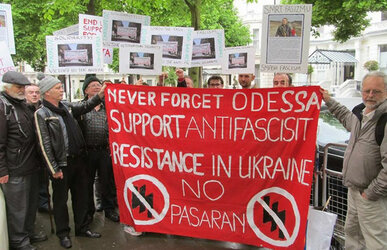
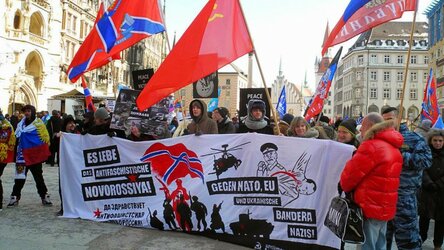

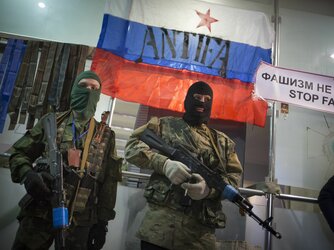
Leftist sympathies for Russia are generally much stronger outside of North America, since North American leftism is much more dominated by Neo-liberal tendencies. For example, one can easily make the argument that Marxism and communism is essentially just a trendy buzzword capitalist consumer ideology in North America, usually abandoned after youth, contrasted with the old communist guard in certain parts of Europe. An interesting point can be made here about this old guard group losing out to the trendy mainstream counterparts. This has left many communists, eastern bloc sympathizers (whether of the right or left), and others as pariahs or anachronisms in modern discussion. This feeling of political helplessness grows where their candidates and ideological statements are rejected. For example, a number of US Democrats had their offices vandalized by the Portland Antifa over Joe Biden defeating Bernie Sanders for the presidential nomination, and then again when Biden was elected as president. Similar riots occurred recently in Chile, this time when the proposed constitution of the ruling party was rejected overwhelmingly by the voters. Examples such as these show how the feeling of powerlessness has ultimately led to a rise of anti-democratic sentiments amongst this group. Sometimes this takes the form of lashing out against fellow countrymen, at other times it takes form as opposing NATO, whether through protest, riots, or more aggressive measures. Putin has catered to these groups by promoting global anti-fascist organizations and congresses, and by the recent sponsored declaration of the United Nations against Nazism (which was seen by Ukraine and the United States as a geopolitical declaration, something which was seemingly confirmed by Putin making anti-Nazism one of his key arguments for attacking Ukraine). One last thing that still allows many communists to look fondly at Russia is the way in which World War 2 is presented. World War 2 forms a primary part of the modern Russian mythos, where it is seen as a triumph of their ideas and national spirit over a powerful invader. Thus, every year Russia continues to host a memorial of Victory Day, in which soldiers march in old style Soviet uniforms under Soviet iconography in Victory Square. Youths too are encouraged (or in some case made) to parade around with pictures of relatives who fought in World War 2. Thus World War 2 and opposition to Fascism, however nebulous that definition is within the minds of the average Russian, remains always in the minds of the Russian population.
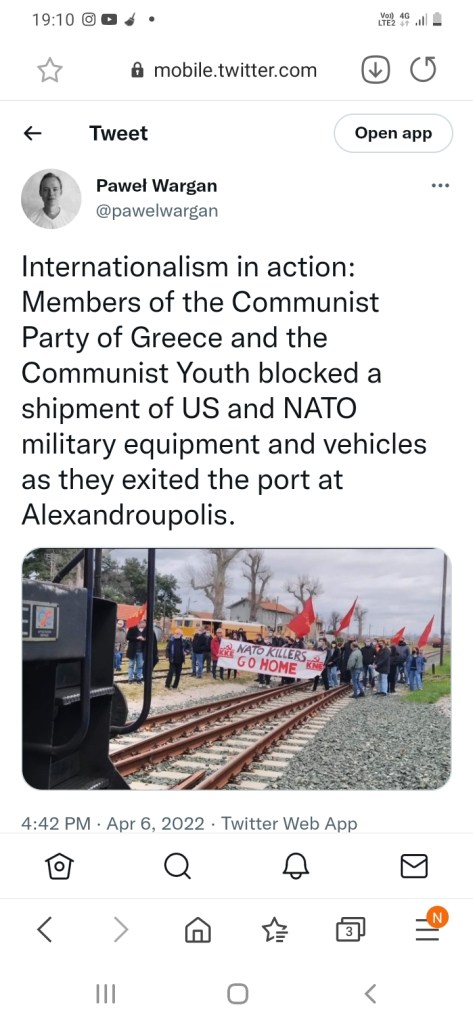

In a similar vein, albeit on the opposite end of the political scale, we have the right reactionaries. These are parties who consider themselves as opponents of modernity, defined by their particular opposition to the progressive Neo-liberalism (also known as “wokeism”), mainstream conservatism (whether of Neo-conservative, Neo-liberal or centrist variants), and, in the case of religious reactionaries, secularism. Ideologies include Civic Nationalism, Ethno-nationalism, Libertarianism, Traditionalist Christianity, Neo-paganism, and Conspiracy Ideology (most prominently the Q-Anon movement, which overlaps with a number of others). These movements were largely in the background of society until the 2010’s when a number of sympathetic political figures were brought to power or power-adjacent positions (Marie La-Pen, for example). The 2016 election of Donald Trump was considered a landmark achievement, as Trump was an outsider to the neo-conservative faction that had dominated the Republican Party for a number of years. Other figures can be cited in this vein such as Viktor Orban (Belated Edit several years later: Orban’s a complete moron. He deserves everything he gets) , Narendra Modi, and Jair Bolsonaro. Though, we should be cautious to avoid associating any of these political figures too closely with the viewpoints that some of their supporters have .

Just as we observed previously with certain left-wing groups, many of the aforementioned ideologies of the right reactionaries often hold to anti-democratic mindsets. For example, you often see governmental philosophies such as republicanism or monarchism glorified over democracy, which is associated with corruption. Consider, for example, the frequent declaration that America is a republic rather than a democracy, with the associated argument that the flaws in America come from its abandonment of republicanism. It is odd then that many who make this claim then go on to associate the woes of the country with oligarchical elites making to-down decisions, a feature of republican systems (meaning the political system, not the US party) rather than democratic ones.

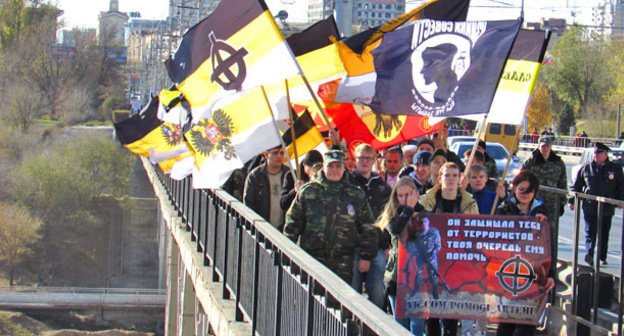
Like other reactionaries, much of the anti-democratic tendencies and hatred or distrust of the general population come from a position of social minimization. While Putin has long had support in certain right reactionary circles, amongst thinkers like Steve Bannon for example, the ascension of the Trump presidency made him their go-to man during his presidential term as it seemed to represent an opportunity for the revival in the west. He was a strong president (in the sense of making full use of presidential power) and had anti-establishment viewpoints. Some of the more hard-core Ethno-nationalists and traditionalists were more skeptical of the Trump form of civic-nationalism (which was actually relatively moderate from a historical perspective), but even many of these skeptic lent mild support to Trump, who was seen as the best option in a broken system.

However, with Trump’s loss in 2020 a great sense of dissolution, bitterness, and anger arose amongst many of these groups. Most reactionaries believe that Biden stole the election. Some even wanted Trump to use military force to remain as president (something which would have guaranteed a civil war in the US, incidentally). Others became extremely bitter towards Trump, considering him to be weak, cowardly, or even a traitor. While some American politicians similar to Trump continue to have influence in America, like Governor Ron DeSantis in Florida, many turned their back on the western establishment and looked out to the world for options to support. Essentially, these groups are looking for a centralized leader with an old conservative or traditionalist approach to society in order to support. Alternatively, some will simply settle for an anti-western strongman, regardless of ideological contradiction.
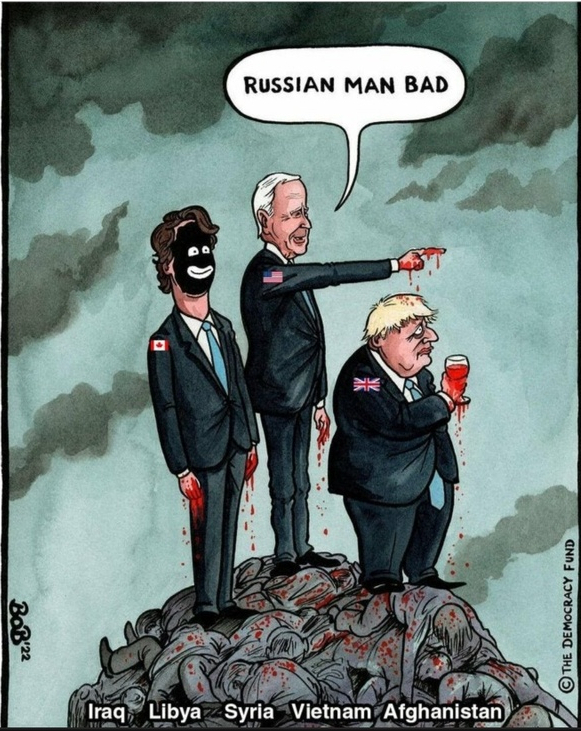
President Jair Bolsonaro of Brazil leads South America’s most powerful country and is at least sympathetic to Catholic traditionalism and Brazilian nationalism, however he also is quite hamstrung by the way that the Brazilian political system works, affecting his perception as a strongman. Prime Minister Narendra Modi of India is a strong Hindu traditionalist leader who is set against the substantially decadent Congress Party. However, since these are Christian/Western nationalists, India is either entirely ignored by their ideologies or outright hated and despised. Additionally, it can be argued that since the Congress Party were the ones who instituted the entrance of India into BRICS, and since Modi has taken a neutralist position on Russia and a hostile position to China, that he is not anti-western enough for this group. A similar observation can be made of Brazil and Jair Bolsonaro, where BRICS entrance was initiated by Luiz da Silva, his political opposite The President of Poland, Andrejz Duda, while of a middle power nation, is another figure sympathetic to catholic traditionalism and an advocate of Polish nationalism (being the one largely responsible for reforming the Polish military into the strong force it is today, something which may well one day be the force which concludes this present conflict). Additionally, he has often been at odds with the European Union over promotions of progressive ideas. However, all of this is rendered moot for the reactionaries since Poland is the strongest supporter of Ukrainian nationalism in this present conflict. Prime Minister Viktor Orban of Hungary is liked by many for his Hungarian nationalism and opposition to the European Union, but only leads a minor country with very limited political influence. President Xi Jinping of China is beloved by some reactionary nationalists and anti-NATO forces who see him as a tough Chinese nationalist whose opposition to NATO excuses some of his less desirable policies. Additionally, he leads the only country that may be directly capable of actually taking on NATO in its totality. However, for most westerners a national communist strongman is a hard sell. Iran is perhaps another option with its opposition to the west and its strongly centralized theocratic government under the leadership of Grand Ayatollah Ali Khamenei. Indeed, the founder of the modern Iranian state, Grand Ayatollah Ruhollah Khomeini, was the one who first labelled the United States as the Great Satan, a term many have adopted in right reactionary circles, whether explicitly or by their actions. However, many right reactionaries, outside of certain Guenon inspired traditionalist circles, tend to hate Islam, even if they might communicate sympathies with the middle east as a whole. Thus we come to their choice, President Putin of the Russian Federation.
Russia is a country which exists as many things for different people, and the propaganda which promotes it intentionally leaves the governing ideology vague enough to allow it to communicate support to virtually any ideology. The aforementioned old communists see in Russia the legacy of the Soviet Union. In Putin they see a man who is in the process of attacking the oligarchical capitalists, those they hold responsible for bringing down the union, and once more defining Russia against the west. However, for the right-wing supporters of Russia, the modern country is an example of a nationalistic country rising out of the political persecutions inflicted on it by the old Communist regime. As Putin makes efforts to attack ideological elements promoted by western progressives, such as homosexuality, transgenderism, or NATO expansionism, they see in Putin a strong traditionalist Christian leader, the last of his kind in control of a European nation. Thus, Russia is regarded as a shining light in the world, a bastion against western decadence, corporate corruption and NATO militarism, and Putin is its champion. One should also not forget the non-western reactionary traditionalists, such as various Islamic groups, who consider Russia’s actions in the Middle East to be a defence of their countries and Islam itself against the expansionist western powers.

Finally, there is what might broadly be labeled the conspiracy ideologies to consider. These are an eclectic group of thinkers and movements who consider history and historical events to be guided by shadowy figures behind the scenes. While often thought to be the purview of internet discussion boards and isolated contrarians, a large number of political leaders around the globe are actually conspiracy theorists of one form or another, constantly seeing battles of subversion, infiltration, and attacks all around them. To give an example, Saddam Hussein, in the novels he wrote, considered the Islamic world to be under attack by a shadowy American-Zionist force. Numerous other examples can be offered here, with both political parties in the US currently accusing the other of being under foreign influence, the Democrats associating Trump with Russia, while Trump associates the Democrats with China. In places like Russia and China, the majority of politicians believe in western subversionary agents. Consider, for example, how Russia constantly promotes Julian Asange, and that they recently granted citizenship and asylum to Edward Snowden. Paralleling this, how many times have you seen Hollywood blame negative audience reactions to their increasingly shoddy films on Russian bot networks? One can even argue that the notion of a global deep conspiracy is rooted deep within the psyche of the monotheistic religions, particularly Christianity and Islam, which teach that other religions and outside cultures are under the control and influence of shadowy demonic forces.
In terms of this present article, however, we are mostly concerned with the reactionary conspiracy theorists. Some of these certainly have their influence, as we’ve seen certain American politicians like Wendy Rogers and Marjorie Green use their talking points. The biggest conspiracy theories of the moment are almost exclusively obsessed with the concept that western elites, in particular those of America and Britain, control and corrupt the world using their money and power, ascribing a sort of grand conspiracy behind the history of the world. This includes beliefs such as Anglo-Saxon freemasonry attempting to control the world, Rothschild banker led Judaism trying to control the world’s finances, the Vatican/Catholicism seeking to control the religions and countries of the world via Jesuit led political subversion, the American Corporate Technocracy attempting to establish a transhumanist vision of the world, and even Nazis somehow gaining control of Anglo-America and using it to continue their war against other powers. A vast array of other ideas such as alien infiltration, demonic control, satanism, luciferianism, etc. can also be woven amongst this set of larger grand scale interpretations of history. In recent years this has all come together in its most explicit form in the movement known as “Q-Anon,” or “Q” (depending on who you talk to).
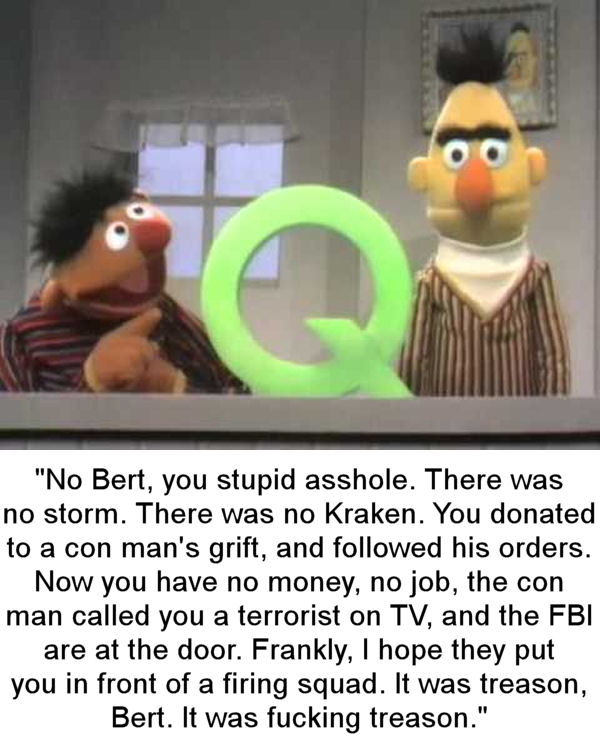
Q-Anon arose from a series of postings on 4-chan by an anonymous individual who went by call sign of “Q”. “Q” claimed to possess insider information about the workings of the American government and a battle between two factions, labelled as the Patriots (or white hats) and the Cabal (also known as the globalists or black hats). It was said that the faults and flaws of America were directly the result of the ideas of the Cabal elites, and that the Patriots were in the process of reversing these subversions.
Here’s an example of a “Q” message on the subject:
Hard to swallow.
“Q”, November 11th 2017
Important to progress.
Who are the puppet masters?
House of Saud (6+++) – $4 Trillion+
Rothschild (6++) – $2 Trillion+
Soros (6+) – $1 Trillion+
Focus on above (3).
Public wealth disclosures – False.
Many governments of the world feed the ‘Eye’.
Think slush funds (feeder).
Think war (feeder).
Think environmental pacts (feeder).
Triangle has (3) sides.
Eye of Providence.
Follow the bloodlines.
What is the keystone?
Does Satan exist?
Does the ‘thought’ of Satan exist?
Who worships Satan?
What is a cult?
Epstein island.
What is a temple?
What occurs in a temple?
Worship?
Why is the temple on top of a mountain?
How many levels might exist below?
What is the significance of the colors, design and symbol above the dome?
Why is this relevant?
Who are the puppet masters?
Have the puppet masters traveled to this island?
When? How often? Why?
“Vladimir Putin: The New World Order Worships Satan”
Q
As you can see, it’s all quite vague stuff, and likely intentionally so from whoever was writing it. Satan here could be a demon, if you so wanted, but it could also just be an idea. And, of course, this is all the sort of thing that we’ve seen in conspiracy circles for decades. We can point out that Trump’s primary ally in the middle east was literally the House of Saud, which is inconsistent with setting them in his apparent groups of enemies. Here are a number of other various posts on the subject of BRICS.
There are more good people than bad. The wizards and warlocks (inside term) will not allow another Satanic Evil POS control our country. Realize Soros, Clintons, Obama, Putin, etc. are all controlled by 3 families (the 4th was removed post Trump’s victory).
11.3 – Podesta indicted
11.6 – Huma indicted
Manafort was placed into Trump’s camp (as well as others). The corruption that will come out is so serious that deals must be cut for people to walk away otherwise 70% of elected politicians would be in jail (you are seeing it already begin). A deep cleaning is occurring and the prevention and defense of pure evil is occurring on a daily basis. They never thought they were going to lose control of the Presidency (not just D’s) and thought they had control since making past mistakes (JFL, Reagan).Good speed, Patriots.
PS, Soros is targeted.Q
“Q”, October 31 2017
Focus Here:
“…raise troubling questions about Halper, who was believed to have worked with the CIA and part of the matrix of players in the bureau’s ‘CrossFire Hurricane’ investigation into Trump’s 2016 presidential campaign. Halper, who assisted the FBI in the Russia investigation, appears to also have significant ties to the Russian government, as well as sources connected directly to President Vladimir Putin.”
https://saraacarter.com/whistleblower-exposes-key-player-in-fbi-russia-probe-it-was-all-a-set-up/Define ‘Projection.’
D’s SCREAM when POTUS meets w/ PUTIN?
“Q”, August 27th 2018:
D’s demand to hold hearings w/ the interpreter used during the private POTUS-PUTIN meeting?
D’s demand ALL meetings w/ PUTIN be CANCELLED?
If POTUS knows everything – control over what orgs are central to operational success?
1. DOJ
2. FBI
3. NSA
4. US MILITARY
5. STATE
6. F_ASSETS
Ask yourself, if above are central to operational success, who would you pick to lead such orgs?
HRC election loss = inflow stop
CF inflow stop = No Name Institute inflow ramp
Compare donors.
Define DARK MONEY.
Direct correlation?
Think Flynn.
Exactly.
Q
“Q” Image posted March 4th, 2019
Thank you Xi.
“Q”, April 9th, 2018
Good start.
China/CQ cancel.
Q
Clarify.
“Q”, April 10th, 2018
Chongqing.
Tuesday.
Demand.
Xi.
Confirm tariff reduction.
Tuesday (China).
Cars.
Article provides foundation.
Major import.
Ford.
US.
Start.
Q
Think HRC [Hillary Rodham Clinton] Russia reset statement.
“Q”, February 6th 2020”
Think Hussein [Barrack Hussein Obama] will have more flexibility after the election’ hot mic statement to Russian depo re: Q to Hussein re: Putin.
Think Hussein WH refusal to send weapons to Ukraine but instead sent only blankets.
Think D’s attack(s) re: POTUS for failure to ‘protect’ Ukraine against Russian aggression?
What advanced weapons did POTUS send to Ukraine?
2 + 2 = 6?
Define projection.
Think $1,800,000,000 > Ukraine.
Think US AID > Ukraine
Think AID > Ukraine
Think
Sold out US to benefit Russia for personal financial gain?
Risked US National Security for personal financial gain?
How was payment made to US person(s)?
Think Ukraine.
Think Iran.
Russia & Iran allies?
Russia, Iran, & China allies?
US pol corruption China
US pol corruption Ukraine
US pol corruption Russia
US pol corruption Iran
Common denominator: China, Russia, and Iran: Closed financial systems?
Logical thinking.
Q
https://www.foxbusiness.com/markets/us-china-sign-historic-trade-deal
Dates are important.
“Q”, May 9, 2020
January 15, 2020.
>Historic trade deal w/ China signed
>>China loses billions in clawback
>[Held][Timed] impeachment articles are delivered to Senate
>FIRST case of COVID-19 lands in UNITED STATES [Seattle-Tacoma International Airport]
Do the Chinese like losing?
Do the Chinese want POTUS removed/replaced P_elec_2020?
Do the Chinese want BIDEN installed P_elec_2020?
Is this about the virus OR THE ELECTION?
Q
Who controls social media?
“Q”, March 7 2018
Who performs in a circus?
Who wrote the code to embed and censor across multiple platforms?
Why Russia?
Why China?
Why Hong Kong?
Why did Edward Snowden (himself) arrange a C-link in multiple countries?
Learn.
Q
>>388588
“Q”, February 15 2018
Why is everything ‘really’ made in China?
Cost savings?
Why is POTUS focused on SA [Saudi Arabia]/CHINA/RUSSIA?
WHY???????????
WHY IS RUSSIA BEING USED AGAINST POTUS?
WHY RUSSIA?
WHAT DAMAGE CAN RUSSIA DO TO DEMS?
WHAT DAMAGE CAN CHINA DO TO DEMS?
IRAN?
NK [North Korea[?
WHY DOES HUSSEIN TRAVEL BEFORE/AFTER POTUS RE: FOREIGN TRIPS?
USE LOGIC.
WHY IS POTUS FOCUSED ON BRINGING BACK MANUFACTURING?
JOBS?
SECURITY?
CONTROL?
TRUE CONTROL?
WHO CAN YOU TRUST?
THE WORLD IS NOT HOW YOU VIEW IT.
TRUST THE PLAN.
WE ARE WINNING.
ARRESTS WILL COME.
LOGIC SHOULD ANSWER WHY IT MUST FOLLOW OTHER UNFOLDING EVENTS.
LEARN AND SPREAD.
BUILD PROOFS.
WE’VE PROVIDED MANY PROOFS THAT CANNOT BE DISPUTED COINCIDENCES.
THIS WAS DONE FOR A REASON.
MORE WILL BE PROVIDED.
DIRECT CONFIRMATION WILL COME.
IT CANNOT COME NOW.
IT WILL BE LOST.
THE MESSAGE IS NOT READY.
YOU ARE PART OF THE ARMY.
WE ARE DEPENDING ON YOU.
FOR GOD & COUNTRY.
WHERE WE GO ONE, WE GO ALL.
STAY SAFE THIS WEEK.
Q
As you can see, it’s all pretty cryptic stuff. He probably sees certain leaders in the countries (such as potentially Putin and Xi) as acting against the Cabal interests within those countries (that presumably interface with the west). My point here isn’t to go into a deep critique of the Q and the movement that he spawned (which I may do in an upcoming Modern Mythos), I just wanted to give a brief overview of his posts on the subject. Regardless of how one wishes to interpret Q’s vague posts about Russia and Putin, it is certainly true that many Q-adjacent sources heavily promote the concept of Russia against the west. However, it is interesting to note that Q seemed to imply that the Democrats wanted Ukraine to be weak, deciding not to send weapons to it, while the rearmament was largely a Republican project.
To give an idea of what I’ve seen from this Q-adjacent movement, here is a brief overview. Some say that Trump, Xi, and Putin are all allies together against the Cabal (also called Globalists, New World Order, etc.). Others think it’s just Trump and Putin. Naturally, this means that President Volodymyr Zelensky is presented as nothing but a western puppet to them. As another point, someone inclined to take the position that there is this trio of good allies set against the Cabal will also tend to believe in anything that justifies them and throws shade on the western elites, their opponents. Thus, any and all war crimes Russia has done in this conflict are actually Ukrainian false flags, the Ukrainians now being the murderers of thousands of their own countrymen. The coronavirus is said to have actually been incubated in Ukrainian bio-labs, specifically for the purpose of destroying Russia and China. Russia, if you will remember, even brought this charge as far as the United Nations, albeit with the end result being ridicule since they attempted to claim that migratory birds were the disease vector. We’ll put that alongside the old fiction of the crucified Russian soldier (something else they claimed about the Azov Battalion.) Numerous other tendencies are present in Q-adjacent groups such as civic nationalism, anti-bank/anti-corporate sentiments, the belief that Biden is not a valid president, anti NATO/anti EU beliefs, etc.
Here are some examples:
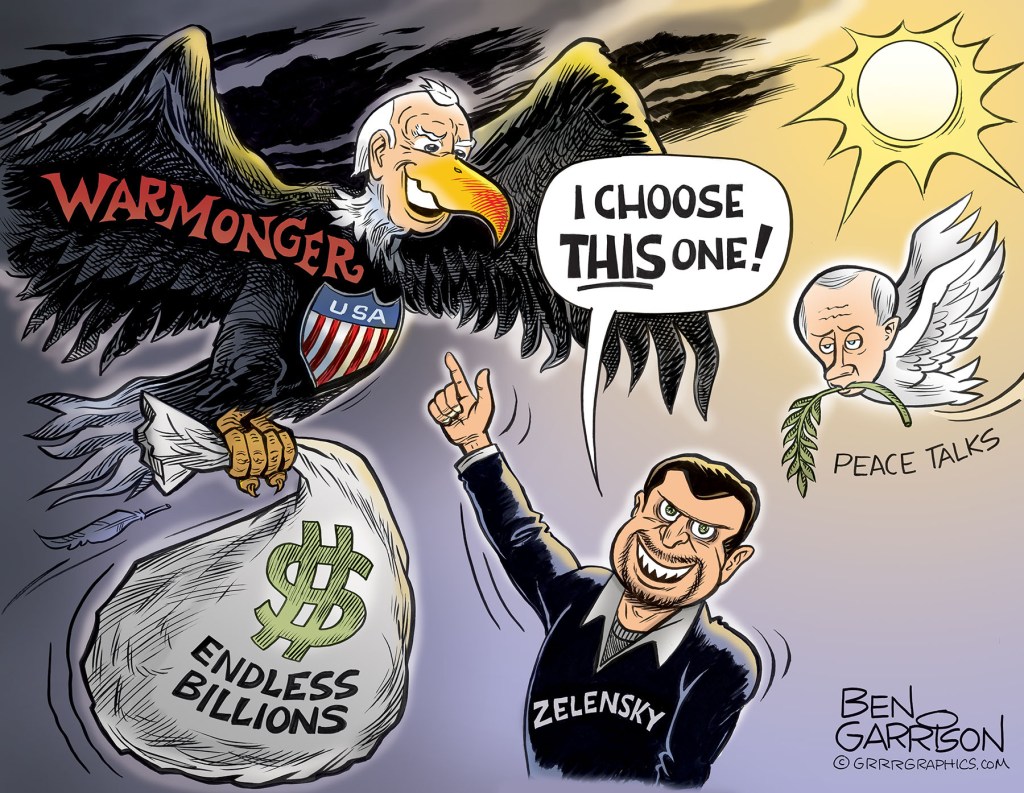


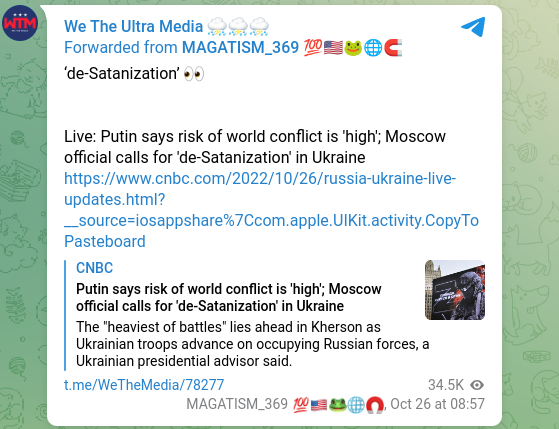


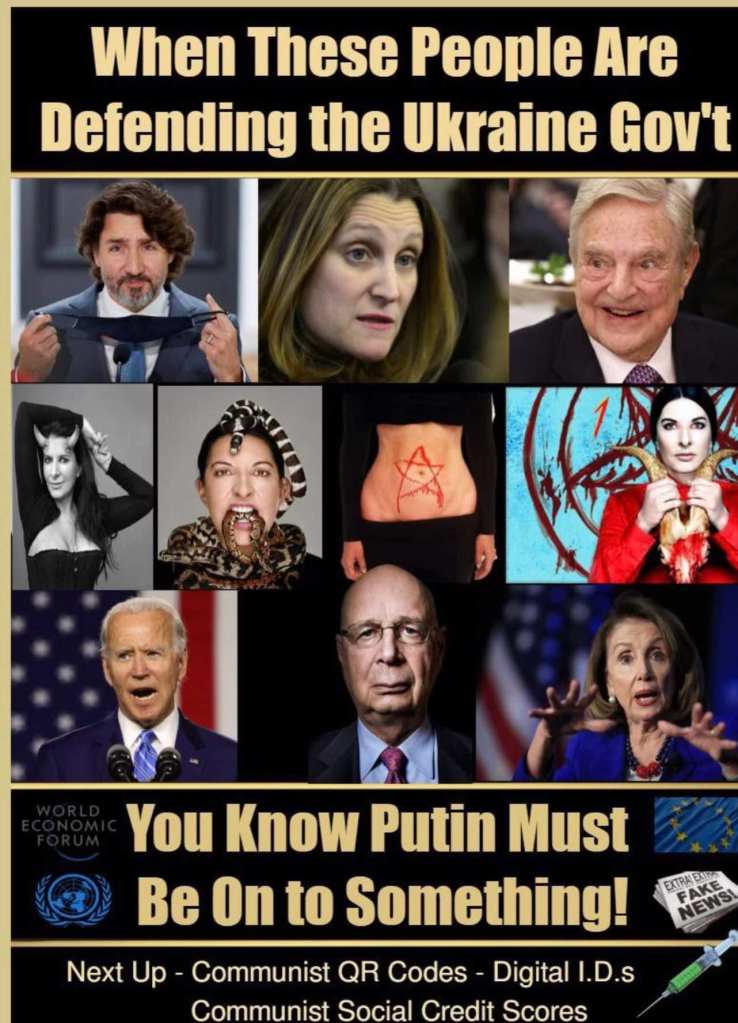

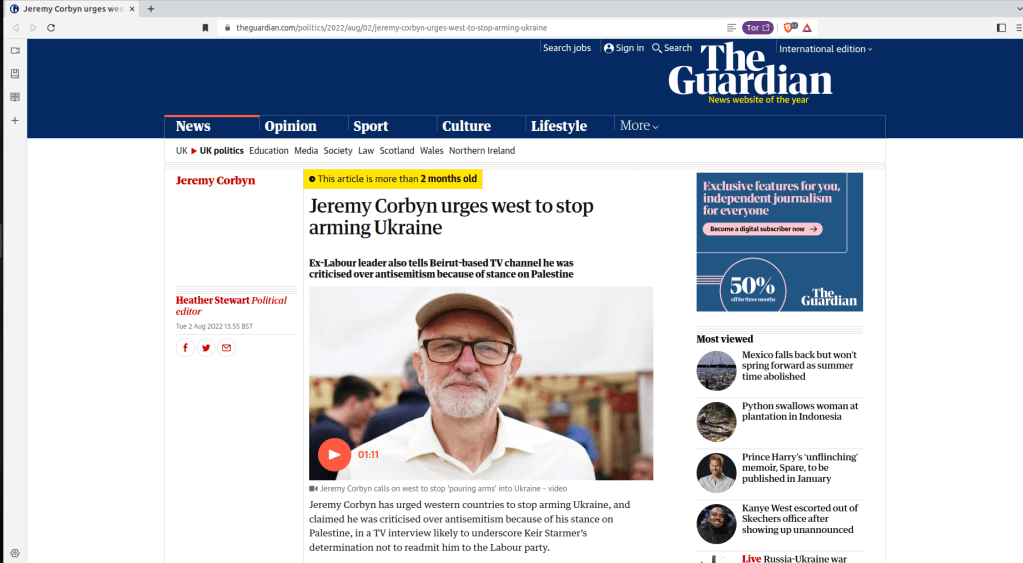


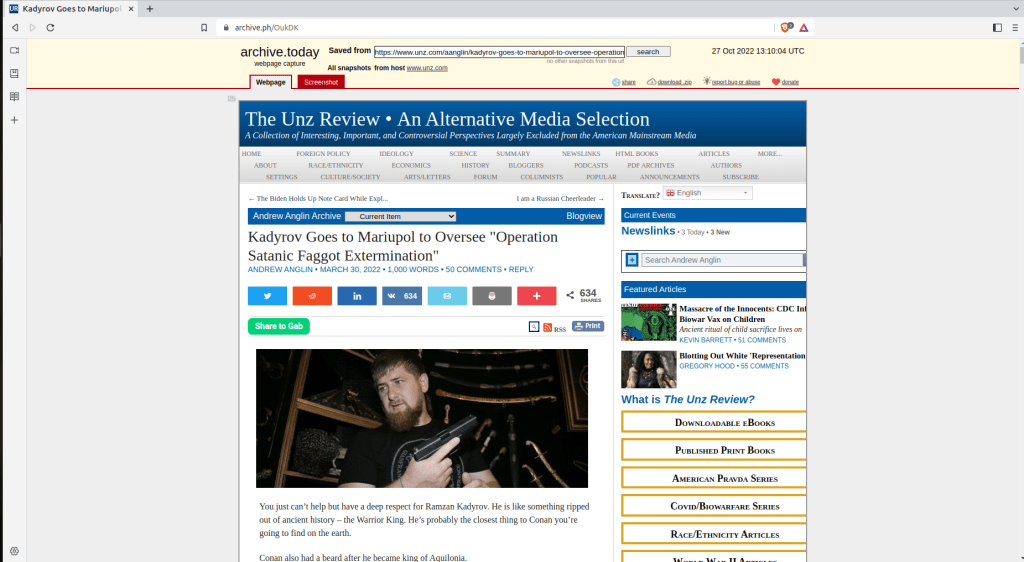


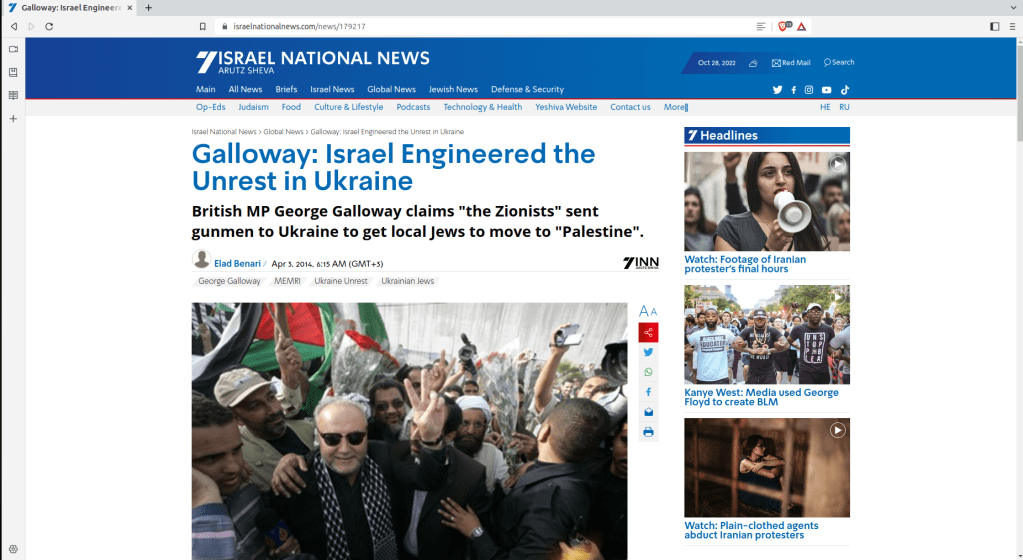


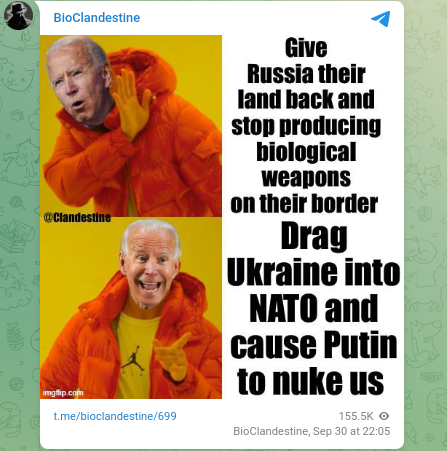
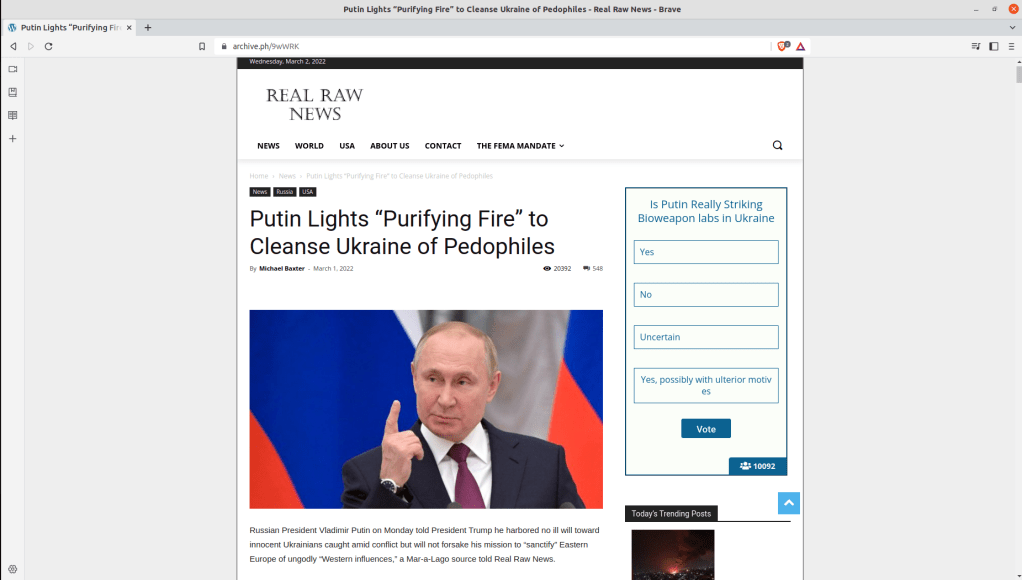
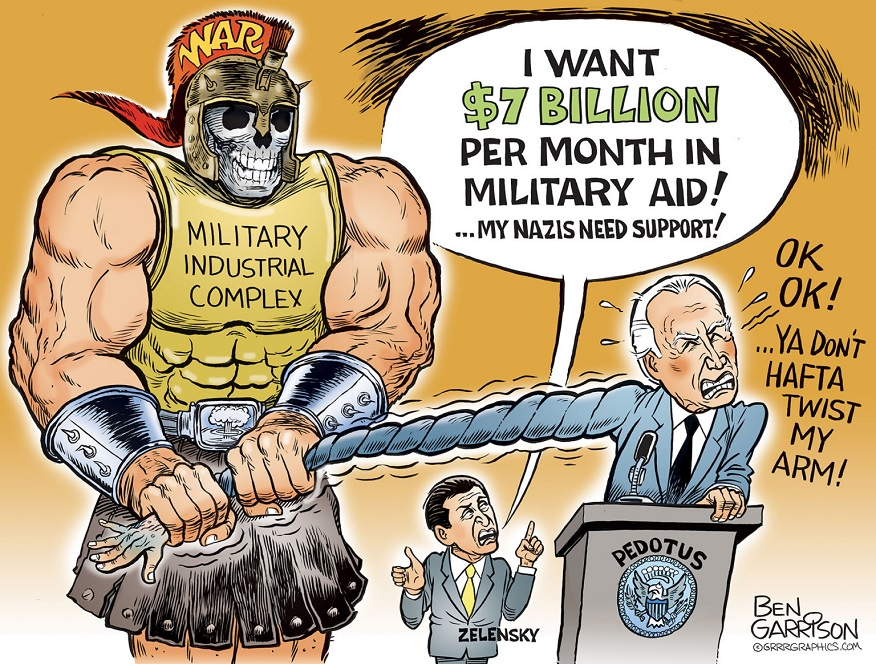


Finally, here is one last example to demonstrate the spanning extent and adaptability of pro-Russian influence in alternative media:
It would be hard to understate how many times I’ve seen it claimed that the Soviet Union was somehow a fundamentally Jewish state that persecuted the Slavs under its control. This serves as a way to absolve the Russians of the creation of the communist national state, inverting the actual political reality where Jews were actually extremely marginalized in that state. It’s historically inaccurate, but it serves the purpose of focusing their ire about Communism onto the west rather than on the population that actually supported it. It should be recalled that Marx, while Jewish, was also consciously trying to create a form of secularized social Christianity in opposition to Capitalism, which he considered fundamentally Jewish.
Summary
Regardless of what ideological position these various groups of reactionaries and contrarians take, the reality is that the vast majority of these positions are irrelevant to the actual nature of the conflict. We are seeing the struggle of two national mythologies, the mythos of Russia, which requires that all the descendants of the Rus be contained in one political entity, and the mythos of Ukraine, which requires an independent nation for Ukrainians. In effect, each of these other groups are taking the Ukrainian-Russian struggle, which has nothing to do with their plights and gripes, and narcissistically making it about themselves and their own chosen beliefs. Thus, to the neo-communists in Europe, if Putin says he’s fighting Nazis and Fascists, they believe him and condemn NATO for supplying Ukraine, a “Nazi” regime, with weapons. And for the right wing traditionalist reactionary, why Putin is against the wokes and the satanists, thus NATO supplying weapons to Ukraine is just like funding drag hour at toddler kindergarten. And behind all of this is a dualistic contention that must separate people into two factions, friends and enemies.
Here’s the reality. You don’t have to believe that political entities of the west are supporting Ukraine out of a sense of altruism. There’s probably more than enough instincts of self-preservation and grudges against Russia going around, perhaps even greed in some circumstances. However, is that not true of almost any conflict in world history? I think there are more than a few villains who find themselves on either side of this conflict. Should we allow ourselves to be swayed this way or that simply out of dislike of a few people who lend their support to a country?
Neo-Liberalism and its Russia Mythos
The fourth, and final mythos about Russia that we’ll be examining is that of the Neo-liberals. Neo-liberalism has served as the governing ideology of the west for most of the post WW2 era. It holds that the way to preserve order and reduce conflict is by creating a economically co-dependent global market. For example, if China has to buy most of its food from the west and the west has to buy most of its manufactured goods from China, then the two have a reduced propensity to engage in conflict. If Europe is economically interdependent, with many ethnic citizens of one country living and working in others, then Europe is unlikely to see the same sort of wars it has in the past. If each country is dependent upon a very few international commercial institutions, then they are unlikely to attempt to cause major economic disruption. Thus is the theory, at least.
In this, I would like to once more highlight two Putin quotes from his recent speech:
“It is on these principles that the US and NATO military doctrines are built, requiring nothing less than total domination. The Western elites present their neo-colonial plans in the same hypocritical way, even with a pretense of peacefulness, they talk about some kind of containment, and such a crafty word wanders from one strategy to another, but, in fact, means only one thing: undermining any sovereign centers of development.
We have already heard about the containment of Russia, China, Iran. I believe that other countries of Asia, Latin America, Africa, the Middle East, as well as current partners and allies of the United States, are next in line. We know that whatever they don’t like, they also impose sanctions against their allies – first against one bank, then against another; now against one company, now against another. This is the same practice, and will expand. They target everyone, including our closest neighbors – the CIS countries.”
…
“The world has entered a period of revolutionary transformations, they are of a fundamental nature. New development centers are being formed, they represent the majority – the majority! – of the world community and are ready not only to declare their interests, but also to protect them, and see multipolarity as an opportunity to strengthen their sovereignty, which means to gain true freedom, a historical perspective, their right to independent, creative, original development, to a harmonious process.
All over the world, including in Europe and the United States, as I said, we have many like-minded people, and we feel, we see their support. A liberation, anti-colonial movement against unipolar hegemony is already developing within the most diverse countries and societies. His subjectivity will only grow. It is this force that will determine the future geopolitical reality.”
Vladimir Putin – September 30th, 2022 speech, on formally annexing part of Ukraine
Taken together, these quotes are a complete rejection of Neo-liberalism and its ideology. The order of Neo-liberalism is presented as fundamentally hypocritical and the concept of the American dollar as the world reserve currency is rejected. It is noted that the Russians, ever since the start of the Russo-Ukrainian War, have been attempting to get other countries to purchase oil from them using Rubles as the exchange medium. Similarly, there are attempts to start up native Russian alternatives to the western currency exchange systems such as Visa, Mastercard, Google Pay, Paypal, etc.
There was also a recent statement from Congressman Jamie Raskin of the United States who quite clearly articulated an ideological Neo-liberal argument for supporting Ukraine over Russia. This was in response to the recent call by 30 progressive Democrats for President Biden to initiate peace negotiations with President Putin. As I like to let sides speak for themselves, I’ll reprint the statement in full below. However, in my opinion imputing certain Neo-liberal ideological elements upon Ukraine makes a similar mistake to the way that western Putinists make. Ukraine is a culture of its own, and in western terms it is most comparable to Poland, perhaps even a bit more conservative in that regard. Regardless, here is the statement:
RASKIN RESTATES THE FUNDAMENTAL IMPORTANCE OF THE UKRAINIAN STRUGGLE FOR NATIONAL SOVEREIGNTY, DEMOCRACY AND FREEDOM
“October 25, 2022
WASHINGTON, DC – Congressman Jamie Raskin today released the following statement.
“I am glad to learn of the withdrawal of the letter of October 24, 2022, which—because of its unfortunate timing and other flaws—led to the conflation of growing Republican opposition to support for Ukraine, as exemplified by recent statements of Minority Leader Kevin McCarthy, with the polar-opposite position of dozens of Democrats like me who have passionately supported every package of military, strategic and economic assistance to the Ukrainian people and are determined to see the Ukrainian people win victory over Vladimir Putin and expel his imperialist forces from their country.
“In the eight months since Russia began its atrocity-filled and illegal war of aggression against the people of Ukraine, the Ukrainian people have given Americans not just the chance to defend the values of national sovereignty, democracy and pluralism but also great hope for the world’s future. Had Ukrainians been quickly defeated by Putin’s army, as so many people expected, had Volodymyr Zelensky fled the country, as so many people expected, then a dangerous tyranny would have destroyed a nascent democracy, and prospects for democratic causes everywhere in the world would have darkened. Large countries would have felt emboldened to attack small countries everywhere.
“But today there is hope because of the strength of President Zelensky and the Ukrainian people, and the cause of democracy and freedom in Ukraine is the cause of the democratic world. We should unite around this just struggle and stay focused on it.
“Ukraine has given the world a lesson in anti-imperialism and how to fight a just war of self-defense even amidst enormous civilian suffering. Putin has claimed, as European colonizers did for hundreds of years, that the Ukrainian state and the Ukrainian nation do not exist. This obvious lie has been his rationale for an increasingly genocidal war of destruction, the openly avowed goal of which is the destruction of the Ukrainian people as such. These last weeks and days, Russian propagandists have repeatedly appeared on television to urge the murder of Ukrainian children and violence against the Ukrainian population.
“It is a bad colonial habit to suppose that ultimately peace depends upon the wishes of the great powers and the great powers alone, and even progressive and liberal people can fall into this colonialist reflex.
“Ukraine’s struggle embodies a democratic future. Its civilian and military leadership is young and diverse, representing a post-Soviet generation that has learned to treasure freedom and value democracy. Its president, who is Jewish and thus belongs to a small national minority, was elected with 73% of the population, and now has even higher levels of support, thanks to his extraordinary wartime leadership. Thousands of Ukrainian women are fighting on the front, and a woman serves as deputy minister of defense. Sexual minorities are represented within the Ukrainian armed forces. Ukrainians soldiers routinely speak two languages. Ukraine has displayed a striking degree of toleration and decency during a war.
“The Ukrainians also inspire democratic forces all over the world with their example of civil society. This war is fought and won on the Ukrainian side with the help of countless civilians, organized informally into small horizontal groups, who fill the gaps in logistics. An emblematic image of this war is of the vans driven to the front by civilians to supply soldiers. Where conscripted Russians destroy Ukrainian homes, neighbors come to help. Another common image of this war is the partially repaired house: in the regions from which Russia has been forced to retreat, Ukrainians do what they can to rebuild their neighbors’ homes.
“Moscow right now is a hub of corrupt tyranny, censorship, authoritarian repression, police violence, propaganda, government lies and disinformation, and planning for war crimes. It is a world center of antifeminist, antigay, anti-trans hatred, as well as the homeland of replacement theory for export. In supporting Ukraine, we are opposing these fascist views, and supporting the urgent principles of democratic pluralism. Ukraine is not perfect, of course, but its society is organized on the radically different principles of democracy and freedom, which is why Russia’s oligarchical leaders seek to destroy it forever. I am proud to have been banned from Putin’s Russia for my pro-Ukrainian legislative activism, and I look forward to visiting Ukraine.
“Ukrainians provide us with an example of courage in defense of national sovereignty and democracy. They are defending their democratic right to choose their own leaders and live in freedom and peace, and they are doing so at great risk and staggering personal cost.
“Ukrainians today give the democratic world a chance for a critical and historic victory, and we must rally to their side. It is important to be on the right side of a just war, and it is even more important to be on the right side and win. Just as Ukrainian resistance gives us hope, a Ukrainian victory would give us an opening to a much better future for all humanity. All champions of democracy over autocracy—whether they call themselves progressives, conservatives or liberals—should be doing whatever we can to ensure that Ukraine wins this just war as quickly as possible. Diplomacy by the Biden administration will inevitably follow as sustained diplomacy always marks the conclusion of war—even with tyrants and despots. But first Ukraine must win—let us continue to unite as Americans and focus on that central and historic imperative.”
https://raskin.house.gov/2022/10/raskin-restates-the-fundamental-importance-of-the-ukrainian-struggle-for-national-sovereignty-democracy-and-freedom
Moving away from ideological points and returning to the general concept of Neo-liberalism, declarations of economic nationalism are one of the easiest ways to earn condemnation from Neo-liberals, although as this is not a particularly appetizing critique to serve to their citizens, other things such as human rights abuses are highlighted. A similar pattern is currently emerging with regards to China, where the leaders of the past several decades were seen as friendly to Neo-liberal values and ideas, while President Xi is an enemy to them. Thus, we’ve quickly seen an upsurge in news about China’s various failings and flaws when even just a few years ago major corporations were attempting to pander to the CCP.
It is here that we get to one of the downsides of the modern west, which is that actual motivations are often hidden behind a sort of irrationalist and sensationalized sort of propaganda. I said before that flaws in countries are typically noted and exploited not because they exist, but because it is convenient to do so at certain times. For example, consider that while the west condemns Russia for their position on homosexuality, many of the countries that the west regularly economically deals with in the Middle East are much much harsher on such persons. This even works internally in the western countries, where many ideologies prefer to emphasize elements of history that isolate people from their country and nation, sometimes true, sometimes exaggerated, sometimes entirely fabricated, all to get them to serve the ideology above anything else.
Put this way, Russia has seemingly taken on a new dimension for the Neo-liberal, divorced even from the substantial influence that they wield internationally. Do you not like the way that a presidential election went? Russia must have interfered. Do you not like a vote on where your country wishes to be in the EU? Russia must have interfered. Did one of your increasingly poorly conceived films get poorly reviewed by the audience? Russian bot nets must have been responsible. Did you get some nasty messages on social media? Russian trolls must be responsible.
I’ve seen each and every one of these claims repeated time and time again. Yet, only flimsy proofs are offered for each statement, and indeed, this all tends to smack of a fundamental truth, that we in the west still remain stuck in our own versions of the dualistic cycle. Instead of a metaphysical threat, our devil has now become Russia, standing in opposition to the bringer of peace, the Neo-liberal world order.
Taken like this, the vein of irrationalist sensationalism that we saw at the start of the Russo-Ukrainian war and in so many other issues of the west begins to make sense. Putting the flag of Ukraine in ones icon is understandable if one lives in Ukraine or has Ukrainian heritage, but it becomes something of an absurdity to simply take that position because it is the popular thing to do. And this is the fundamental problem with social media trends, where irrationalist desire for group conformity and group praise becomes what one is working towards. Thinking is hard, but there’s always a slogan or catchy phrase designed to bypass thought. And going along with trends and what is popular is even easier.
Of course, this is not to say that irrationalism is present in all forms of Neo-liberalism. I would say it’s more a case that much of the modern corporate world prioritizes conformity and displays of conforming allegiance over distinctive claims of truth. And, as these displays change with whatever the ones in charge wish to make popular, it is fundamentally irrationalist rather than truth based. We will call this the western way of proclaiming that a deer is a horse.
A Response to the Russian Mythos
Having summarized the Russian and Ukrainian mythologies and the response to them by the outside world, I would now like to conduct an in-depth critique of the Russian mythos.
Irrationalism
“Political language — and with variations this is true of all political parties, from Conservatives to Anarchists — is designed to make lies sound truthful and murder respectable, and to give an appearance of solidity to pure wind.”
Politics and the English Language, George Orwell
“It is the so-called West that has trampled on the principle of the inviolability of borders, and now, at its own discretion, decides who has the right to self-determination and who does not, who is not worthy of it. Why they decide so, who gave them such a right is not clear. To themselves.”
Vladimir Putin – September 30th, 2022 speech, on formally annexing part of Ukraine
I’ve described what is claimed about the modern Russian mythos but here is a question: what is the end goal of this grand campaign that Russia is to lead? What results do the wish to bring about in the world? The answer is that the end goals are intentionally left vague and undefined, allowing the government to draw from a collage of Imperial Russian, Soviet, and Post-Soviet ideas. One minute the government might proclaim a talking point about Christianity, the next they revel in things straight out of the old communist playbook. And the expectation of the average citizen is to either support everything that they say or remain quietly depoliticized.
This is the power of irrationalism, whereby it doesn’t matter what the thing promoted is, only that you agree with the powers that promote it. This trend of contradictions, non-concreteness, and vague abstraction is all through the speeches and philosophies of the Russian leaders, as I will demonstrate in my review of Putin’s speech. If we go by the trend of irrationalism, this is the point, to present a seemingly broad-tent of ideas that are all supported by the central pole of Putin. The only concrete point then is the distinction between friend and enemy, the baseline of political power.
Irrationalist ideologies adopt words that intentionally have vague and loose definitions, into which anything that is currently desired might be poured. We have broad, lofty sounding categories, often ridiculously and irrationally inclusive, that confuse and baffle the mind, becoming irrational emotionally charged battle cries that transcend though. For example, what do Russian ideological terms like hegemony, multi-polar world, Atlanticist, or Eurasia actually mean? Compare to the western irrationalist terms dejure such as “whiteness” or post-modernnity. We see that all these terms are vague and and void of natural meaning, instead serving as meaningless words that are left to the tyranny of the definer. Multi-polar even ends up adopting the meaning of the world being ruled over by many empires instead of nations.
Having dispensed with consistency, an irrationalist can pick a collage of ideologies talking points, such as communist talking points, Malthusianism, Fascism, or varied religious ideas. It matters not how or why the state acquires power over the average citizen, only that it achieves this submission of the populace to the current leader. The Russian media organization Russia Today is a prime example of this contradictory attitude, and one that is mostly aimed at those outside of Russia. One day it will have Alex Jones on to bash the western governments with his blend of libertarianism and conspiricism, the next it will have someone on like Pepe Escobar, a anti-colonial Marxist. Confused yet? The answer is that it matter not what is promoted, only that the desired end result is reached, that being to give fuel to the fuel anti-western movements while lending credence to the idea that Russia supports their particular take on the world, whether it is far-right or Neo-marxist. Thus, Russia becomes seen as more worthy of support than their native state, encouraging activities to further Russian goals, such as peace protests against involvement in Ukraine or acts of political subversion.
The end result is that Russian propaganda embraces this idea of contradiction rather than presenting a specific end goal. Previously Soviet propaganda relied upon creating firm distinctions that were held, even to the detriment of its end goals when reality contradicted them. The world was always divided into different blocks, classes were always set against one another, and a suspicious eye was cast on anyone who dared to get out of line (such as the famous Stalin/Trotsky, or the Stalin/Tito split). In order to turn people against Soviet enemies and generate support for Soviet allies, Soviet propaganda would engage in various forms of irrationalist manipulation, from exaggeration and excuse to outright fabrication. This trend has been revived for the Ukrainian campaign, and one need only consider the following way in which Russia panders to its supporters, domestic and foreign:
Numerous sites of Russian atrocities against civilians have been uncovered in Ukraine and the exhumation of corpses have been witnessed by international observers. However, Russian media instead chooses to take a page from conspiracism and label these as Ukrainian false flags. Thus, it is promoted that Ukraine actually slaughtered its own civilians (in Russian occupied areas, need we add), in order to artificially blame them. And a great number of variants of these incidents are then fabricated by conspiracist media, such as the Ukrainian government running child trafficking centers, etc.
For western conservatives, many hate the way that the corona-virus was handled, and this anger can be channelled by Russia. The current evidence suggests that the Wuhan Institute for Virology was directly or indirectly connected with the contamination. This association is bad for Russia since it paints their primary ally in a bad light. Thus, by rewriting the narrative, Russia can use the distrust of the targeted population and turn it to their advantage. Now they claim to have discovered US funded bio-labs in Ukraine which were used to produce pathogens such as the corona-virus. In other words, one should not blame China for the act, but rather the fury of the populace should be turned on the US and Ukraine instead. They were so confident of this claim that they took it to the United Nations before managing to make fools of themselves by claiming birds as the transmission vector, amongst other logical problems with using labs on the Russian border to produce such things.
Another broader case of irrationalist language, appealing mostly to the older generations and the neo-communists, is the Russian claim that Ukraine is a bastion of Fascism and Nazism, with one of their points justifying their invasion being to “de-Nazify” Ukraine. Because of the way that the order of the world after WW2 was based on an utter rejection of Nazism, the hatred of Fascism and Nazism has been ingrained in both western societies and Russian societies for a long time, to the point where the use of either of these words immediately bypass the thought processes, substituting them with emotional irrationalism. No better example of this can be seen than in the older Russian citizens interviewed on the war, who near universally accepted the claim that Ukrainians were all fascists and Nazis, and thus the war was entirely justified on that basis. Keep in mind that this war is being undertaken on principles that are essentially the same as those Hitler used to invade Czechloslovakia and Poland, that being claimed persecution of an ethnic minority, stolen land, and ideologically hostile governments. This all brings to mind a rather Orwell quotes on political language and the irrationalist abuse of language:
“The word Fascism has now no meaning except in so far as it signifies “something not desirable.” The words democracy, socialism, freedom, patriotic, realistic, justice have each of them several different meanings which cannot be reconciled with one another. In the case of a word like democracy, not only is there no agreed definition, but the attempt to make one is resisted from all sides. It is almost universally felt that when we call a country democratic we are praising it: consequently the defenders of every kind of regime claim that it is a democracy, and fear that they might have to stop using that word if it were tied down to any one meaning. Words of this kind are often used in a consciously dishonest way. That is, the person who uses them has his own private definition, but allows his hearer to think he means something quite different.”
Politics and the English Language, George Orwell
Putin throughout his speech claimed that the Russians were victims of attempted colonialism and cultural genocide, even as he uses that supposed victimhood to justify engaging in the exact same behaviors. He’ll speak of connected destinies, yet never actually justify that on anything more than irrationalist sentimentality. He’ll condemn the concept of a global hegemony, despite the obvious fact that a global hegemony does not exist. For example, if the US, EU, CANZUK, China, India, and Russia/CSIS are all places of influence in their own right, then how is that not already a multi-polar world?
As for the specific linguistic mechanisms by which the irrationalism is promoted in Putin’s speech, I’ve identified several of them. The first is the extensive use of “half-truths,” also known as lying by omission. Lying by omission occurs when someone talks about something that has actually happened, yet leaves out critical details to contextualize said action. This can be employed to effectively rewrite a piece of history, entangling it in a net of narrative. In this way good actions can be tarnished or exaggerated, the evils of an enemy can be magnified, and the evils of friends can be minimized or concealed.
Consider the following examples:
“Mary was caught holding the murder weapon above the corpse.”
Reality: Mary is a police inspector at a crime scene who is carrying out an investigation. She is currently holding the murder weapon in her hand and inspecting it.
“The throat of the corpse had a distinctive 9mm bullet, exactly the calibre of weapon Jane had been caught with.
Reality: Jane had been at the scene of the crime with a handgun, however the victim had been riddled with bullets from the submachinegun wielded by her boss, the Donn.
“A shocking murder occurred in the district of Representative Finch, leaving his credibility in question. Representative Evans called for the resignation of Representative Finch, chastising him for his failure to keep the people safe.”
Reality: Twenty-nine murders occurred at the same time in the district of Representative Evans, who used the murder in Representative Finch’s district to take the heat off of himself.
Secondly, we find that, though the speech is about the annexation of Ukrainian territories, it is not focused on Ukraine as such. Instead, Putin is weaving a narrative that Ukraine, and ever country affiliated with the west, is a puppet of the west. For example, he makes the claim that the fall of the Soviet Union was an illegitimate act engineered by the west and traitor elites, rather than being the result of the constituent republics voting to leave.
This is the political manifestation of the longstanding effects of ideological dualism. For a man who rants so often against concepts such as western hegemony to promote his multipolar world, he seems so often to actually conceive of humanity not as a diverse group of peoples, but instead as a political duality. Those in favor of Russia are good, everyone else is a western puppet state. Indeed, he will also attempt to present the concept of the west as a construct opposed to humanity itself, choosing to single out the English as the ones set against humanity.
Thus, the speech is presented as a sort of global manifesto against the west and Anglo-America in particular. It weaves from point to point, never connecting them with any ideology, save the vague notions of multi-polar worlds and independent development. Yet, his current actions render any concrete points into absurdities, unless one chooses to view the world through the narrative of Putin and his allies.
To illustrate the ills of dualism, we need only look at what it has done to the societies of the world. First established in the ascent of political parties, religions, and cliques, dualism necessarily develops into polarization of one party and another. What often started with relatively minor social issues (such as Conservatism and Liberalism actually being primarily about trade policy) increasingly developed into claims that the other represented a existential threat to the population. And what places we’ve gone in the modern world with this position. Now we have man is set against woman, the youth against the elderly, ethnic group against ethnic group, party against party, class against class, the subgroups against the normal, and so on it goes. This takes on the religious aspect of God vs. the Devil, good vs. evil, light against darkness.
Thirdly, we have the issue of psychological projection. Projection occurs when one takes an ideas, conflicts, and dualities inherent to oneself and imputes them on others. For example, a very dark manifestation of this occurs in the psychology of mass murderers where a mixture of narcissism and social rejection come together to input a direct evil on the rest of society, or a specific part of society, which is used to justify their actions. Numerous historical military actions undertaken by expansionist governments have been simply this mentality with a venire of civilization attached to it.
In this case of this speech, Putin projects his internal conflicts onto the world, shaping categories where none truly exist. For example, current America must be a project designed to further Anglo-Saxon ends, even when there are literally no ethnically Anglo-Americans present in the Biden cabinet.
Anglo-America and Mythology
As Russians primarily wish to attack America, they have developed the concepts of Siberianism (also known as Eurasianism) and Atlanticism. I previously explored the concept of Siberianism, wherein it was determined that this Russian mythos regards the land of Siberia as the home of the Indo-European peoples, or even of humanity itself in some lines of thought. Thus, they believe that to control Siberia is to control the heart of the world, and with it a near endless place to expand into. Control of Siberia shows that Russians have a key attachment to the land, which thereby also symbolizes their connection to tradition and destiny.
America and Britain, by contrast, are denounced as Atlanticists, tying their lands to Plato’s story about an expansionist island power of the Atlantic which sailed into the Mediterranean and attacked Athens. The belief is that island countries are naturally the places of rootlessness and separation from humanity, tied to mercantile sea-based empires in opposition to the traditionalism of land-based societies.
First, I would like to begin with a direct criticism of this idea. Migratory island based populations are not that different from the way that nomadic land based tribes act. Both move from place to place, intent of exploration. Both also end up having very distinctive expansionist tendencies, typically caused by lack of resources or even split-offs of the tribe. Secondly, the British actually have developed distinctive cultures in their various counties, most of which were agriculturally based until the late 19th century. If the point is that the British mercantile class has developed outward going tendencies, then it must be pointed out that dealing in foreign goods is essentially what merchants, including those of Russia, do.
Similarly, if the contention is that Americans are somehow to be held as uniquely distinctive from Siberians, due to not having a land bridge connection, then where does that leave countless other peoples such as the Filipinos, Australian Aborigines, Polynesians, Madagascans, Icelandics, Japanese, Indonesians, etc.? Of course, this entire contention falls apart if it can be demonstrated that America is capable of hosting traditional civilizations in an isolated position from Siberia, the supposed world heart. And, importantly, America’s truest cultures were not empires or under the influence of empires. The Maya, long considered the foremost bearers of culture were actually a confederation of city states. Such was athe form of government in most parts of America.
To begin this contention, I would like to present elements of two stories to the reader from the Native-Americans of the eastern seaboard, collectively known as the Algonquin peoples. The first is a solution to the problem of the giant and the giant slayer that we discussed earlier:
The Giant Magicians
“There was once a man and his wife who lived by the sea, far away from other people. They had many children, and they were very poor. One day this couple were in their canoe, far from land. There came up a dense fog; they were quite lost.
They heard a noise as of paddles and voices. It drew nearer. They saw dimly a monstrous canoe filled with giants, who greeted the little folk like friends. “Uch keen, tahmee wejeaok?” “My little brother,” said the leader, “where are you going?” “I am lost in the fog,” said the poor Indian, very sadly. “Ah, come with us to our camp,” said the giant, who seemed to be a good fellow, if there ever was one. “Truly, ye will be well treated, my small friends, for my father is the chief; so be of good cheer!” And they, being much amazed at this gentleness, sat still in awe, while two of the giants, each putting a tip of his paddle under their bark, lifted it up and put it into their own, as if it had been a chip. And truly the giants seemed to be as much pleased with the little folk as a boy would be who had found a flying squirrel.
And as they drew near the beach, lo! They beheld three wigwams, high as mountains, in size according tot hat of the giants. And coming to meet them was the chief, who was taller than the rest.
“Ha!” he cried. “Son, what have you there? Where did you pick up that little brother?” “No, my father, I found him lost in the fog.” “Well, bring him home to the lodge, my son!” So the giant took the small canoe in the palm of his hand, the man and his wife sitting therein, and carried them home. Then they were taken into the wigwam, and the canoe was laid carefully in the eaves, but within easy reach, about a hundred and fifty yards from the ground.
Then an abundant meal was set before them, but the benevolent host, mindful of their small size, did not give them more to eat than they would have needed for about ten years to come, and informed them in a subdued whisper, which could hardly have been heard a hundred miles off, that he name was Oscoon.
Now it came to pass, a few days after, that a company of these well-grown people went hunting, and when they returned the guests must needs pits them that they had no game in their land which answered to their size; for they came in with strings of such small affairs as two or three dozen caribou hanging in their belts, as a Micmac would carry a string of squirrels, and swinging one or two moose in their hands like rabbits. Yet, what with these and many deer, bears, and beavers, they made up in the weight of their game what it lacked in size, and of what they had they were generous.
Now the giants became very fond of the small folk, and would not for the world that they should in any way come to harm. And it came to pass that one morning the chief told them that they were to have a grand battle, since they expected in three days to be attacked by a Chenoo (frost giant). Therefore the Micmac saw that in all things it was even with the giants as with his own people at home, they having their troubles with the wicked, and the chiefs their share in being obliged to keep up their magic and know all that was going on in the world. Yea, for he would be a poor powwow and a necromancer worth nothing who could not foretell such a trifle as the day and hour when an enemy would be on them!
But this time the Sakumow, or sagamore, was forewarned and bade his little guests stop their ears and bind up their heads, and roll themselves in many folds of dressed skins, lest they should hear the deadly war-scream of the Chenoo. And with all their care they hardly survived it; but the second scream hurt them less; and after the third the chief came to them with a cheerful countenance, and bade them arise and unpack themselves, for the monster was slain, and though his four sons, with two other giants, had been sorely tried, yet they had conquered.
But the sorrows of the good are never at an end, and so it was with these honest giants, who were always being pestered with some kind of scurvy knaves or others who would not leave them in peace. For anon the chief announced that this time a Kookwes – a burly, beastly villain, not two points better than his cousin the Chenoo – was coming to play at rough murder with them. And, verily, by this time the Micmac began to believe, without bating an ace on it, that all of these tall people were like the wolves, who, meeting with nobody else, bite one another. So they bound and bundled up as before, and put to bed like dolls. And again they heard the horrible shout, the moderate shout, and the smaller shout, until sooel moonoodooahdigool, which, being interpreted, meaneth that they hardly heard him at all.
Then the warriors, returning, gave proof that they had indeed done something more than kick the wind, for they were covered with blood, and their legs were stuck full of large pines, with here and there an oak or hemlock, for the fight had been in a forest; so that they had been as much troubled as men would be with thistles, nettles, and pine splinters, which is truly often a great trouble. But this was their least trial, for, as they told their chief, the enemy had well-nigh made Jack Drum’s entertainment for them, and led them the devil’s dance, had not one of them, but good luck, opened his eye for him with a rock which drove it into his brain. And as it was, the chief’s youngest son had been so mauled that, coming home, he fell dead just before his father’s door. Truly this might have been deemed almost an accident in some families; but lo! What a good thing it is to have an enchanter in the house, especially one who knows his business, as did the old chief, who, going out, asked the young man why he was lying there. To which he replying that it was because he was dead, his father bade him rise and walk, which he did straight to the supper table, and ate none the less for it.
Now the old chief, thinking that perhaps his dear little people found life dull and devoid of incident with him, asked them it they were aweary of him. They, with golden truth indeed, answered that they had never been so merry, but that they were anxious as to their children at home. He answered that they were indeed right, and that the next morning they might depart. So their canoe was reached down for them, and packed full of the finest furs and best meat, when they were told to tebah’-dikw’, or get in. Then a small dog was put in, and this dog was solemnly charged that he should take the people home, while the people were told to paddle in the direction in which the dog should point. And to the Micmac he said, “Seven years hence you will be reminded of me.” And then tokooboosijik (off they went).
The man sat in the stern, his wife in the prow, and the dog in the middle of the canoe. The dog pointed, the Indian paddled, the water was smooth. They soon reached home; the children with joy ran to meet them; the dog as joyfully ran to see the children, wagging his tail with great glee, just as if he had been like any other dog, and not a fairy. For having made acquaintance, he without delay turned tail and trotted off for home again, running over the ocean surface as if it had been hard ice; which might, indeed, have once astonished the good man and his wife, but they had of late days seen so many wonders that they were past marvelling.
Now this Indian, who had in the past been always poor, seemed to have quite recovered from that complaint. When he let down his lines the biggest fish bit; all his sprats were salmon; he prayed for goslings, and got geese; moose were as mice to him now; yea, he had the best in the land, with all the fatness thereof. So seven years passed away, and then, as he slept, there came unto him divers dreams, and in them he went back to the Land of the Giants, and saw all those who had been so kind to him. And yet again he dreamed one night that he was standing by his wigwam near the sea, and that a great whale swam up to him and began to sing, and that the singing was the sweetest he had ever heard.
Then he remembered that the giant had told him he would think of him in seven years; and it came clearly before him what it all meant, and that he was erelong to have magical power given to him, and that he should become a Megumoowessoo. This he told his wife, who, not being learned in darksome lore, would fain know more nearly what kind of a being he expected to be, and whether a spirit or a man, good or bad; which was, indeed, not easy to explain, not is it clearly set down in the chronicles beyond this, that whatever it might be, it was all for the best, and that there was a great deal of magic in it.
That day they saw a great shark cruising about in their bay, chasing fish, and this they held for an evil omen. But, soon after, there came trotting towards them over the sea the same small dog who had been their pilot from the Land of the Giants. So he, full of joy, as before, at seeing them and the children, wagged his tail and danced for glee, and then looked earnestly at the man as if for some message. And to him the man said, “It is well. In three years’ time I will make you a visit. I will look to the southwest.” Then the dog licked the hands and the ears and the eyes of the man, and went home as before over the sea, running on the water.
And when the three years had passed the Indian entered his canoe, and paddling without fear, found his way to the Land of the Giants. He saw the wigwams standing on the beach; the immense canoes were drawn up on the water’s edge; from afar he beheld the old giant coming down to welcome him. But he was alone. And when he had been welcomed, and was in the wigwam, he learned that all the sons were dead. They had died three years before, when the shark, the great sorcerer, had been seen.
They had gone, and the old man had but lingered a little longer. They had made the magic change, they had departed, and he would soon join them in his own kingdom. But ere he went he would leave their great inheritance, their magic, to the man.
Therewith the giant brought out his son’s clothes, and bade the Indian put them on. Truly this was as if he had been asked to clothe himself with a great house, since the smallest fold in them would have been to him as a cavern. But he stepped in, and as he did this he rose to great size; he filled out the garments till they fitted; he was a giant, of Giant-Land. With the clothes came the wisdom, the m’teoulin, the manitou power of the greatest and wisest of the olden time. He was indeed Megumoowessoo, and had attained to the Mystery.”
The Algonquin Legends of New England, Charles G. Leland, 1884
The reader will note that here even the traditional word for magic, related to the old father of magic, Man/Manu, is preserved here as manitou, just as the pacific islanders preserved it as mana. And, in the same way, the two also use it as a title for spirits. It is also interesting that, as with many Native-American stories, the giants in this case are identified with whales.
In the next story, we have an old Iroquois tale about a snake and a young woman, one that is a very true explanation of the symbol of the Knight and the Dragon.
The Horned Snake and the Young Woman
A woman living near Cayuga Lake had been asked many times by young men to marry her, but she would never consent. The knowledge that she was good-looking made her very proud and haughty.
During the warm weather the family slept out of doors. One night, however, the young woman remained inside the lodge. As was customary in those days, a skin mantle was hung up for a door. In the night the young woman, awaking, saw some one looking through the doorway, whose face glistened and whose eyes shone. The face disappeared and a man walked into the lodge; coming to the bed, he sat down at the side of the young woman and began to talk. His conversation was very enticing, and she could not help listening to him, but she did not answer. Thinking she was asleep, the strange man, shaking her, asked, “Are you asleep?” She did not answer. After putting sticks on the fire to make a light, he again asked, “Are you asleep?” She could no longer resist, and drawing the mantle down from her face, said, “No.” She saw that he was very handsome and that even his raiment glistened. He spoke of taking her for his wife, promising to give her all he had, and saying, “You will find plenty of fine things in my lodge and you shall have them all.” While he talked she was fast becoming of his mind, and at last she consented to be his wife. One man after another had failed to win her, but this stranger was so engaging that she was willing to go to him. When he left her, he said, “I will come for you in two days.”
The next morning the young woman’s family wondered why they did not see her, for she was usually the first to be up. Her mother said, “I wonder what the matter is.” Going to the lodge, she found her asleep. She shook her but could not arouse her. Her people came to see her from time to time, but still she slept. At last, on looking in, they saw her sitting with her head down, as though in deep thought. They wondered what her trouble was – had she had evil dreams? Finally she got up, but seemed sad, not as cheerful as usual. They saw that something serious was on her mind.
As the time approached for the husband to come, the young woman thought, “I will put on my best clothes that I may look as nearly as possible like him.” When the time came he appeared before her, saying, “I have come for you.” Arising, she followed him without hesitation. Pointing to a hill, he said, “I live on the other side of that hill.” On the way the young woman thought that she might be possessed of something evil and almost resolved to go back. The man seemed to know her thoughts, for looking at her he said, “You are mine, and we are on our way home.” So she continued to put her feet in his footprints. At last he said, as if in answer to her thoughts: “You have become my wife; you can not help yourself. My home is near.” They descended the wall of a precipice until they reached a large opening in the rocks. She was glad at any rate to be so near the lodge. Stopping again, she took council with herself and almost resolved to go back, but an inward feeling that she must keep on prevailed.
As they entered the hole in the rocks, which led into what seemed to her to be a lodge, she saw many fine things which she thought would be a comfort to her. In one corner was a beautiful skin couch; her husband said to her, “This is your couch.” She was well pleased with her new home.
Some time passed. She did not discover that the man was different from other men. As soon as the sun rose every day, he went away.
One day he told her that he was going a long distance, whereupon she thought: “Now he will be gone a good while. I will look around and see where I am.” On going out she found that she did not know where the place was, nor in what direction they had come. She went on and on, more for amusement than anything else, thinking perhaps that she should find the way out, and that then she could reach home. At last she decided to go back into the lodge.
She had not gone far when she heard some noise behind her, at which she was greatly frightened. “You need not be frightened,” said a man; “I was looking for you. Stand still, my grandchild, and do not be afraid of me; I am sent to tell you of your danger; you must do my bidding, for I pity you. Your husband is a great horned snake. I am going to kill him and destroy his lodge. You must go up in that high place yonder; sit down and watch. Nothing will happen to you. When you see your husband, keep your eyes on him and learn to know what he is.”
On going up into the place indicated and looking around, she could see no clouds in the sky – all was bright and clear. Suddenly, however, she saw beyond the place a large body of water rising, and soon it was as high as the hole in the rocks which led to her home. Then she saw approaching the rocks a great horned snake with glistening face. She was frightened when she looked on this creature and knew it was her husband. Just as its head was inside the rocks, she heard a terrible thunder clap; lightning struck the rocks and they were all blown to bits. Then the water subsided. After a while the old man came, saying: “Your husband is killed. There are three of us. We know that you are under evil influences now, but we will try to save you. You can go home, but you must be purified first.” While he was talking the other two came. The old man told her to take off her clothes. She knew that she had to do as he requested.
Taking up a small vessel, he gave her to drink a portion of what it contained, and then rubbed the rest of the contents on her back about the loins. In a short time three large snakes passed from her, whereupon the old man remarked, “You are now saved from the evil orenda (magical power) with which you have been afflicted.” To purify her further he gave her a beverage which caused vomiting. The matter which she threw up consisted of worms, ants, maggots, and all kinds of foul creeping things. While living with her husband her mind had been so much under his spell that she had believed that the food which he gave her was good and wholesome. The three men, now satisfied, said to her: “You are at last thoroughly purified and freed from the evil power of your husband and his people; so you can return to your home, which is seven days’ journey from here” (when she made the journey with her husband it seemed to her but a short distance). Then the old man said to her: “I am he whom your people call Hinon (the god of lighting/thunder). You must marry one of your own people, who is older than you are, for the younger ones are filled with witchcraft; and you must tell your friends all that has happened to you, for if you do not do so, you will undergo the same misfortunes again.” Thereupon they took her home; while on the way it seemed to her that they were flying through the air.
The morning after returning home her people found her lying in the lodge. Her family were all delighted that she had returned to them safe. When they had found she was missing they had searched for her everywhere, but had never been able to find even a trace of her. She related to them her adventures, telling them how she had become the wife of a great horned snake, and how she had been rescued from it by Hinon, their grandfather.
When her grandfather, Hinon, had left her at the lodge doorway he had given her a basket, telling her to fill it with native Indian tobacco, saying, “For with this plant we cleanse ourselves.” He told her further that from time to time she should leave a small quantity of the tobacco in the woods, which he would get as a grateful offering to him.
Seneca fiction, legends, and myths, F.W. Hodge, 1918
This story is actually one which has a far greater tradition to it than the Knight and the Dragon, preserving the original hero as the God of Lightning and Thunder, just like in the oldest of tales.
If the Eurasian contention is true and civilization necessarily comes from , then why are old traditions preserved in America even as their true form was forgotten by the Rus? If we choose to divide the world between Atlantis and Eurasia, between materialistic evil and cultural destruction, then how can the most Atlantian of continents maintain such traditions? If we were to inquire about the traditional stories of Gaul and Iberia, what could be said? Virtually nothing about them remains, with everything being either statues and symbols that we do not understand or the vague writings of historic conquerors, often verging on propaganda. In other words, there is a distinct historical discontinuity inherent in the western European peoples. But this is not limited the west, for the Slavic peoples seemingly have an even greater sense of historical discontinuity, given their early nomadic tendencies.
It is interesting that even classifying Western Europe as fundamentally Indo-European is rather a contentious issue. For example, it seems like the original Iberian peoples did not even originally speak an Indo-European language, with only modern Basque remaining as a representative of this fact. Indeed, the same can be noted for even the most eastern of west-European analogues, the Armenians, whose Hurrian ancestors also did not speak a Indo-European language. As far as other ancient peoples go, we have evidence that the Hyksos were part of this western European grouping and they spoke a Semitic language. One can even ask whether the Slavic peoples originally spoke Indo-European, or whether their language was ultimately adopted during the long interaction with the Indo-Iranian Scythians. My point is that one should be careful about over-stating the concept of Indo-European tradition, especially when we get into some other facts uncovered through genetic analysis.
Finally, let us consider what being Eurasian fundamentally entails. If we are talking about the land mass itself, then Eurasia is typically regarded as Siberia, Russia, and the Central Asian countries, the mid-point between the Asians and the Europeans, often literally in terms of genetics. Yet, it is a mistake to claim that Eurasian peoples are all literally from this land mass. Or that, we need to do a brief genetic analysis of Europe and North America.
Genetically speaking, amongst men in Europe two of the most common groups of lineages are I and R. However I is considered a paired lineage with J, which is the most common lineage in the middle east (and also has some presence in Europe, particular in Italy). I is mostly found in central Europe from the Mediterranean to the Nordic countries. Thus, it appears that this group originally migrated from the Middle East, additionally with E1b (a North African lineage found particularly in Greece and Spain). We also have two archaic lineages in N and G, N being the Finnic lineage and G being a Caucasian or Indian lineage (depending on how one wishes to interpret it). Finally, we have R1b, the largest western European lineage and R1a, the largest Slavic lineage. R is paired with Q, a lineage which is relatively rare in Europe outside of the Nordic countries (where 4% of men possess it, though given findings in the north sea islands, this may have been as much as 8% in the past). This gives a basic idea of the lineages in Europe. Female lineages are similarly a mixture of European and Middle Eastern.
Comparing North America, we find that it is much more specialized genetically, possessing three naturally occurring male lineages. The primary male lineage is Q, with R (paired to Q) and C (an archaic Asian lineage that is most common to Mongolians and south-east Asians). While initially researchers considered R as a strictly European lineage, the lack of other identifiable European lineages like I, G, or E1b in Native-American genetic studies suggests that this is indeed an old native lineage. An example of this is among the Maya where 7/8 of men had Q lineages, while the other 1/8 had R lineages, excluding the other traits. This finds its highest percentage in the Ojibwa peoples (the second largest native group in Canada, numbering approx 200,000), where 55% of men have R lineages with the rest being split between Q and C lineages. C is most prominently found in the western part of North America, being largely absent from South America. Additionally, testing on Polynesians have shown that R appears to occur naturally alongside their C lineage with examples of this ranging from Easter Island to the Maori of New Zealand (who have approximately 30% R lineages).
The female lineages of North America, on the other hand, all trace their lineages to East Asia with one exception, X2. X2 is currently found in approximately 35% of Algonquin (north eastern seaboard native) female lineages. X lineages are extremely uncommon in East Asia, with <0.4% of the population possessing the old world X1 equivalent. X1 is also uncommon in Europe, but can be found relatively commonly in the area around Syria and Turkey, particularly in the Druj ethnic group where it is at 16-18% of female lineages. This lineage is also not a late introduction to North America since Kennewick Man, the oldest body found frozen in North America that dates from 11,000 years ago, has been shown to have possessed Q as his paternal lineage and X2 as his female lineage, making him very much a representative of the modern Algonquin peoples. Outside of this anomaly, the female lineages are, as stated before, East Asian in their origin. Some are unique to South America or North America, with others being more or less common in parts.
My point is that the overall population of the Americas should be regarded as Eurasian from a genetic perspective, an in-between of Europeans and Asians. And I believe a cultural study very much bears this out with Gods, beings of folklore, and philosophical/religious traditions showing a preservation of old traditions that even many old world peoples have forgotten. If one can find purer memories of archaic traditions in the Americas, and preserved in spite of not speaking Indo-European languages, does that not undermine the claim of Indo-European traditionalist continuity inherent in Eurasianism?
Lastly, I wish to address that final point that Dugin made about his form of dualism. This is his quote considered once more:
“Our heroes are alive even when they are dead. Your “heroes” are dead even when they are – as yet – alive. This is a war in the spirit world. The one who is on the side of the Light is the light. The one who is on the side of Darkness is a nonentity.”
It is odd that an army of conscripts, delusional foreign supporters, criminals, gangster mercenary consortia, and increasing disillusioned volunteers being declared some sort of heroic army for some vaguely defined metaphysical entity. There are undoubtedly Russians who have performed heroic acts in this conflict, just as there are in all armies from the ancient Spartans to the Nazi Germans. However, a hero in the military sense does not a just cause make. And is the largely volunteer Ukrainian army somehow non-heroic for going up against a nation with 3.5x their population and vast quantities of Soviet-era hardware? If anything, this is all rather a testimony to the state of the world wherein the majority of the population has been taught to outsource their thinking to a small set of aristocratic elites.
However, to go further into the dualistic mindset, I contend that it was always a misunderstanding of how the world works, or at least how old religions conceived of it working. Old religions held that the world was cyclical in nature, with eras going one into the other, each ending in something of a paradox. To speak of the fundamental paradox of humanity, the original governing system of humanity was tribal based direct democracy, wherein one elder was selected to be the chief, the first among equals. While the worldview of primitive peoples is often regarded as childish by the civilized, it is undeniable that this system required every grown person to be an adult. Yet, as civilization develops it has always displayed a tendency towards centralizing decisions in the hand of a few, whether that few are an aristocracy, a mercantile oligarchy, or an administrative bureaucracy. In turn, this leads to the majority of the population outsourcing their decisions to the few who lead them, becoming content to take orders, something which can be easily interpreted as a regression into childhood.
Religiously speaking, we find this in the old doctrine of cyclical eras of time. An era is defined as a period where one race of sapient beings holds mastery over the world. During this time, some prove themselves failures, others simply live their lives and die, while the best proves themselves worthy. At the end of the era the ones who are worthy continue on in the world, whether as incarnated sapient beings or even gods, while those who are unworthy or malicious are confined to the underworld as ghosts. As the next era continues, some of these ghosts are give the chance to be reborn after fixed periods of time, while others are permanently held in the underworld. The worlds not being entirely separate, ghosts are sometimes able to inflict torments on peoples, leading to the concept of malicious ghosts or ghosts which must be propitiated. To this day some cultures preserve this tradition of the malicious ghost, such as the East Asians. However, the dualistic Monotheistic religions reinterpreted them as the beings we now know as demons. Of course, this is a very deep topic to get into and one that requires much more time to prove, but my point is that this Underworld of ghosts, malicious, kindly, or indifferent, and Super-reality of Gods is a far more complicated than this dualistic notion of light and darkness.
This business of the nonentity seems to be following after the old style Gnostic interpretation of beings, which are divided into the ascendant beings of the Light; the gray children of Sophia, the daughter of the gods; and the dark emanations of the Demiurge, the evil child of Sophia. Here is a brief statement from a Gnostic text on the subject:
“Evil cannot produce good fruit. Everything, wherever it comes from, produces what is like it. Not every soul is of the truth or of immortality. In our opinion, every soul of the present times is assigned to death and is always enslaved, since this soul is created to serve its own desires. These souls are destined for eternal destruction, in which they are and from which they are, for they love the creatures of matter that came into being with them.
“But immortal souls are not like these, Peter. Still, as long as the hour has not yet come, an immortal soul resembles mortal souls. It will not reveal its true nature: it alone is immortal and contemplates immortality, and has faith, and desires to renounce these mortal souls.
“People do not gather figs from thistles or thorns, if they are wise, nor grapes from thornbushes. Something always stays in that state in which it exists. If something is in a bad state, that comes destruction and death for the soul. But the soul abides in the eternal one, the source of life and immortality of life that these resemble. All that does not really exist will dissolve into nothingness, and those who are deaf and blind associate only with people like them.”
The Revelation of Peter
Ascendant beings are naturally inclined towards spiritual pursuits and possess a connection to the Realm of the Eight Gods, having both souls and spirits. The gray children are the in-betweens, forming the majority of material creatures and possess souls. Some will find their way to superior places, others will fail and fall. In contrast to both of these, the dark emanations of the Demiurge don’t actually have souls, but instead have a connection to the Demiurge, who they must believe is God and all of existence. As you can tell, that’s quite the charge to throw at ordinary Ukrainian volunteers who are just fighting for the independence of their country.
And we’ve begun to see the effects of this emphasis on dualism with Russia’s propaganda that labels the west as fundamentally satanic. This appeals to both the Christians and Muslims Incidentally, a satan in the original Biblical context was actually an angel charged with acting as a prosecutor or adversary (as the name translates to in Hebrew), and was regarded as one of the Elohim:
6 Now there was a day when the sons of God came to present themselves before the Lord, and Satan (aka an adversary) also came among them. 7 The Lord said to Satan, “From where have you come?” Satan answered the Lord and said, “From going to and fro on the earth, and from walking up and down on it.” 8 And the Lord said to Satan, “Have you considered my servant Job, that there is none like him on the earth, a blameless and upright man, who fears God and turns away from evil?” 9 Then Satan answered the Lord and said, “Does Job fear God for no reason? 10 Have you not put a hedge around him and his house and all that he has, on every side? You have blessed the work of his hands, and his possessions have increased in the land. 11 But stretch out your hand and touch all that he has, and he will curse you to your face.” 12 And the Lord said to Satan, “Behold, all that he has is in your hand. Only against him do not stretch out your hand.” So Satan went out from the presence of the Lord.
Job 1: 6-12, ESV translation
Jews to this day don’t even believe in the Christo-Islamic Satan, so what does that tell you? And a demon, originally daimon/daemon, was just the Greco-Roman name for a nature spirit, such as a fairy or even the spirits of old heroes. However, that is much less convenient for political religion, thus, in their vapidity, they have erected an artificial dualistic adversary unto whom they impute all the ills of the world and rulership of anyone not under their control. After all, labelling something as “satanic” or “demonic” was one of the original irrationalist propaganda words designed to bypass thought and stir up emotional outbursts.
Finally, we must remember that claims of wars in the spiritual world are currently objectively unprovable. I don’t believe that the Russians somehow hear the whispers of the divine that they might make such contentions. And it is here in this contention between Light and Darkness that we find the political manifestation of dualism. If Russia is the manifestation of the Light, then their opponents must be that of the Darkness. I’m going to be very blunt. None of the current patriarchs, bishops, or priests of the Russian Orthodox religion, nor any of the others Putin mentioned in his speech, have ever spoken to a god. At best, we can say that some of their rites and rituals may, if their contentions are true, have been passed down from previous people who did. This means that their authority is derivative, and they can only make an educated analysis of what moral paths might be derived from their lineage of doctrines. How then do they proclaim with confidence that soldiers in an aggressive war are somehow cleansed of any sins that they do? No. Just like so many others before them, the priests have made the choice to become political puppets and propagandists, concealing this behind a veil of mystical deceptions.
“The urge to save humanity is almost always only a false-face for the urge to rule it. Power is what all messiahs really seek: not the chance to serve.”
H.L. Mencken, Minority Report
Conclusion
This has been an examination of Russia’s mythos. I’ll be back soon with the complete Horseshoe post and then an analysis of the speech.





2 responses to “Modern Mythology: Putin’s War, Part 1”
It’s fascinating reading that Russian stuff. It’s truly a different world, closer to southern Baptist America than anything you normally read
LikeLike
There certainly are many similarities with the recent Russian trend towards emphasising Satan and LGBT issues. Most of the Q-Anon/Q-Anon adjacent types in the US are also religious Protestants, or at least adjacent to such, with the Roman Catholic Archbishop Carlo Maria Vigano being the notable Roman Catholic contribution to their beliefs . That being said, pro-Russian sentiments are relatively new among American Protestants. Growing up in Baptist churches a few decades ago, I often heard pro-Israel sentiments, largely driven by dispensationalist theology common to such sects, but I don’t recall ever hearing pro-Russian or pro-Putin sentiments. Support of Putin was more confined to the conspiracist circles of the time, and even many of those have only gotten on the Putin bandwagon relatively recently, largely in the post Edward Snowden/Julian Assange era. For example, as I’ll be showing in my next piece, Alex Jones of Infowars actually published a piece during the election of Trump wherein he accused Putin of financially supporting anti-Trump progressive groups. Regardless, the current tactic of Russia seems to involve making itself synonymous with the social disgruntlement of Christians, Muslims, dissident rightists, and certain Communists/Socialists, then using them to create chaos in the ranks of its enemies (specifically by making people feel closer to the government of Russia than those of their own countries).
LikeLike