
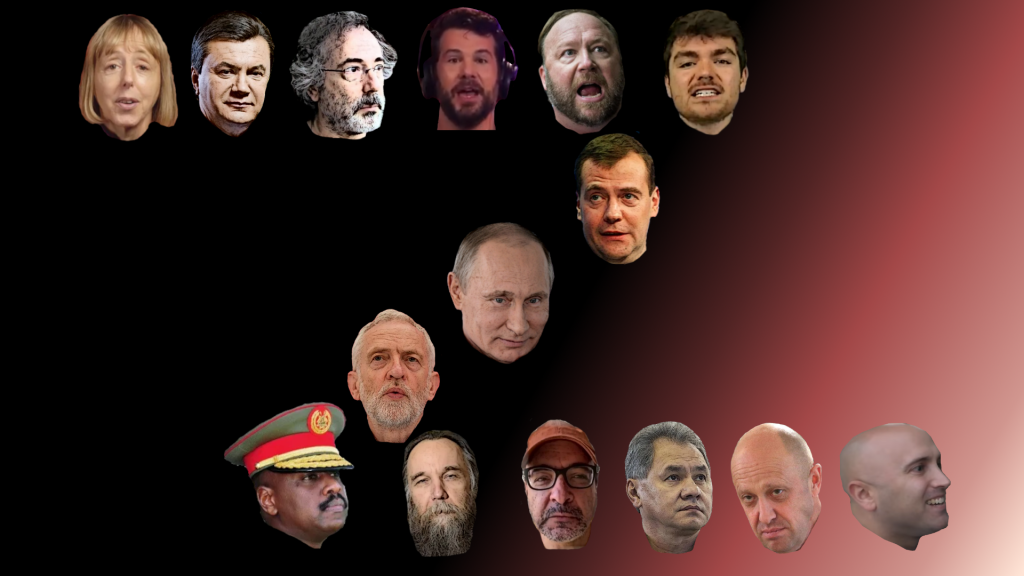
“Awaking from an involuntary fast food induced coma, Moscow’s only sober soldier is thrust back into the joyous meeting of the Kremlin’s top influencers. Questions await to be asked and answered.
Will Putin regret inviting America First? Can Patriarch Krill, who is definitely not a sock puppet, rally the influencers with his words of encouragement? What is the proper etiquette for replying when someone disrupts your stream? What does a transcendent author looks like, and why is his physiognomy clearly better than the leader of the Azov Battalion? What are the true horrors that American Cheese capable of? Will Vox finally teach the puppy a lesson? How should you deal with teenagers on voice chat as a 35 year old man? Is anti Tall White racism actually a good thing?
All this and Putin’s helpful suggestion on how to solve the logistical issue with Uganda’s aerial transport logistics await.
Send Everyone Who Is Relaxed To The Frontlines!”
A Note On The Series
With this marking the final episode of Mobiks, I’d like to offer a brief explanation about why I put together the series . Early in this blog’s history, I mentioned that I didn’t really want to do political topics, and that’s still my general mentality about such issues. Of course, my various examinations of the Russo-Ukrainian War are by necessity political. This isn’t the sort of issue that is conducive to fence-sitting, unlike perhaps other recent conflicts like the Ethiopian Civil War or the current Sudanese Civil War.
I’m not a very actively political person by nature, and a lot of that is because my current political leanings are towards a Synthesis project. That is to say that there are very deep issues with our current Conservative-Progressive paradigm in the West and overcoming this paradigm is the political issue of our age. Simply put, Progressivism is actually full of extremely stagnant and anti-futuristic ideas, resulting from a archaic mindset, and Conservatism embodies very few of the helpful teachings of the past, being mostly an odd chimera of social-moralism Christianity and modernism .
This general atmosphere in the West is currently a combination of outdated ideas, poor ideologies, outdated economics, and an outdated political system. So therein you have the current Western paradox of stable societies, but societies that don’t really understand their reason for being.
If the war has done anything for the West, it’s that it has highlighted these issues. The Western European countries are, bluntly, not prepared ideologically for any sort of conflict on this scale. It’s clear that Western Europe has gone so far down the post-modern/post-Christian rabbit hole (the state that Nietzsche called the death of God (while preserving the grammar of God)) that they don’t have a solid grasp on their reason for being. This ends up meaning that even a lot of the people who claim to oppose the adversaries of the West actually end up indirectly supporting them, simply by furthering the alienation and polarization of society. Meanwhile, the US is so ideologically polarized that ideologues are now imputing their “culture war” onto a country that has nothing to do with their specific issues. Eastern Europe has a much stronger sense of being and self, which is ultimately most embodied in Ukraine. The real triumph of Ukraine isn’t in some grand ideology, it’s simply in a statement of being, the most natural ideology. And for all the issues of that country, for all the parasitic corruption that has plagued it since its independence, it made that choice.
And this is the atmosphere into which we get the current deluge of contrarianism that outside forces seek to manipulate, expand, and control for their own ends. It’s basically the idea that: “I don’t like the West right now, ergo I’m going to go support Russia and China as my external saviors.” Meanwhile, the trends of decay in Russia and China are simply of a different character to Western issues, having just cloaked themselves in more primordial tribal forms of being, but a tribalism of nihilism rather than as a sense of continuity. This is rather comparable to a Roman looking at the decadence of late Roman society and concluding that the Goths and Huns, being more primordial and non-decadent societies, would be preferable to his own. Meanwhile, in his rush to nihilistically condemn his own society, which he justifies by pointing at its past heights, the Roman has simply chosen to condemn the parts of his society that continue to choose to be.
I’d like to close with two pieces, the second from the KGB Defector Yuri Bezmenov, and the first a quote from the Indian philosopher Sita Ram Goel about the situation in India after independence.
“I had a strong inclination to settle in favour of nationalism as a strong antidote to Communism. My country, right or wrong, that seemed to be emerging as my main motto. But my bubble was one day pricked by Ram Swarup to whom I listened as he talked to a friend of RSS-BJS persuasion. This friend was laying too much emphasis on eschewing everything that was foreign. Ram Swarup said: “But foreign should not be defined in geographical terms. Then it would have no meaning except territorial or tribal patriotism. To me that alone is foreign which is foreign to truth, foreign to Atman.” This touched some chord in my own heart. That was the end of my tether. I did not know which way to turn next.
Ram Swarup was now becoming more and more meditative and reflective in his comments on the current political scene. He often talked of a cultural vacuum which Communism was using to its own great advantage. Communism, he said, was deriving support from a deeper source, a new self alienation amongst our political and cultural elite, and advancing with the help of forces which on the surface seemed to be allied against Communism. It was not our democratic polity alone which was under attack from Communism. There were several other forces which had come together to suffocate and render sterile the deeper sources of India’s inherent strength.
Meanwhile, we became acutely aware of the progressive degeneration of politics in India. Our politics was no longer national politics. It was getting increasingly ridden with many fissiparous factors like caste, language and provincial parochialism. Nation building was no longer the aim of this politics. Winning elections and grabbing power and privilege, without a corresponding shouldering of responsibility or accountability to the people, was becoming an end in itself. A politics which was no longer informed by a larger and deeper culture was likely to become pretty poisonous.
A similar degeneration was taking place on the international plane as well. The United States was prepared for a hot war which may not take place. But it was not at all prepared for an ideological contest in which the issues may be decided in the long run. The Soviet Union was supplying a lot of ideas, ideology and categories of thought in a stream of books, pamphlets and periodicals. The only response which the United States could muster against this menace was economic aid. It was widely believed amongst U.S. thinkers and rulers that a man was likely to become better wedded to freedom and democracy if his standard of living was raised. Ram Swarup remarked one day: “The Soviet Union swears by Dialectical Materialism. But what it practices is Idealism. On the other hand, the United States swears by Idealism. But what it practices is Dialectical Materialism. There is a neat division of roles between the two powers. The Soviets take care of our heads. The United States takes care of our hearths and homes.”
How I Became a Hindu, Sita Ram Goel, Chapter 7
Future Ventures
I’m going to work on a combined Mobiks video that has all the parts in it. However, to make it different I’ll only put subtitles for the harder to understand accents (some of the jokes hit differently if you don’t know that they’re coming). The AI Russian accents (which are actually a combination of Russian and Turkish AI accents) are a bit too difficult to understand without subtitles. I’ll also probably put out a brief compilation of the theme songs I composed for the series.
In terms of future animations, I’ve got a number of ideas that I’m working on, specifically a series following a group of ghost hunters and a number of misc. one-off topics. Future installments will be in the 3-10 minute range, with the aim of keeping a fairly consistent release schedule (1-2 weeks). This series will likely be a while in planning since I always like to be a few episodes ahead.
I also have some plans for non-animation related content on the channel about mythological/folklore content of the blog. For that I’ll make sure to release a transcript on the blog with those episodes, for those who prefer to follow along that way.



 Kotharian Lightning