

Introduction
So I recently watched a documentary called The People vs. George Lucas from the early 2010’s. This was from the era before the Disney purchase, though fairly heavily into the era of monopolistic franchises and artistic decline in cinema. The documentary shares the feelings of Star Wars fans and artists that Star Wars influenced in the era after the release of the Prequel Trilogy. Most of the fans interviewed fall into the turbo-fan or fandom category, people who have gone beyond enjoying a cultural product and instead made it a major, sometimes even defining, part of their identity. It’s been an interesting watch, and has sparked my interest in talking about the origins of pop culture, the unique circumstances that led to its rise and (still in progress) fall. I’ll also talk about the purpose of media, fandoms, the concepts behind Art and Entertainment, and a bit of a critique of Star Wars and the various points where it went wrong at the end of the article.
Art and Entertainment
Art and entertainment aren’t separate. A movie/book like Jurassic Park is meant to be entertaining, but it also has artistic points to make, specifically about the futility of trying to control and manipulate complex systems. Art and entertainment exist on a spectrum. Basically on the X axis you can put Art and Entertainment as the far points, and on the Y axis you can plot High Concept at the top and whatever word you like for incoherence at the bottom (Pandemonium, gibberish, dribble, pointlessness, slop, etc.)
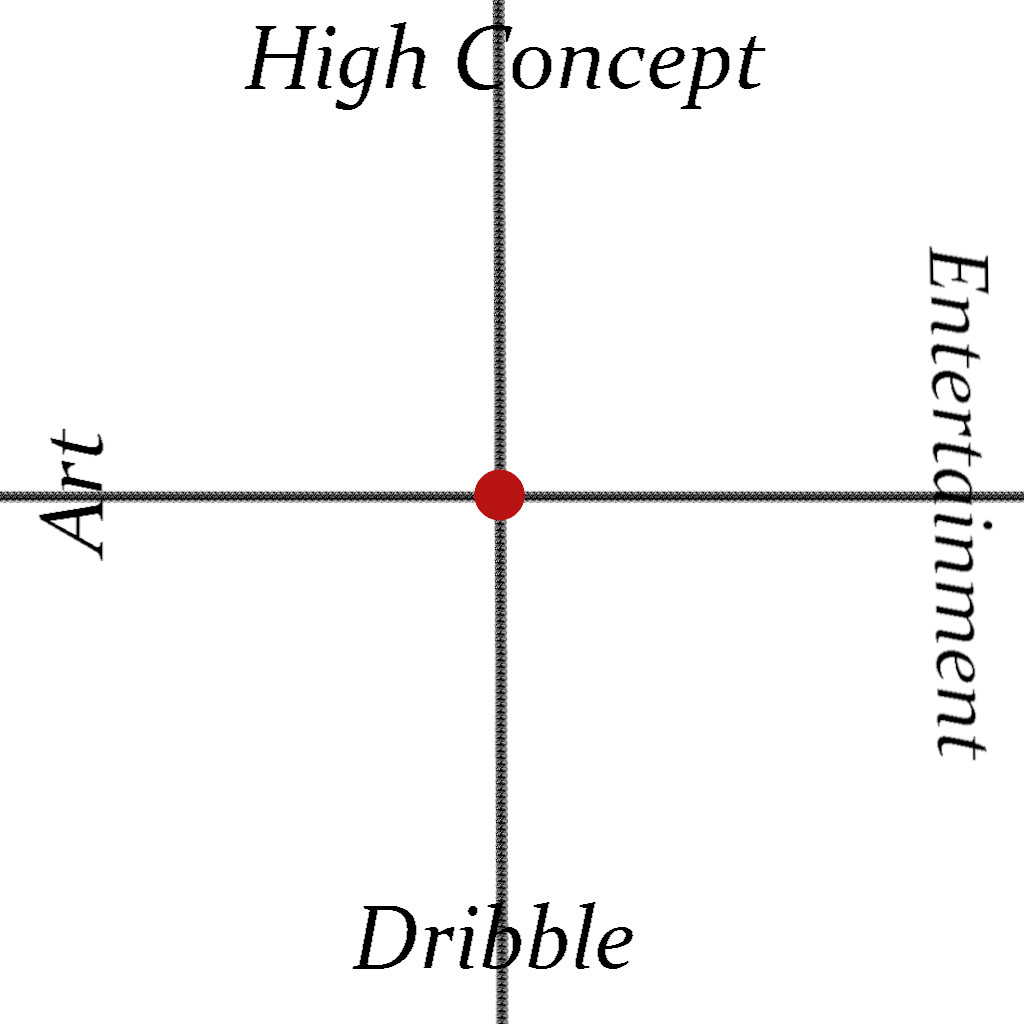
It’s actually possible to make incoherent or chaotic art as actual high concept art in the critical sense. The Dadaism movement, for example, created pieces of art that were intentionally terrible and pointless as a way to mock the pretentiousness of 20th century artists. But that involves the actual thought to engage in a deconstructive process, that thought itself becoming what makes something high concept art. And it should be mentioned that such critiques only work for a short time as high concepts. If someone were to engage in Dadaism nowadays, it would just be seen as pointless pretension, and rightly so.
By the same token it’s possible to make an artistic piece that is theoretically high concept, but becomes utter incoherent in practice. An example of this is Meredith Monk’s short film Turtle Dreams. So what is the high concept theory behind the film? Basically, in certain Amerindian cultures, particularly amongst the Algonquins, the land/world is said to rest upon the back of a giant turtle. Alternatively, the turtle is said to have been the one who brought the land up from the waters. The idea behind Turtle Dreams is to have this world turtle wander around the ruined landscape of an industrialized society, reflecting the interaction between a primordial reality and the ecological destruction of industrialization, all to a discordant chaotic soundtrack that emphasizes the break between the two, a nightmarish dream. So a fair enough interesting concept to explore. May or may not be your thing, but such is art. And the entire thing is ruined in the presentation which becomes takes on the tone of a surreal comedy, if anything, rather than a serious presentation. You can find that short film on Youtube and I think you’ll understand what I mean if you see it.
An entertainment high concept is also a possibility, but tends to function on another level than artistic high concepts. I’m not certain that a purely entertainment high concept exists, but I think the closest we can come is the idea of Metamodernism, in this case where fiction becomes self-referencing and intertwined. Like having the Star Trek cast show up in Family Guy or the Futurama Cast in the Simpsons, having the Simpsons do Death Note, etc. Or perhaps something like a well choreographed Sports halftime show could be considered high concept entertainment. Maybe sports itself could be an example of high concept entertainment with its various rules that have no deeper meanings or philosophical underpinings other than one tribe (i.e. team) working to achieve a goal against another. How humans interact with one another in the context of that setting can have more social and philosophical ramifications about teamwork, but the actual game itself doesn’t have a deeper meaning.
One of the long-standing effects of the Internet is that we’ve gradually moved away from mono-cultural forces and franchises. Back when TV and theatre movies were the determiners of mass culture, franchises reigned dominant. This is the era where you had Star Trek ascendant on TV, Star Wars in the movies, and Disney for children’s entertainment. Japan had animated series like Dragonball and Pokemon that became extremely popular on TV. Musically, the big studios were dominant and their acts were the ones that people heard on the radio and consequently knew about. Book stores carried books from the big publishing companies, consisting of their variety of classics or in current authors being pushed by the publishers. Comic books were dominated by DC and Marvel with only rare outsiders like Asterix and Tintin breaking into the public sphere. Anything outside of this model was considered hauteur and underground. For example, anime was not the cultural force it currently it. Apart from a few popular series that played on tv such as Dragonball, Digimon, One Piece, Sailor Moon, Pokemon, and Naruto, it was underground to the point that apart from a few specialty stores, most anime was distributed via bootleg tapes. You were lucky if they were subtitled. This world of mass culture, the world of centralized pop culture, existed precisely because it was at the nexus point where you had methods of mass cultural deployment (television, radio, movie theatres), but limited methods of mass cultural discussion. This meant that the culture you flowed in was a product of centralization with minimal input from the average person. The closest one typically got to cultural discussion was in fan magazines which, while popular, were also a lot more niche than the Internet.
It’s important to note that this power of pop culture only truly existed in the 20th century. Before that the most important cultural elements weren’t dictated by commercial publishers. You had books, but the most important books and stories were largely non-commercial in nature and definitely not franchise related. There were grand opera and orchestral productions, but the cultural songs most people were familiar with weren’t commercial. Point being, consumerist pop culture was a product of a very unique point in time, largely as a transitional force between technological eras.
The difference between the 20th century media and the 21st century media is that we now have methods of mass cultural discussion via social media. Unfortunately the forum, the best social media discussion platform, has become less common. But we still have all manner of discussion avenues. With this, there is a lot more opportunities to access niche media, and in some circles like music fans you’re likely hard pressed to find people who would recommend big label music over indie/small label music. This goes for all forms of digital media. There are simply a vast number of options out there for cultural products to interact with.
Media isn’t the last element to be effected by this change. Democracies will eventually have to acknowledge that the rationale for representative democracies, the limitation of having to have people vote in a singular place, no longer applies. You can effectively poll an entire constituency in minutes with the correct application. And instead of having someone vote in your place who you may or may not have voted for, you could vote on issues yourself. The concept of money grapples with questions of value in a digital era.
Mainstream media has therefore lost its singular power in most aspects of society. The last true cultural phenomenon to emerge was the Marvel Cinematic Universe and Fortnite. These dominated the movie and gaming landscape for years. However, Marvel’s last cultural phenomenon was the movie Endgame which brought its saga to a close. Everything after that, with the exception of the ever-popular Spiderman movies, has been niche and definitely not a cultural driver. Fortnite remains popular but is no longer the definitive force in gaming. In terms of music, Taylor Swift is the last turbo-popular artist. Bands are simply becoming more niche and spread out. There’s no definitive art movement and high art is largely the domain of only a few thousand very rich people with auction houses seeing a decline in their sales. I don’t think there’s a single living painter or sculptor who approaches being a household name. AAA games, with their massive production budgets, are currently losing ground to AA games with modest budgets, and many publishers are switching models to support smaller studios over their previous massive in-house studios. While popular series come out on streaming services, there simply aren’t any that transcend to long-standing household names. And, of course, television, movies, and games are competing as much with Youtube and Social Media as with rival products. The primary currency is attention and Youtube and Social Media simply require less attention than other forms of media.
Psychologically, there is an interesting element to mass availability of media which is that it becomes less individually cherished. One element of scarcity is that media standouts are highly valued, which is why you get the historic reputation of Star Wars and Star Trek, or even paintings like the Mona Lisa. But once that enters the mass production stage, where there aren’t a few properties than can draw your attention but thousands and millions, the individual becomes less important. So you can now search out extremely niche media that suits your personal tastes and your tastes can shift and change over time. And we’re living in a world that now has largely global communications. India and Africa are rapidly coming online with their combined populations in the billions. China is a holdout for the globe because of its media firewall, but should democratic forces arise that overthrow the present regime of censorship, you could add another billion. Point is, now you have the entire population of the planet that could potentially be interacting together and exchanging media. Which has the consequence that there’s a lot of oversaturation going on. A massive market, but also a market that’s difficult to get noticed in. Trust me, I’ve been trying to get eyes on my books for years and it’s hard, very hard. Being able to throw a lot of ad money around is still the biggest advantage of the big publishers, although I suspect online ads themselves aren’t as effective as we’re led to believe. Ironically enough, this connection actually makes dominant culture even less likely. It’s probably easier to make it as an artist with a very subtle niche like fantasy books in the Bulgarian language than a new author in English language (with theoretically 1000x the potential readers compared to Bulgarian).
Social factors have contributed to many of these changes. We’ll use cinema as an example. People sometimes cite the current lack of quality of many Hollywood movies as the reason for the decline of cinema. Some claim over politicization, others says the decline of franchises and creativity, others say the lack of studios wanting to take risks. That’s all partially true. But there are a bunch of external factors as well. A big one is that the primary market for movies and most media has historically been the 18-35 demographic. At this point we’re on the cusp of the last Millenials aging out of that with Zoomers becoming the majority of that demographic. Zoomers grew up in the climate of the internet without long term attachments to media. Not to say that some don’t have such attachments, but a lot of the phenomenon of modern franchises were driven by Millenials. Zoomers are also a substantially smaller demographic than Millenials due to lower birthrates amongst Gen X compared to Boomers. So while more Zoomers play video games than even Millenials, they’re also smaller than that demographic. At this point the older Millenials are rapidly aging out of rabidly caring about media, except for those most intertwined with the franchises. Theatre tickets have increased in price, meaning that while a single ticket or a pair of tickets can be afforded, it is now difficult to justify taking the family to a theatre. Compounding this, advancements in home entertainment mean that you easily get a better viewing experience in the home compared to the theatre, without the potential for disruptive elements and unsavoury people. And you get the comfort of your own choice of food and being able to pause as needed. Steaming has also rendered the theatre experience questionable as has social media.
Point being, even if Hollywood or whatever other media distributor were to consistently make good movies, they’d still not work in the theatre format. But the theatre and its tickets are what make AAA productions potentially profitable, meaning that you’re at a point where such extravagant productions are becoming unprofitable, save for the most popular of characters. To give an example, the recent Superman movie made 615 million dollars which may not have even made a profit given its production budget of 225 million (once you factor in the theatre take and advertising). As far as superhero movies go, the mainstay of the post 2010 box office, that means only Batman and Spiderman have made real money.
There’s another element to consider here which is the potential effect of AI media. AI isn’t at the stage where it’s going to be producing something complex like a movie, a TV show, a game, or a long form novel. But it is at the point where you can get custom images (GPT 4), voiced music (Suno is getting rather shockingly good), voiced elements (ElevenAI), short voiced videos, short stories/text blurbs, and 3D models. This is another potential disruption which removes at least some of the need for direct talent. In the hands of people who are skilled at directing, this can easily become a way of acquiring what would otherwise require a polymath level of artistic talent or a production staff. On the flipside, it also increases the amount of low effort trash out there.
Now let’s discuss Fandoms and the purpose of media.
On Fandoms and Media Purpose
Of course, the obsession of fandoms and fan culture has only gotten more pronounced over the years with the internet. Previously, to participate in a fandom you’d have to attend real world events like conventions, the best known type being the Trekkie (Star Trek) fan conventions. With the advent of the Internet, you could now actively participate in a fandom from your own home constantly. This vastly increased the number of fandoms and the number of people actively participating in them.
It is here that I’m going to separate the concept of a fandom from people who merely like or enjoy something. Fandom culture goes beyond just enjoyment of something to an obsession with a fictional setting, making it a part of one’s identity. In the documentary, there is a particularly well known line that says “George Lucas raped my childhood.” So for this fan, he combined disappointment in the prequel trilogy with an attachment to Star Wars that goes far beyond just mere enjoyment. It was his childhood, perhaps the most important part of his childhood.
We could get psychological at this point and discuss how certain personalities have difficulty separating fiction from reality. Sometimes it gets categorized as an autistic tendency, but autism is a term which has been far too broadly applied to too many personalty types. This is common in autism, by the way, but is of a different type than fandom. For example, an autistic person who likes Star Wars would claim to literally be a Jedi or the kid of Luke Skywalker or something to that effect. The typical Fandom personality disorder doesn’t go that far, but makes fiction a core component of their personality.
If you want to understand the usefulness of media and art to someone, it’s that it is helpful to think through scenarios without having some of the baggage/constraints of the real world and historical events. The problem with focusing only on fiction is that the extent to which such a thought experiment corresponds to reality varies. In fiction you can write anything that can be conceived of by the mind and even hint at abstracts that are impossible to fully grasp. Much like how in math you can write infinity infinities with two symbols ∞∞, an impossibility that shows the limitations of applying abstracts to reality.
One of the best thought experiments in literature comes from a Hindu text that is the source of the multiverse idea. In it, the God of the Universe, Brahman, comes to the place where the deity Krishna dwells. He announces that he is Brahman, to which the messenger from Krishna asks him “which Brahman.” Perplexed, as he thinks himself the only Brahman, he enters and talks with Krishna. And when he asks about this, Krishna shows him visions of a myriad of Brahmans and other deities from greater universes whose forms are near incomprehensible. Brahman has four heads, symbolizing the four directions, but other Brahmans have hundreds, thousands, millions of heads. There are deities who have millions of hands and arms. The conclusion has Brahman imagining other forms of himself that are greater and capable of much more, the idea being to imagine transcending limitations and not imagine oneself as the peak of existence, only a starting place. Humbling and inspiring at the same time. And in this case, Krishna is the height of existence who can imagine and see everything at the same time.
It’s obvious that a lot of modern entertainment is ephemeral. People spend so much time on social media with little text blurbs, images, and shortform videos that will be thrown down the memory hole in no time at all. A lot of longer form media tries to grab at political points and social movements, only to discover that it’s all outdated within months. You can call that Futurama syndrome where the supposed vision of the future was outdated within a decade of the show airing. And modern political media is lucky to remain relevant for a year. All of this means that it’s hard for media to mean anything lasting because it is designed to just be temporary attention grabbers. “Content” is the relevant word here. And the reality is that new media is even more “Content” heavy than pop culture media.
That’s where the need for a new thoughtful media emerges. Not one that seeks to dominate every waking moment of fans, which is an issue with a lot of multi-media and extensive media projects (just think of all the games that have daily logins and daily challenges to keep you constantly playing for hours each day). Rather, what is needed is a sort of media that advances ideas that last and make a point. Political and ideological points fade with time. What lasts are things which are true to the human experience now, in the past, and in the future.
Polarization and Media Alternatives
The introduction of mass social media, together with the increasingly gaunt states of Liberalism and Christianity, have led to mass social polarization in the Western world and even much of the second world, largely based around ideas of what will succeed the end of these ideologies and systems. In an era of polarization there are two mainstream choices that you can make with an artistic piece and one renegade choice that you can make.
The first choice is that you can pick a mainstream side and stick with their doctrines. This usually involves heavy artistic compromises in conforming, but at least you get to say something that you consider meaningful. However, in intertwining with the doctrines of an ideology, your artistic senses become vapid even as you proclaim what might be a philosophical doctrine. Up to the 2000’s era, this sort of vapidity was largely and rightfully associated with the films coming out of Christian media or Communist media. Nowadays, they’re most closely associated with Neo-Progressive media.
The second choice is that you can choose to make a vapid entertainment film that doesn’t say anything. The thriller, horror, animation, comedy, and Streaming Service movies are full of this type of film. A lot of people on the Internet like to throw around the term slop nowadays, and that’s basically what these movies are. You’ll watch them and forget about them in days. I don’t want to say that everything has to be super thoughtful. A lot of people just want some media to unwind to after their work days, whether that media is a simple comedy movie or a sports game or a basic video game. I am saying that making your highest budgeted films, to the tune of hundreds of millions of dollars, this sort of entertainment media really runs into issues.
The third choice, the renegade choice, is that your media can make a point and be critical of the ideas in a society. And not in the vapid sort of propaganda social criticism pieces that you see, which are just meant to channel you into this or that political ideology. This sort of media has to be actual criticism pieces that bolster your ability to think. A lot of artists nowadays fancy themselves as renegades, but are actually . It’s like Nietzsche’s story of the death of god, where someone agrees that god is dead only to ask you to attend church with them.
On that note, here’s my take on Star Wars.
Everything about Star Wars in a little under 3,000 words
If you want to understand George Lucas (for his good sides and bad sides), it’s important to understand that his interest in films is largely about special effects rather than story. Industrial Light & Magic, the digital FX studio associated with Lucasfilms, has always been his favorite part of the business. The original trilogy pioneered many types of practical effects shots that were revolutionary for the time. What made this truly iconic was the pairing of those techniques with Ralph McQuarrie’s striking designs and John William’s epic music scores. The prequels were largely testing grounds for Lucas’s forays into CGI, once again pioneering a number of techniques. In the time after the prequels, he was largely interested with a high budget CGI TV (the Clone Wars) which was differentiated from most children’s TV at the time because of its techniques. His interest in video games centered around the Force Unleashed Games, which had integrations with motion controls on systems like the Nintendo Wi. His final big interest, before the Disney sale, was making the game Underworld which was pioneering certain techniques in video game storytelling. It’s significant that the only post-Disney project he’s been interested in is the Mandalorian which has been testing new screen tech which they claim can reduce the budget of a high quality scene by 50-60%. So you can make a CGI integrated series for 20 million dollars an episode vs. the fifty million it would have cost without the screen. I would say that in terms of currently active film makers of the same mindset, James Cameron is probably the most likeminded to Lucas.
Now for the bad part. Setting aside whether you like the prequels or not, Star Wars wasn’t in good shape at a management level before the Disney purchase. Its last big foray into film with Indiana Jones in 2008 had not been received well, despite both Lucas and Spielberg being involved. The Micheline Chau era of Lucasfilm (where Lucas stepped away to focus on his film museum and had an appointed successor basically run operations, and the era this documentary was made) had a lot of issues at the leadership and management level and that’s reflected in the lack of large-scale products and confusion in the smaller products. Underworld, which was the big Star Wars project at the time, got derailed by Lucas deciding to step in and change its main character from an original character to Boba Fett most of the way through the production. That basically put the project in development turmoil which it never got out of. The Expanded Universe had written itself into a number of issues (Lucas never cared that much for it and probably would have rewritten it if he ever made the sequels, but it was the primary thing keeping the story going). Of course, the reality is that the younger generations had largely moved on to Marvel as a cultural phenomenon rather than Star Wars at this point. It was still possible for the sequel trilogy to succeed in this environment, but ultimately the produced trilogy divided fans and lacked the charm to become a cultural touchstone. And I think at this point we’re largely past the ability to have cultural phenomenon like Star Wars was. Someone could make a good Star Wars movie next year and it would do well, might even make a billion dollars, but it wouldn’t even reach the cultural effects of the prequel trilogy. That’s just the reality of it.
The Original Movies
The original two movies are great, especially in their original context. They’re nothing innovative from a story or character perspective, but are carried with their design and supporting elements. They’re basically good stories and average acted characters (with the exception of Han Solo’s standout performance) that are elevated by excellent character and world design and musical scores. I’d easily put both of them on my top film list (not at the top, mind you, but in the top 25). The problems start in the Return of the Jedi.
Problems with Return of the Jedi
– The recycled use of the Death Star as a threat.
- The resolution of the love triangle with the revelation that two of its participants (who have shared two romantic kisses) are brother and sister. Which is the fourth worst way of resolving a love triangle, by the way. This is entirely unnecessary and is done to offer a rather cheap extra stake when the friendship/comradery between Luke and Hand/Leia is more than enough already.
- The resolution of the Anakin as Darth Vader reveal by having Yoda and Obi Wan know that he survived and became Darth Vader, with the conclusion that they lied to Luke.
- The lack of any coherent setup for the Darth Vader heel turn. Vader has never shown any remorse or anything. So his turn comes across as a spur of the moment when there’s a lot more needed for such a turn. There’s just Luke insisting that Vader can still turn good, even when there’s never been a hint of that.
- The ground battle is entirely unbelievable. Arrows and strikes that medieval quality armor (even bronze age armor) could nullify manage to defeat space armor (that is made of metal). A battle that any modern day army would win. And it’s all versus the supposed best battalions of the Imperial Army. Which will cheapen the perception of the army in the future to the point that they become jokes. And while that might have seemed funny, making your enemy just incompetent actively diminishes the heroism of your characters.
- The insinuation that Luke destroying the Emperor is somehow an evil action, despite the Emperor having been guilty and complicit in every war crime committed by his forces.
- The start of the odd kiddie pandering elements in Star Wars with the Ewoks. And that’s how you’ll eventually get funny voice battle droids and fart jokes in the Prequels, alongside people being decapitated, cut in half, and burned to the fourth degree.
- And, bluntly, Carrie should have been in rehab rather than filming. Once you know that, her acting in a number of scenes becomes obviously drug-fueled incongruity. Harrison also isn’t interested in being there. Fortunately for the movie, it’s Mark Hamill’s standout performance in the series, which helps.
The franchise was not dealt a lethal blow in the Return of the Jedi, but its fundamental seriousness was dealt a lethal blow. Going forwards, Star Wars would never shake the baggage it picked up in Return of the Jedi. Is Return of the Jedi a bad movie? No, but it is an utterly mediocre end to what could have been an epic trilogy. It’s the end result of prioritizing visual effects over storytelling.
As far as the special editions go, yeah they definitely are adding in a lot of the silly and pointless elements. Some of the world building elements work, but overall a waste of time.
The Prequels end up having Return of the Jedi problems on steroids while also trying to tell an epic story that Lucas simply isn’t capable of pulling off as a writer and director.
Problems with the Prequels
- The Clone Wars off comment in the original trilogy clearly didn’t picture the Republic being the ones aligned with the clones. Because you can’t exactly mount an idealistic crusade when your primary fighting force is a bunch of brainwashed genetically tampered artificially docile slave soldiers.
- Speaking of which, the people using droids pretty clearly have the moral edge in this conflict by virtue of their chosen weapons alone.
- Anakin’s family, outside of his mother, have fond memories of him in the Original Trilogy. As if they knew him for a long time before he left with Obi Wan. In the Prequels they only knew him briefly and he was an angsty emo for the entire time and was mourning for his mother.
- Obi Wan also said he recruited Anakin for his idealistic crusade during the clone wars. In the Prequels it was a decade before.
- Leia remembers the face of her mother as an infant and said she died when she was very young.
- The memories of Anakin expressed by his family in the OT do not correspond to the time he spent with them.
- Slaves would be ridiculously expensive compared to simply having robots for the same purpose. I could see some forms of slavery like prostitution and control obsessives being present in a sci-fi timeline and likely debt slavery/indentured servitude as well, but not forced slavery for the sole purpose of labour.
- The scale of the Prequel War is all off. Coruscant is a planet that is formed of a single massive city with hundreds of levels, its population alone being in the trillions. That’s without factoring in the hundreds-thousands of other planets that form the Republic. And depending on who you ask, that’s underselling the whole thing. The logistics to supply such a city with raw materials, food, and water would result in millions of cargo starships coming to the planet every day. To give a comparison, New York City sees over 125,000 cargo trucks transport goods to and from the city every day in a city with a population of 20 million in its urban area. You can imagine the cost and logistical network that a single planet like Coruscant would require, how much wealth and power would be required to keep it going. And it would have to possess a massive protections and custom enforcement wing with a strong security and police force just for smugglers and pirates alone. The police force in standard modern countries is typically between 0.2-0.5%, bolstered even farther if you include the military. Which would be in the hundreds of millions or even billions for this single planet. And the scale of the Clone Army is apparently 6 million soldiers. WW2 Germany, by comparison, had 13.6 million and the Soviets had over 30 million on populations of 100 million and 300 million respectively. At the population size of Coruscant and the industrial potential of that planet alone, billions of soldiers could be equipped in a very short period of time. Now, just looking at the original trilogy, the Empire seems a lot smaller than that. They have about 30 ships (equivalent of an aircraft carrier/battleship in our modern times) and the Death Star in their last battle. You might say this doesn’t effect the entertainment you get from the films, and that’s largely correct. However, it does effect the coherence of the setting. Honestly, in a film that was more interested in exploring the actual reasons for rebellion, a bunch of outer systems having to supply an extremely decadent planet city like Coruscant with an out of touch government with insane amounts of natural resources could easily make for an intriguing story. But you don’t get any of that, just goodies and badies fighting with the twist that the goodies were manipulated all along. The same issue goes for the empire in the OT btw. They come across as evil guys who just want to do evil because they’re bullies. Nothing about the concept of order or social glory that the fascists they’re based on went on about. That’s at least attempted in the Prequels, not very well, but the concept is there.
There are some good ideas in the Prequel films. In the final battle between Obi-Wan and Anakin, there’s a statement made:
Obi Wan “My allegiance is to the republic, to democracy”
Anakin “If you’re not with me, then you’re my enemy.”
Obi Wan “Only a sith deals in absolutes. I will do what I must.”
That’s actually a really good critique of the ideas behind supremacism. In particular, supremacism operates on the idea that everything is based on a friend-enemy distinction. If you’re not an ally, you’re an enemy. Some people joke about the lines (typical delivery issues and all), but that’s ultimately the idea behind it contrasting democracy, numerous ideas in a society, with supremacism, the rule of the singular absolute.
Anyways, here’s a take. I think that the first two-thirds of the movie The Lost Boys does a vastly better job of communicating the temptations for desiring the sort of anarchic power that defines the Sith (anarchic here referring to not binding the self to any laws, something that ironically enough usually corresponds to tyrannical laws imposed by the self on others. You can also call it authoritarian libertinism). The Lost Boys is a movie about the interacts of a young man, Michael, with a group of anarchic young men who turn out to be vampires. They live apart from society and do whatever they want, each of them having the powers to exercise that anarchy. In order to gain and maintain those powers, they of course have to hurt others. The primary theme song of the movie, Cry Little Sister, has the argument for retaining humanity expressed by children singing elements of the chorus that are framed as how you love humanity (Thou shalt not fall, Thou shalt not die, Thou shalt not fear, Thou shalt not kill).
(Granted, there is a tonal whiplash in The Lost Boys between the first 2/3 and the last 1/3 where it ends as a sort of black comedy with a lot of goofy elements. That unfortunately has the effect of undermining a lot of the art of the project for a few laughs. But the first 2/3 is really good.)
The Post-Prequel Era
The sequels have already been critiqued so much in the years since they’ve been released. I can’t think of anything valuable that they added to the universe or any real points that they made. The Abrams films only add in the single complexity of more humanized imperials, which is good but not really enough to justify their existence. Johnson’s movie aims for more complexity but doesn’t actually achieve it. Fairly cynical overall, although I personally found the force sensitive stable boy at the end a nice touch, probably the best small moment in the sequel trilogy. As many have noted, to actually see if either film type worked you would have had to let Abram or Johnson have all three movies. As it is, you just have a discordant chaos, an attempted deconstructionist art film without the proper setup and the entertainment films that have their elements deconstructed at the mid-way point, leaving the payoff hollow. And Rogue One/Solo are just entertainment flicks that don’t try to add anything to the setting. Although, as a sidenote, Solo was left with the plot hole of trying to solve Han Solo’s boast in a New Hope about making the Kessel Run in a number of Parsecs, which are not a unit of speed as the writers believed in that movie but a measure of distance. Which makes Luke calling out his BS in the original movie all the more believable. In terms of believability, we’re also up to the point where they’ve made things like inaccurate stormtroopers canon (contradicting the first movie and basically ruining the coolness behind Ralph McQuarrie’s design).
Oh, and the primary extra source of media, the EA Battlefront Games, managed to be lame in the first instalment and a greed-fest in the second instalment. So even that part, which may have weathered the storm, failed.
The Post Sequel Era
There doesn’t seem to be anywhere left to go. People have largely given up on the associated media like books. The Star wars Jedi Survivor game was popular, but not a mega hit. The most recent big budget game, Star Wars Outlaw, flopped. Toy sales and merchandise sales are majorly down. A lot of streaming shows have been released, but only the Mandalorian was successful and it has been declining in popularity since the novelty of a Star Wars TV show has worn off. It’s a lot of going through the motions with products that range from okay to bad, settling in at mediocre. And that probably describes a lot of Star Wars now, mediocre. Every film since the original two has been mediocre or bad as an artistic project and only average as entertainment projects.
From Here
As fun as long critiques of the films can be, more than this doesn’t really need to be said. Star Wars is a franchise which is in many ways emblematic of the issues with pop culture. The good ideas get shallow with time, turn into hollow self-referential shells, and the thing is kept going long beyond its appropriate expiry date for the sole reason of printing money.
If you’ve ever seen Red Letter Media’s Nerd Crew specials, you’ve seen the absurdity of the commercialism of the franchise. The best example, in my opinion, was a licensed pop corn maker in the shape of the Death Star. Yes, a weapon that exists for the sole purpose of planetary genocide in support of an evil empire has become so vapid that it’s a joke popcorn maker. It’s stripped of any artistic weight that it had, becoming just a design that is cast away from its original purpose. They’ve had Darth Vader cereals. Why not have Hitler Honeycomb at that point? It’s the exact same thing artistically speaking. And remember, this is stuff that was put in place before the Disney buyout.
Conclusion
I suspect Star Wars shows the fate of most of these major media franchises. The artistic, the meaningful, will ultimately be sacrificed for the sake of maximized profits. It’s also why I would strongly urge you not to get invested in franchises. They will eventually go that way, they always do. If you want to get some entertainment out of them, go ahead that’s your choice. Just keep it at entertainment. Don’t become a fan who makes them such a part of your identity that you crumble when the inevitable happens.
That’s all for now. Thanks for reading.


 Kotharian Lightning